401(k) calculator: project your retirement balance with employer match. Enter salary, contribution percent, match, and return to forecast long-term growth.
Results are estimates for planning purposes and are not financial, medical, or professional advice.
How to Use the 401(k) Calculator
A 401(k) is an employer-sponsored retirement plan, often with free money in the form of an employer match. This calculator projects your balance from your current savings, yearly contributions, the employer match, and compound growth.
- Enter your current 401(k) balance, or zero if you are just starting.
- Enter your salary, your contribution percent, and your employer match percent.
- Enter the expected annual return and the years until retirement.
- Review your projected balance, your annual contribution, the employer match, and your combined yearly savings.
401(k) Projection Formula
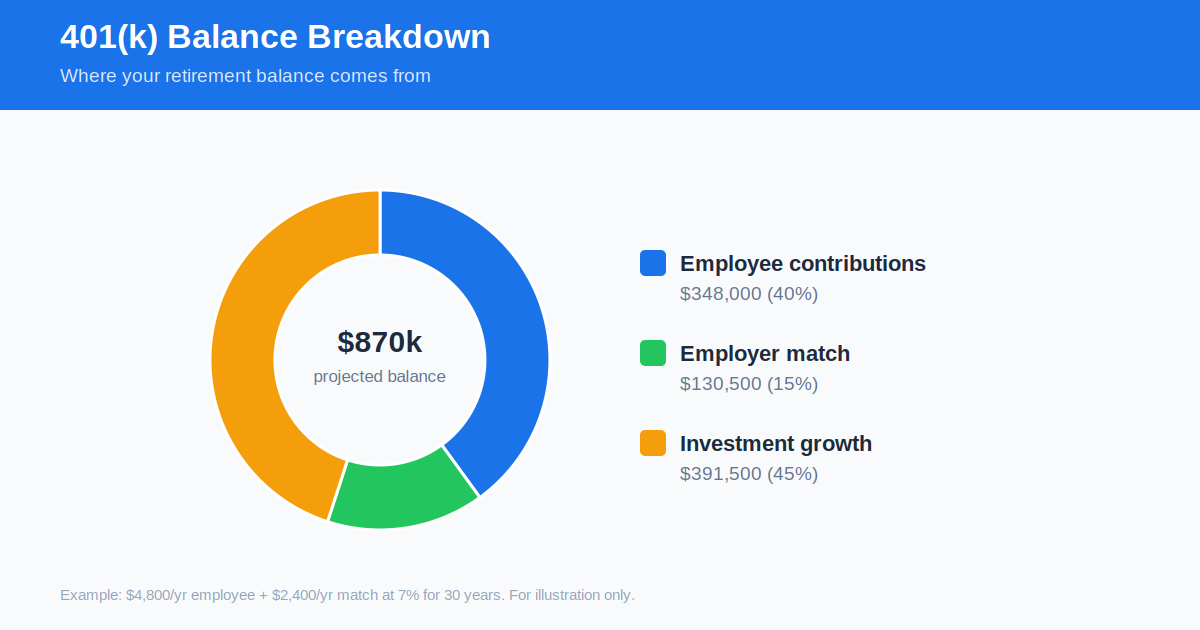
The projection has two parts. Your existing balance grows untouched: Balance x (1 + r)^n. Your yearly contributions, which are your contribution plus the employer match, grow as an annuity: Annual x (((1 + r)^n – 1) / r). For example, with 25,000 dollars saved, an 80,000 dollar salary, 6 percent employee and 3 percent employer contributions, and 7 percent returns over 30 years, the existing balance grows to about 190,306 dollars while yearly contributions of 7,200 dollars grow to about 680,118 dollars, for a total near 870,424 dollars.
Example
James earns 80,000 dollars, contributes 6 percent (4,800 dollars per year), and gets a 3 percent employer match (2,400 dollars per year). Starting from 25,000 dollars with 30 years at 7 percent, his balance reaches about 870,424 dollars. Without the match the same plan ends near 643,718 dollars — the match and its growth are worth roughly 226,706 dollars.
How the Employer Match Is Calculated
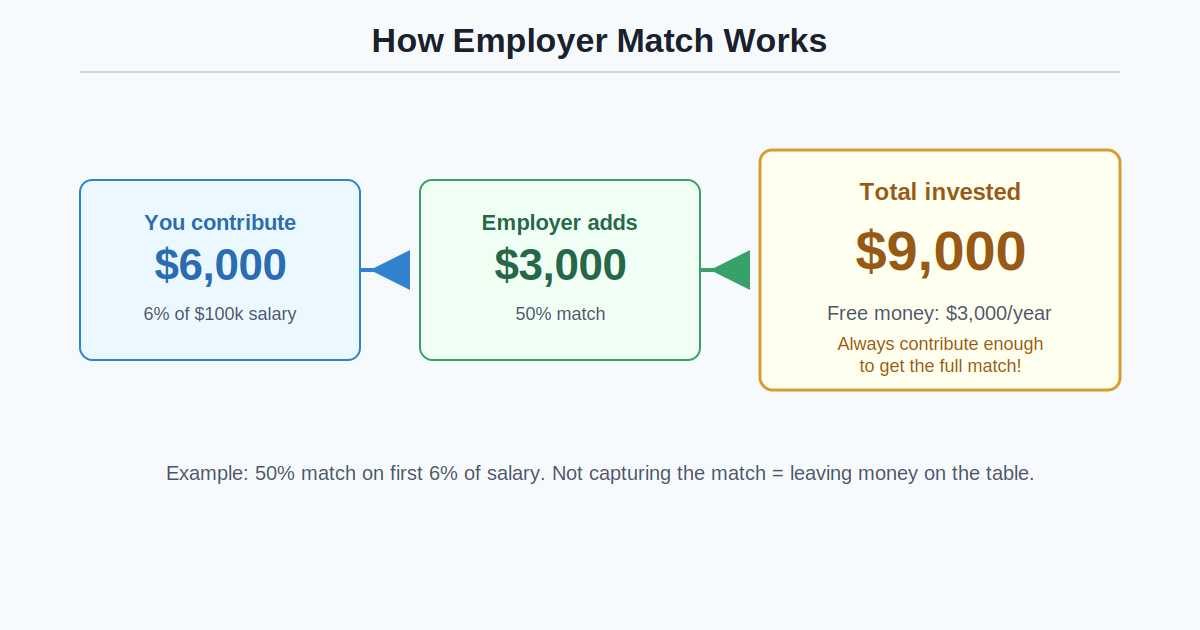
Most plans match a percentage of what you contribute, but only on the first slice of your salary. “50 percent up to 6 percent” adds 50 cents per dollar on the first 6 percent of pay — an effective match of 3 percent of salary, the figure to enter above. Contribute only 3 percent and the match halves; the rest is lost. Two-tier formulas (100 percent on the first 3 percent, 50 percent on the next 2 percent) pay in full once you contribute 5 percent.
Traditional vs Roth 401(k)
Many plans offer both. Traditional contributions leave your paycheck before tax and withdrawals are taxed in retirement. Roth 401(k) contributions are taxed now, but qualified withdrawals, including all growth, are tax-free. Expect a lower tax rate in retirement and traditional usually wins; expect the same or higher and Roth usually wins.
Frequently Asked Questions
How much of the employer match do I get?
This calculator assumes you earn the full stated match percent of your salary. Many plans match 50 cents per dollar up to 6 percent of pay, so enter your plan’s effective percent.
What is a good 401(k) contribution percent?
At minimum, capture the full employer match. Many advisors suggest 15 percent of income including the match for a comfortable retirement.
Does this include fees and taxes?
No. The projection is before investment fees and before taxes on traditional 401(k) withdrawals. Fees of even 1 percent a year can meaningfully reduce the final balance.
What return should I expect?
Long-run stock market returns average near 7 percent after inflation. Use 5 to 6 percent for a conservative mix with more bonds, or up to 8 percent for an aggressive all-stock allocation.
Can I contribute too much?
The IRS elective deferral limit is 24,500 dollars for 2026 if you are under 50. From age 50 add an 8,000 dollar catch-up, and at ages 60 to 63 the catch-up is 11,250 dollars. If your salary times your percent exceeds the limit, the real world caps you.
Does the employer match count toward my contribution limit?
No. The 24,500 dollar limit covers only your contributions. Employer money counts toward a separate combined limit of 72,000 dollars for 2026, with catch-ups on top.
Related Calculators
Model after-tax saving with the Roth IRA Calculator, see what a raise does to your pay with the Pay Raise Calculator, and explore compounding with the Compound Interest Calculator.