Free polynomial derivative calculator: enter the coefficients of ax^3+bx^2+cx+d plus a point x to get the derivative function and its exact value instantly.
Results are estimates for planning purposes and are not financial, medical, or professional advice.
How to Use the Derivative Calculator
This calculator differentiates cubic and lower-degree polynomials and evaluates the derivative at any point you choose.
- Enter the coefficients a, b, c, d for the polynomial ax cubed plus bx squared plus cx plus d.
- Enter the x value where you want the derivative evaluated.
- Press calculate to see the derivative function.
- Read off the slope value at your chosen point.
Derivative Formula
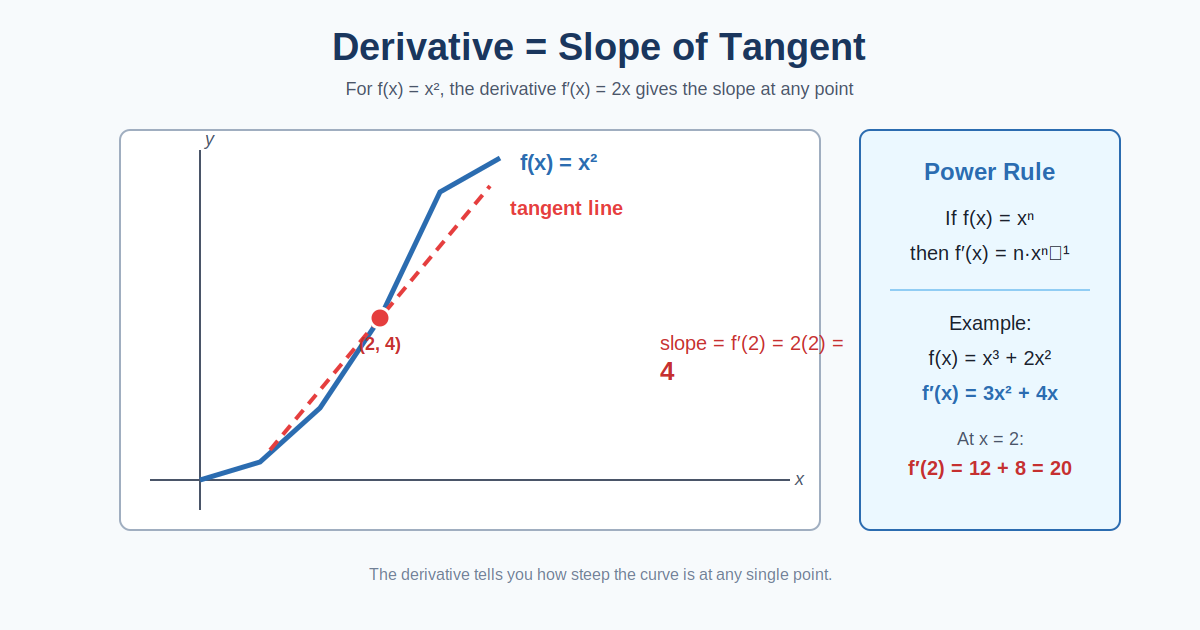
The power rule says the derivative of x to the n is n times x to the n minus 1. Applying it term by term, the derivative of ax cubed plus bx squared plus cx plus d is 3a x squared plus 2b x plus c. The constant d disappears because the derivative of a constant is zero. The value at a point gives the slope of the tangent line there.
Example
For f of x equals x cubed plus 2x squared plus 3x plus 4, the derivative is 3x squared plus 4x plus 3. At x equals 2, that is 3 times 4 plus 4 times 2 plus 3, which equals 12 plus 8 plus 3, or 23. So the curve rises with slope 23 at x equals 2.
One more example shows how a zero coefficient and a negative term behave. For f of x equals 2x squared minus 4x plus 1, think of it as a cubic with a equal to 0: the derivative is 4x minus 4. At x equals 3, that is 4 times 3 minus 4, or 8, so the curve climbs with slope 8 there.
Real World Applications
Derivatives appear everywhere rates of change matter. Physicists derive velocity from position and acceleration from velocity. Economists use marginal cost, the derivative of total cost, to decide production levels. Machine learning trains neural networks with gradient descent, which follows derivatives downhill to minimize error. Biologists model population growth rates, and engineers optimize designs by finding where derivatives equal zero, the peaks and valleys of a function.

Common Mistakes to Avoid
Three errors show up again and again. First, forgetting to multiply the coefficient by the exponent: the derivative of 2x squared is 4x, not 2x. Second, sign slips on negative terms: minus 4x differentiates to minus 4, and a missed minus sign flips the slope direction. Third, degree limits: this tool handles cubics and below, so x to the fourth power cannot be entered. Leaving out the x to the fourth power term of a degree 4 polynomial silently changes the function, so a result computed without it answers a different question.
Frequently Asked Questions
What does a derivative tell me?
It gives the instantaneous rate of change, which is the slope of the tangent line at each point. A positive derivative means the function is rising there, a negative one means it is falling, and zero marks a flat spot that may be a peak, valley, or inflection point.
Why does the constant term vanish?
A constant never changes, so its rate of change is zero by definition.
Can this handle sin or e^x?
No. This tool covers polynomials only. Transcendental functions need their own differentiation rules.
What is a second derivative?
Differentiate the result again. It measures concavity, or how the slope itself is changing.
How is this used in real life?
Derivatives model velocity from position, marginal cost in economics, and optimization in engineering.
Can this calculator handle x to the power 4 or higher?
No. The inputs cover a, b, c, and d for ax cubed plus bx squared plus cx plus d, which is a cubic at most. A term like x to the fourth power has no input box, so this tool cannot differentiate it.
What does it mean if the derivative at my point is zero?
Zero slope means the curve is flat at that point: it could be a peak, a valley, or an inflection point where the slope pauses before continuing. Check points just before and after to see which one you have.
Related Calculators
Try our Scientific Calculator and Slope Calculator for more math tools.