Calculate reading time for any text: paste content or enter a word count and pick your reading speed. Get the time in minutes or hours instantly. Free tool.
Results are estimates for planning purposes and are not financial, medical, or professional advice.
How to Use the Reading Time Calculator
Bloggers show “5 min read” on articles, students plan study sessions, presenters check handout length, and teachers estimate how long a read-aloud will take. This calculator tells you how long any text takes to read. Paste the text directly for an automatic word count, or just enter a word count, then pick a reading speed that matches the material.
- Paste your text into the box, or enter the word count in the field below if you already know it.
- Choose a reading speed: Slow (150 wpm) for careful or technical reading, Average (200 wpm) for everyday content, Fast (300 wpm) for skimming familiar material.
- Read the result: total words and the estimated reading time in minutes, or hours and minutes for long texts.
- Use it to label blog posts, plan presentations, or schedule study and audiobook time.
Reading Speeds at a Glance
Reading speed is not one fixed number. It changes with the difficulty of the text, the reader, and the goal. The three settings in this calculator cover the realistic range for silent reading with normal comprehension:
| Setting | Words per minute | Best for | 1,000 words takes |
|---|---|---|---|
| Slow | 150 wpm | Technical, academic, or unfamiliar material; studying; non-native readers | 6.7 minutes |
| Average | 200 wpm | Blog posts, news, emails, general non-fiction | 5.0 minutes |
| Fast | 300 wpm | Skimming familiar topics, light fiction, quick reviews | 3.3 minutes |
Reading research often quotes an average silent reading rate of roughly 200 to 250 words per minute for adults reading English, which is why the 200 wpm setting is the default here. Dedicated speed readers claim 400 wpm and above, but comprehension drops sharply at those rates, so they are rarely honest planning numbers. When a deadline actually matters, stay at or below 200 wpm in your plan and let any extra speed be a bonus.
Reading Time Formula
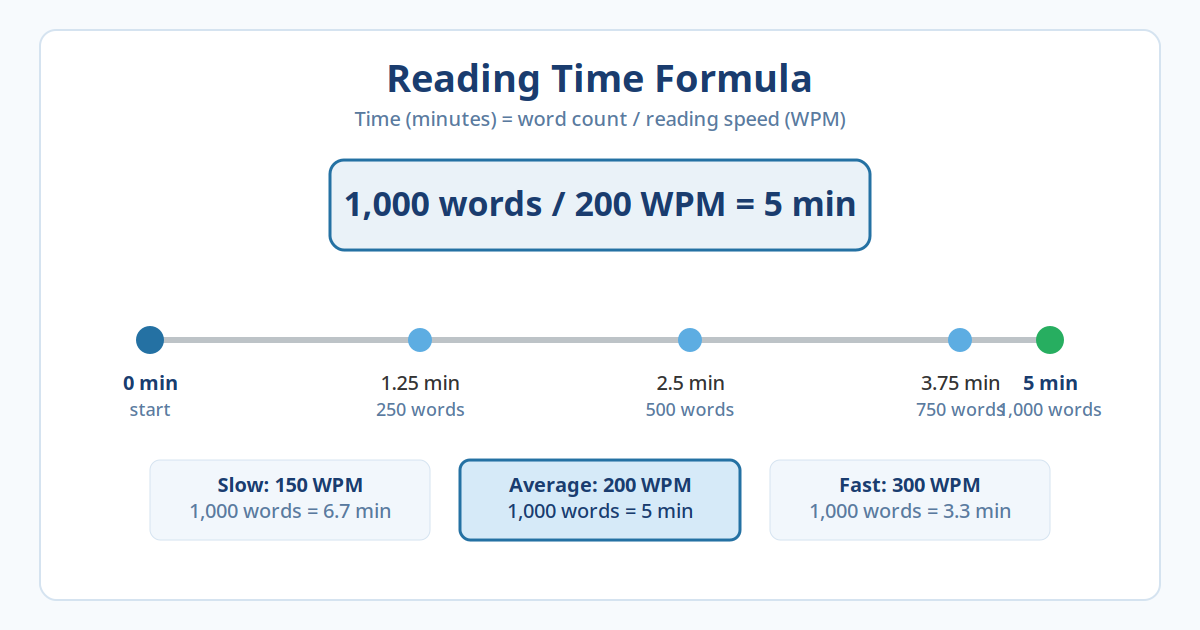
The formula is as simple as it gets: reading time equals the word count divided by reading speed in words per minute.
Reading time (minutes) = Words ÷ WPM
Results under 60 minutes are shown as plain minutes. Results of 60 minutes or more are shown as hours and minutes, so a 400-minute novel reads as “6 hr 40 min”. When you paste text, the calculator counts words by splitting on whitespace — the same method most word processors use — so hyphenated words and numbers each count as one word.
Example Calculation
A 1,000-word article at the average speed of 200 words per minute takes 1,000 divided by 200, which is 5.00 minutes to read. A 12,000-word thesis chapter at a careful 150 words per minute takes 80 minutes, displayed as 1 hr 20 min. A typical 300-page novel holds around 75,000 to 90,000 words: at 80,000 words and average speed, that is 400 minutes, or 6 hr 40 min of actual reading time.
Common lengths at a glance, all at the average 200 wpm setting:
| Content | Typical words | Reading time |
|---|---|---|
| Email or memo | 300 | 1.5 min |
| Blog post | 1,200 | 6 min |
| Feature article | 2,500 | 12.5 min |
| Short story | 7,500 | 37.5 min |
| Novella | 30,000 | 2 hr 30 min |
| Novel | 80,000 | 6 hr 40 min |

Reading Time vs Speaking Time
Reading time and speaking time are not the same thing. Speaking aloud — a presentation, a video script, a podcast, or a speech — runs much slower than silent reading, at roughly 130 to 150 words per minute, because the speaker breathes, pauses, and emphasizes. Presenters also lose time switching slides, waiting for reactions, and answering questions.
To approximate speaking time with this calculator, use the Slow (150 wpm) setting. The math then works out to about 1,300 to 1,500 words for a 10-minute talk, roughly 3,900 to 4,500 words for a 30-minute presentation, and 7,800 to 9,000 words for a full hour. If your script must fit a hard slot, rehearse once with a stopwatch — the estimate here will get you close, but your own pace is the final word.
Frequently Asked Questions
How many words per minute does the average person read?
About 200 to 250 words per minute for general content. Technical or unfamiliar material drops most readers to around 150 words per minute.
How long does it take to read 1,000 words?
About 5 minutes at average speed, 6 to 7 minutes for careful reading, and just over 3 minutes when skimming fast.
How is word count calculated from pasted text?
The text is split on whitespace, so every group of characters separated by spaces, tabs, or line breaks counts as one word, matching standard word processor counts.
What is a good reading time for a blog post?
Most successful blog posts target 3 to 7 minutes, roughly 600 to 1,400 words. Longer guides of 10-plus minutes work when the topic deserves depth.
Does reading speed include comprehension?
The estimate assumes normal comprehension. Speed reading above 400 words per minute usually sacrifices understanding, so stick with 150 to 300 for realistic planning.
How long does it take to read a 300-page book?
A 300-page book usually holds 75,000 to 90,000 words. At an average 200 words per minute, an 80,000-word novel takes 400 minutes — about 6 hours 40 minutes of reading. Careful readers at 150 wpm should plan on roughly 8 to 9 hours.
How many words do I need for a 10-minute speech?
About 1,300 to 1,500 words. Speaking aloud runs at roughly 130 to 150 words per minute, much slower than silent reading. Use the Slow (150 wpm) setting in this calculator to estimate speaking time, and add a little slack for pauses.
Related Calculators
Working with text? Try our Word Counter, Business Days Calculator, and Percentage Calculator.