What size air conditioner or heater do you need? Calculate BTUs for any room.
What Is a BTU Calculator?
A btu calculator tells you exactly how much heating or cooling power a room needs, measured in British Thermal Units. One BTU is the energy needed to raise one pound of water by one degree Fahrenheit — the standard unit the HVAC industry uses to rate air conditioners, furnaces, space heaters, and heat pumps. An oversized unit wastes money on purchase day and on every electric bill; an undersized one runs nonstop without ever reaching a comfortable temperature.
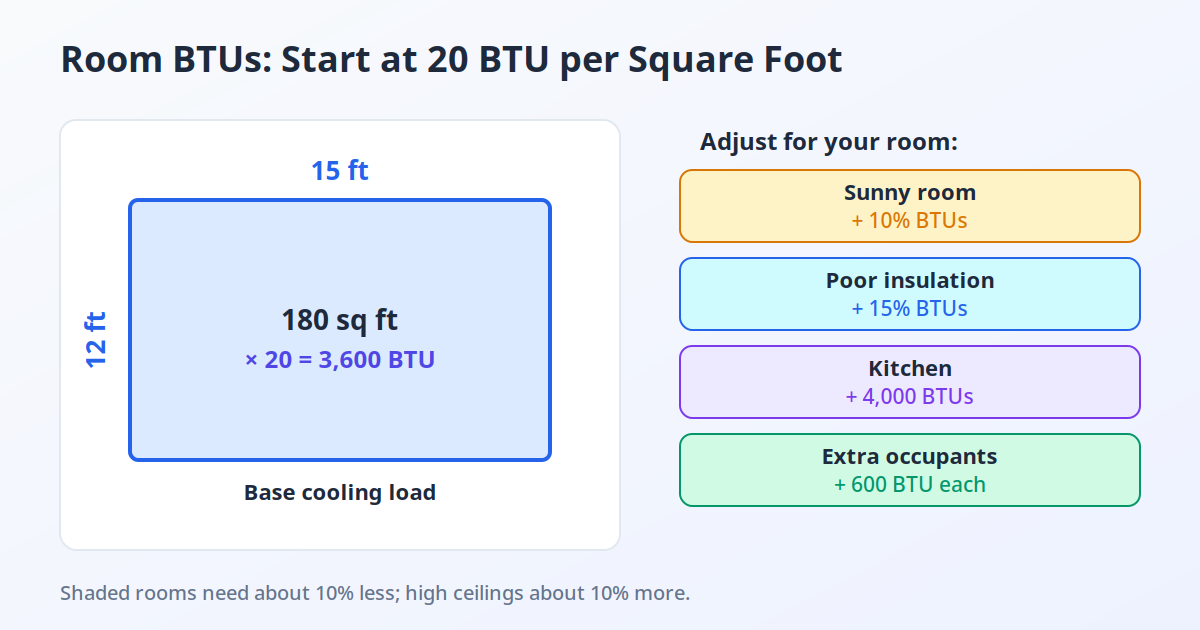
The standard rule of thumb is about 20 BTU per square foot of living space, assuming an 8-foot ceiling, a moderate climate, average insulation, and one or two occupants. Real rooms are rarely standard, though. Ceiling height, climate zone, sunlight exposure, kitchen heat, and the number of people in the room can each shift the answer by thousands of BTUs. This tool applies all of those adjustments for you, so the result reflects your actual room instead of a national average.
Use it before shopping for a window air conditioner, portable AC, mini-split system, or space heater — for bedrooms, living rooms, offices, kitchens, garages, or open-plan spaces. You will walk into the store knowing your exact capacity range.
How to Use This Calculator
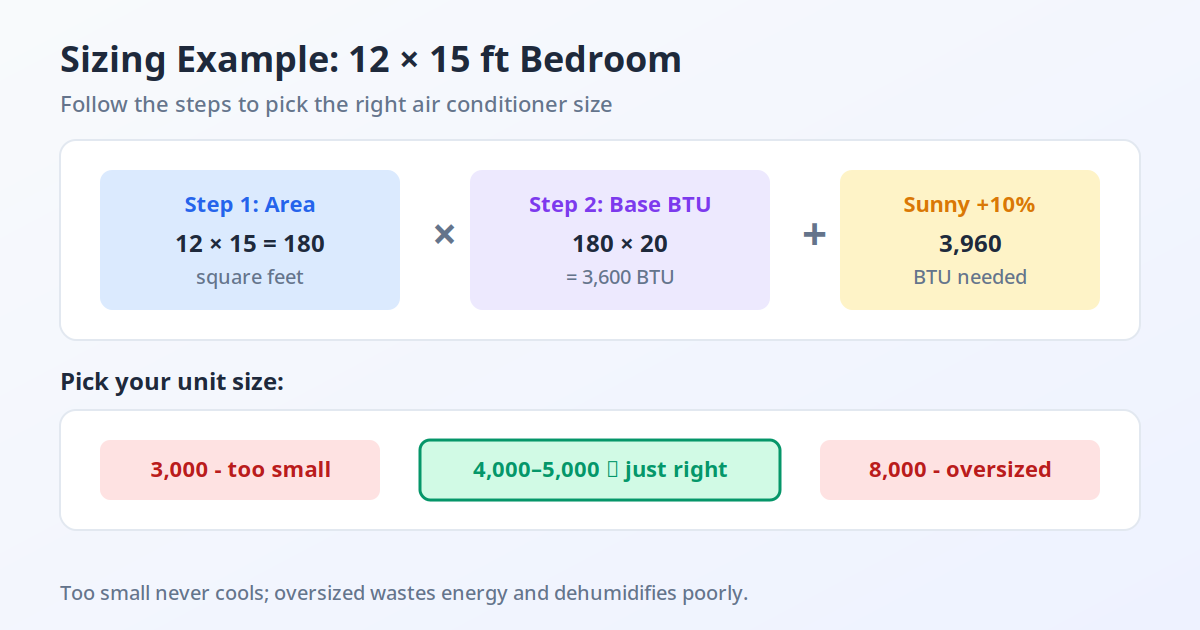
- Measure the floor area. Multiply length by width in feet — a 12 by 15 foot bedroom is 180 square feet. For L-shaped rooms, split the shape into two rectangles and add the areas. Round up slightly rather than down.
- Enter the ceiling height. The 20-BTU rule assumes 8-foot ceilings. A 10-foot ceiling holds 25 percent more air, so the tool multiplies by your height divided by 8. Vaulted ceilings need extra capacity because heat stratifies near the top.
- Pick your climate zone. Mild zones rarely top 80 degrees Fahrenheit, temperate zones are average, and hot zones see long stretches above 90 degrees. Multipliers of roughly 0.8, 1.0, and 1.2 swing the result by thousands of BTUs on a large room.
- Set sunlight exposure. South- or west-facing rooms with big windows gain far more solar heat. Choose sunny to add about 10 percent, shaded to subtract 10 percent, and average for everything else. Skylights and glass doors count as sunny.
- Add people and kitchens. Each occupant beyond the first two adds about 600 BTU of body heat. A kitchen adds 4,000 BTU for ovens, stoves, and appliances — often the largest single adjustment.
- Read the recommended size. The tool maps your result to common sizes: 5,000 BTU covers about 150 square feet, 6,000 covers 250, 8,000 covers 350, 10,000 covers 450, 12,000 covers 550, 14,000 covers 700, 18,000 covers 1,000, and 24,000 covers roughly 1,500. Choose the size at or just above your load.
- Compare efficiency ratings. At your chosen size, check EER or SEER ratings. Two 10,000-BTU models with different ratings can differ by 20 percent on summer electric bills.
The BTU Formula Explained
The core of any BTU sizing method is a simple area-based estimate refined by correction factors: BTU = floor area in square feet × 20. The 20-BTU figure comes from decades of HVAC practice for homes with 8-foot ceilings in temperate climates, and it lines up well with manufacturers’ published sizing charts. It assumes average insulation and a target indoor temperature near 72 degrees Fahrenheit.
Ceiling height scales the base load by actual height divided by 8, because you condition a volume of air, not just a floor. Climate zone applies a multiplier — about 0.8 for mild regions, 1.0 for temperate, 1.2 for hot — reflecting how hard the equipment fights outdoor heat. Sunlight adds or removes roughly 10 percent: solar gain through glass is a major heat source, which is why identical rooms can feel very different in afternoon sun.
People and Kitchen Adjustments
A resting adult gives off roughly 400 to 600 BTU per hour, so the method adds 600 BTU per occupant beyond the first two. A kitchen adds a flat 4,000 BTU for ovens, ranges, and appliances — even an idle refrigerator cycles all day. In an open-plan kitchen and living room these adjustments can total 5,000 to 7,000 BTU, the difference between a 10,000 and a 14,000 BTU unit.
The full sequence: base = area × 20; multiply by (ceiling height ÷ 8); multiply by the climate factor (0.8, 1.0, or 1.2); multiply by 1.10 for sunny, 0.90 for shaded, or 1.00 for average exposure; add 600 per extra person; add 4,000 if the space includes a kitchen. Professionals instead use the Manual J method, which models wall R-values, window types, air infiltration, and duct losses room by room — far more detailed, but overkill for choosing a window, portable, or mini-split unit.
Limitations
This estimate does not model insulation quality, window efficiency, air leakage, duct losses, or altitude, which can shift real loads by 10 to 30 percent. It is not meant for whole-house central systems, commercial spaces, or rooms with unusual heat sources like server racks or huge glass walls — those need a Manual J study. It is tuned for cooling; heating load is a separate calculation driven by winter temperatures, although the same BTU unit measures both.
Finally, capacity and efficiency are different things. EER measures BTUs of cooling per watt at one fixed hot operating point; SEER averages performance across a whole season. A 12,000-BTU unit at EER 12 draws 1,000 watts, while the same capacity at EER 10 draws 1,200 watts — a gap that pays for the pricier model several times over each summer.
Worked Example: A Sunny Living Room
Take a living room in a hot climate: 18 by 20 feet, 9-foot ceilings, large west-facing windows, four regular occupants, and an open kitchenette. Here is the calculation step by step, the same sequence a btu calculator follows.
Base load: 18 × 20 = 360 square feet × 20 = 7,200 BTU. Ceiling adjustment: 9 ÷ 8 = 1.125, so 7,200 × 1.125 = 8,100 BTU. Hot-climate multiplier of 1.2: 8,100 × 1.2 = 9,720 BTU. Sunny exposure adds 10 percent: 9,720 × 1.10 = 10,692 BTU. Two extra occupants add 2 × 600 = 1,200 BTU, reaching 11,892 BTU. The kitchenette adds 4,000 BTU, for a final 15,892 BTU.
The table below shows each step with its running total. At 15,892 BTU the right choice is the standard 18,000 BTU size, which suits about 1,000 square feet in milder conditions. Rounding down to 14,000 BTU would leave the room underpowered on the hottest afternoons, when the sun, the kitchen, and four people are all adding heat at once.
| Step | Calculation | Running total (BTU) |
|---|---|---|
| Base load | 360 sq ft × 20 | 7,200 |
| Ceiling height | 7,200 × (9 ÷ 8) | 8,100 |
| Hot climate | 8,100 × 1.2 | 9,720 |
| Sunny exposure | 9,720 × 1.10 | 10,692 |
| Two extra occupants | 10,692 + 2 × 600 | 11,892 |
| Kitchen | 11,892 + 4,000 | 15,892 |
| Recommended size | Nearest standard size at or above load | 18,000 BTU |
Why Not Just Buy Bigger?
An oversized air conditioner cools the air so quickly that it shuts off before removing enough moisture — this is short-cycling. The room feels cold and clammy, mold risk rises, and the compressor wears from constant cycling. Undersizing is worse in its own way: the unit runs forever, never hits the target temperature, and burns maximum power the whole time. The example above lands in the sweet spot — a right-sized unit runs in long, steady cycles that control both temperature and humidity.
BTU, Tons and Kilowatts: One Capacity, Three Units
The same cooling capacity is sold under three different units depending on the market and the equipment type. Window units are rated in BTU per hour, central systems and mini-splits in tons, and European and Asian spec sheets in kilowatts. Convert with 1 ton = 12,000 BTU/h and 1 kW = 3,412 BTU/h:
| BTU per hour | Tons | Kilowatts (kW) | Typical use |
|---|---|---|---|
| 5,000 | 0.42 | 1.47 | Small bedroom window unit |
| 9,000 | 0.75 | 2.64 | Smallest common mini-split |
| 12,000 | 1.0 | 3.52 | Medium room / 1-ton system |
| 18,000 | 1.5 | 5.28 | Large living area |
| 24,000 | 2.0 | 7.03 | Small apartment or floor |
| 36,000 | 3.0 | 10.55 | Whole small house (central) |
So when a mini-split is advertised as a “3.5 kW” model, it is a 12,000 BTU/h (1-ton) unit — directly comparable to the number this calculator gives you.
Frequently Asked Questions
What does BTU actually measure?
A British Thermal Unit is the heat energy needed to raise one pound of water by one degree Fahrenheit. On an air conditioner or heater, the BTU rating is how much heat the unit can move in one hour — higher BTU means more power, not better efficiency. Efficiency is what EER and SEER ratings describe.
Is it bad to buy an oversized air conditioner?
Yes. An oversized unit cools the air so fast that it shuts off before removing enough humidity, a problem called short-cycling. You get a room that feels cold but clammy, higher mold risk, faster compressor wear, and a bigger purchase price for no benefit. Choose the smallest standard size that meets or slightly exceeds your load.
What happens if my AC is undersized?
It runs nonstop without ever reaching the target temperature on hot days, and draws maximum power the whole time — costing more while cooling less. The compressor also wears out faster with no rest cycles. If your load is 15,000 BTU, a 12,000 BTU unit is not a bargain; it is a machine that fails every summer afternoon.
How does ceiling height change the requirement?
The 20-BTU-per-square-foot rule assumes 8-foot ceilings. Taller rooms hold more air to condition, so the load scales by your ceiling height divided by 8 — a 10-foot ceiling adds 25 percent. Vaulted ceilings need even more because heat collects near the peak. Measure rather than guess.
Why add BTUs for kitchens and extra people?
A resting adult gives off 400 to 600 BTU per hour of body heat. Kitchens are far larger heat sources — ovens, ranges, and even a cycling refrigerator pour heat into the space. The standard fixes are 600 BTU per occupant beyond the first two and 4,000 BTU for a kitchen; skipping them is the most common cause of undersized estimates.
What is the difference between EER and SEER?
EER measures cooling per watt at one fixed hot operating point — a snapshot on a very hot day. SEER averages efficiency across the whole cooling season, so it better predicts your summer electric bill. Higher is cheaper to run in both cases, and the premium for a better rating usually pays for itself within a few seasons.
Can I use one BTU estimate for both heating and cooling?
The BTU unit measures both, but the loads differ: cooling fights summer heat gain from sun, people, and appliances, while heating fights winter heat loss through walls, windows, and air leaks. This method is tuned for cooling, which is what most shoppers are sizing. For heating in cold climates, get a professional heat-loss calculation before buying a furnace or heat pump.
What size AC do I need for my room?
As a quick rule of thumb, you need about 20 BTU per square foot of living space. A 250 sq ft bedroom therefore needs roughly 5,000 BTU, while a 500 sq ft living room needs about 10,000 BTU. Use the BTU calculator above with your exact dimensions, ceiling height, and sun exposure for a precise recommendation.
How many BTU do I need per square foot?
Most rooms need 20 BTU per square foot, but kitchens need about 4,000 extra BTU and very sunny rooms need 10% more. Poorly insulated spaces may need up to 30 BTU per square foot. Check the BTU per square foot chart logic built into the calculator to adjust for your specific room conditions.
How do I convert BTU to AC tonnage?
One ton of air conditioning equals 12,000 BTU per hour. So an 18,000 BTU unit is a 1.5-ton AC and a 24,000 BTU unit is a 2-ton AC. Most residential rooms need between 0.4 and 2 tons, which is why sizing correctly with an air conditioner size calculator matters for efficiency.
How do I convert BTU to kW?
Divide the BTU-per-hour rating by 3,412 (1 kW = 3,412 BTU/h). For example, 12,000 BTU/h ÷ 3,412 = 3.52 kW, and 18,000 BTU/h = 5.28 kW. Kilowatts are the standard cooling-capacity unit on European and Asian spec sheets, while North American equipment is labeled in BTU/h or tons (1 ton = 12,000 BTU/h).
What size AC do I need for a 12×12 room?
A 12 × 12 room is 144 square feet. The 20 BTU-per-square-foot rule gives a baseline of about 2,880 BTU, but the smallest practical air conditioners sold are around 5,000 BTU, and standard sizing charts recommend a 5,000 BTU unit for rooms of 100–150 square feet. Choose 5,000 BTU for a typical bedroom, and step up toward 6,000 BTU if the room is sunny, upstairs, or has high ceilings.
Related Calculators
Try our Unit Converter, Cooking Measurement Converter, and Fuel Cost Calculator.
Related: Electricity Calculator, Horsepower Calculator.