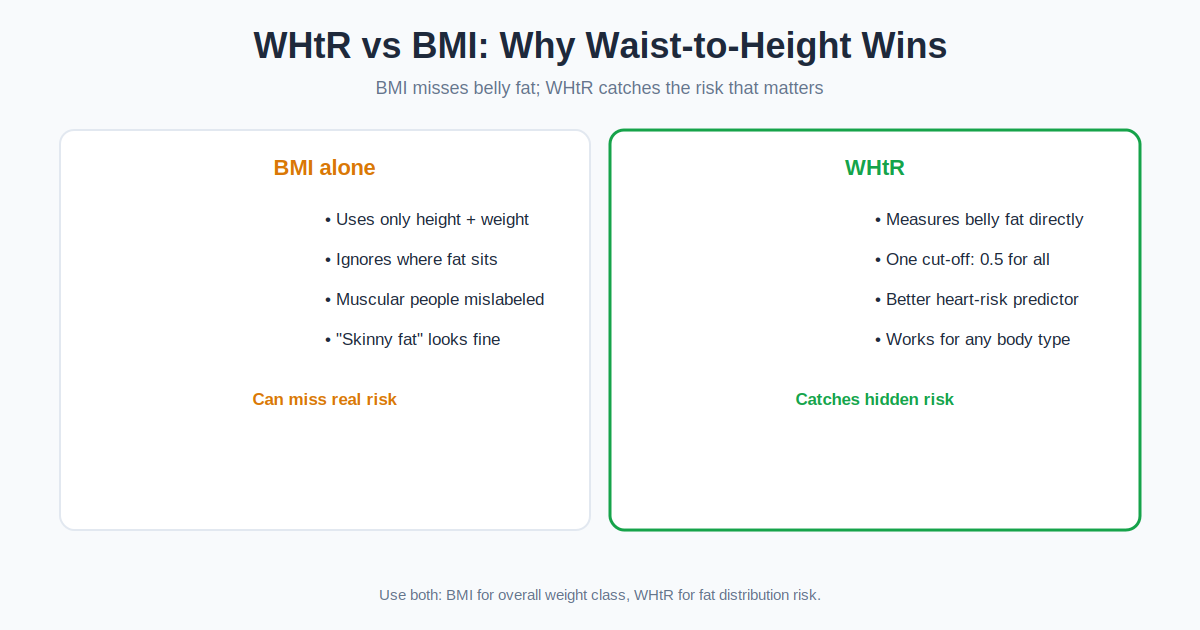
WHtR predicts health risk better than BMI for many people. Keep your waist under half your height — check your ratio in seconds.
Measure your waist at the navel and enter it with your height.
How to Use the Waist to Height Ratio Calculator
- Find a soft tape measure. Stand relaxed and find your navel (belly button) level.
- Wrap the tape around your waist at the navel, keeping it level all around and snug without pinching.
- Breathe out normally and read the number. Do not suck in your stomach.
- Enter your waist in centimeters and your height in centimeters.
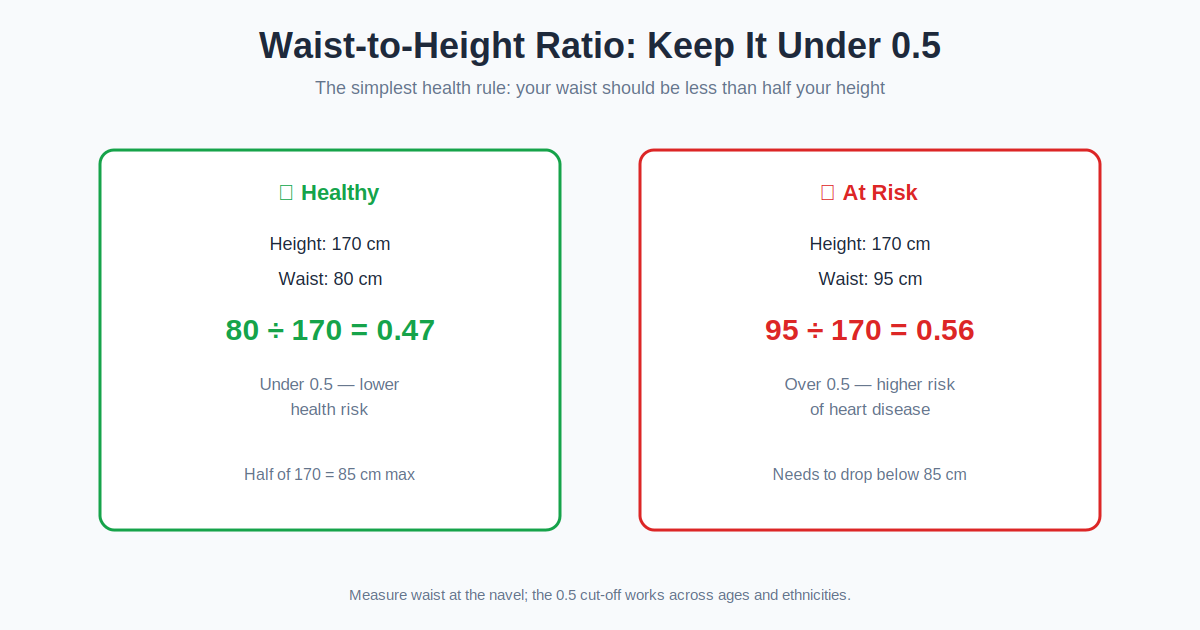
- Click Calculate. Aim for a ratio under 0.50: waist less than half your height.
- Note your maximum healthy waist, and remeasure every few weeks under the same conditions.
Waist to Height Ratio Formula
The formula could not be simpler: WHtR equals waist circumference divided by height, both in the same units. A ratio of 0.50 means your waist is exactly half your height. Research across many populations has found this ratio predicts cardiometabolic risk, diabetes, and even mortality better than BMI, because it directly captures abdominal fat, the type most tied to disease. BMI can misclassify muscular people as overweight and miss normal-weight people with dangerous belly fat; WHtR sidesteps both problems since it does not use weight at all. The widely cited guidance from researchers like Margaret Ashwell is to keep your waist under half your height, a message so simple it fits on a piece of string: cut a string to your height, fold it in half, and it should fit around your waist. Categories used here: under 0.40 may indicate underweight, 0.40 to 0.49 is healthy, 0.50 to 0.59 signals increased risk, and 0.60 or above signals high risk. The ratio works for adults of all builds, though it is less validated for children, pregnant women, and very tall or short extremes.
Worked Example
A person 175 centimeters tall with an 85 centimeter waist has a WHtR of 85 divided by 175, which is 0.486, in the healthy zone just under the 0.50 line. Their maximum healthy waist is half of 175, or 87.5 centimeters, so they have 2.5 centimeters of headroom. If the same person’s waist grows to 95 centimeters, the ratio becomes 95 divided by 175, or 0.543, crossing into increased risk territory. To return to the healthy zone they need their waist under 87.5 centimeters, a reduction of 7.5 centimeters. Compare this with BMI for a muscular 175 centimeter, 90 kilogram athlete: BMI is 29.4, technically overweight bordering on obese, yet if his waist is 82 centimeters his WHtR is 0.469, healthy, correctly reflecting low abdominal fat. This is exactly why many researchers now prefer WHtR as a screening tool. It answers one question well: is there too much fat around the middle, regardless of what the scale says.
How to Measure Your Waist the Standard Way
Because WHtR depends on one tape measurement, technique matters more here than in any step of the arithmetic. The measurement point used in medical guidance (including NICE) is the midpoint between the bottom of your lowest rib and the top of your hip bone — for most people this sits just above the navel, not at it. Stand relaxed, breathe out normally (don’t hold your stomach in), and wrap a flexible tape horizontally around your waist, snug but not compressing the skin. Take two or three readings and use the average; single readings easily vary by 1–2 cm. Avoid measuring over clothing, at the waistband of your trousers, or at the belly button, which is a different point for many body shapes and can shift your result across a category boundary.
WHtR vs BMI: What Each One Misses
BMI looks at weight and height only, so it cannot tell muscle from fat or say where fat sits. WHtR specifically targets central (abdominal) fat — the fat packed around internal organs that is most strongly linked to heart disease and type 2 diabetes. Each one has a blind spot: a muscular person can look “overweight” on BMI while having a perfectly healthy WHtR, and a person with a normal BMI can still carry risky amounts of belly fat, which WHtR will catch. Using both numbers together gives a much clearer picture than either alone. It also helps to know that some guidelines publish slightly different cutoffs by sex (around 0.53 for men and 0.49 for women in one widely used framing), but the widely accepted 0.5 boundary applied above for everyone is the standard used in most research and public-health advice.
Tracking Your Ratio Over Time
A single reading is a snapshot; the trend is what tells the story. Measure once a month, at the same time of day and with the same technique, and record the ratio alongside your weight. A helpful non-technical check is the string test: cut a piece of string to your height, fold it in half, and see whether it fits around your waist — if it does, your ratio is at or below 0.5. Because WHtR needs no scales, it is one of the easiest health numbers to keep an eye on, and small monthly improvements are genuinely meaningful: for a 175 cm person, every centimetre off the waist moves the ratio down by roughly 0.006.
Frequently Asked Questions
Why is WHtR better than BMI?
WHtR directly measures abdominal fat, which drives most obesity-related disease. BMI uses total weight, so it misreads muscular builds and misses thin people with belly fat.
What is a good waist to height ratio?
Under 0.50. The simple rule is to keep your waist circumference less than half your height. Lower is generally better down to about 0.40.
How do I measure my waist correctly?
At the navel level with a soft tape, level all around, snug but not tight, after breathing out normally. Measure in the morning for consistency.
Does WHtR work for children?
It is mainly validated for adults. Children’s bodies change rapidly with growth, so pediatricians use age-adjusted growth charts instead.
Can I be healthy with a high WHtR if my BMI is normal?
A high WHtR with normal BMI is sometimes called normal-weight obesity and still carries elevated metabolic risk. Reducing waist size through diet and exercise is worthwhile.
What waist size should I aim for at my height?
A simple rule: keep your waist under half your height. At 175 cm that means 87.5 cm or less — the calculator shows this ‘maximum healthy waist’ for your exact height automatically.
Does WHtR differ for men and women?
The 0.5 boundary is used for everyone in most research and guidelines. Some sources quote slightly different healthy ranges by sex (about 0.53 for men and 0.49 for women), but the widely accepted advice is the same keep-it-under-half rule.
How often should I measure my WHtR?
Monthly is plenty — measure at the same time of day with the same technique and track the trend. Waist measurements naturally vary by 1–2 cm, so a single reading is less informative than the direction of change.
Related Calculators
Cross-check with our BMI Calculator and our Waist to Hip Ratio Calculator for complementary views of body fat distribution.