Free number sequence finder: enter at least 3 numbers to accurately detect arithmetic, geometric, Fibonacci-like or square patterns and predict the next terms.
Results are estimates for planning purposes and are not financial, medical, or professional advice.
How to Use the Number Sequence Finder
Enter any sequence of at least three numbers and the finder will detect the underlying pattern and predict the next three terms — perfect for IQ test practice, series homework, and checking puzzle answers.
- Type your numbers separated by commas.
- Include at least three terms for reliable detection — four or more is much better.
- Press calculate.
- Read the detected pattern and the next three terms.
The Four Pattern Families
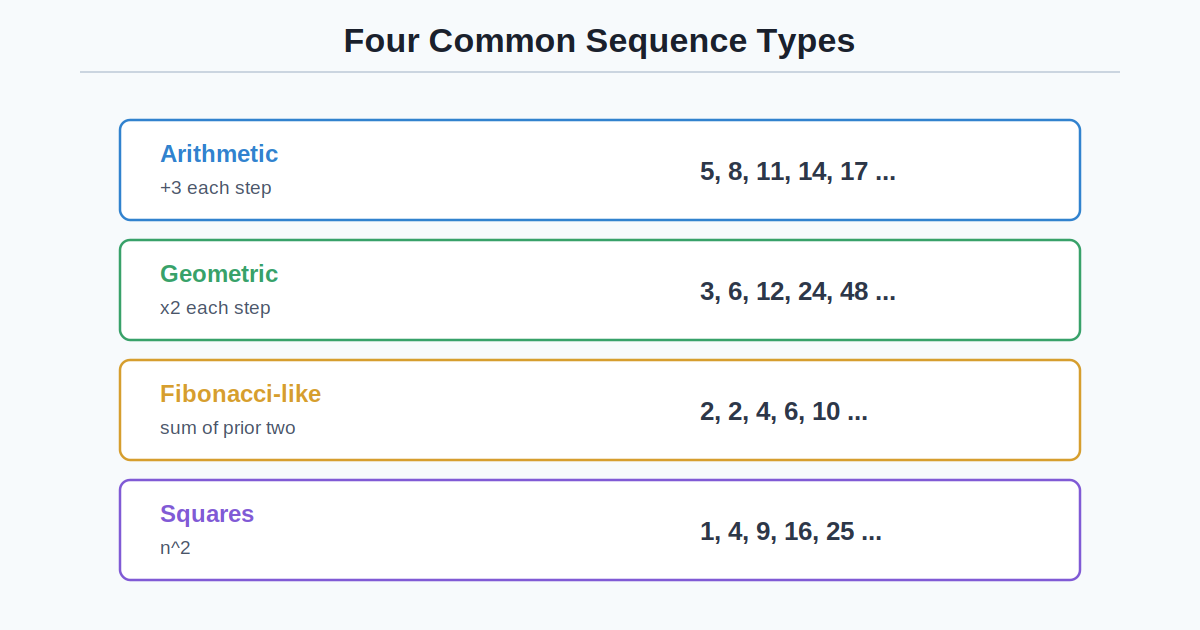
The finder tests four classic patterns in this order, returning the first that fits all your terms:
| Family | Rule | Example | Next terms |
|---|---|---|---|
| Arithmetic | Constant difference: aₙ = a₁ + (n−1)d | 3, 7, 11, 15 (d = 4) | 19, 23, 27 |
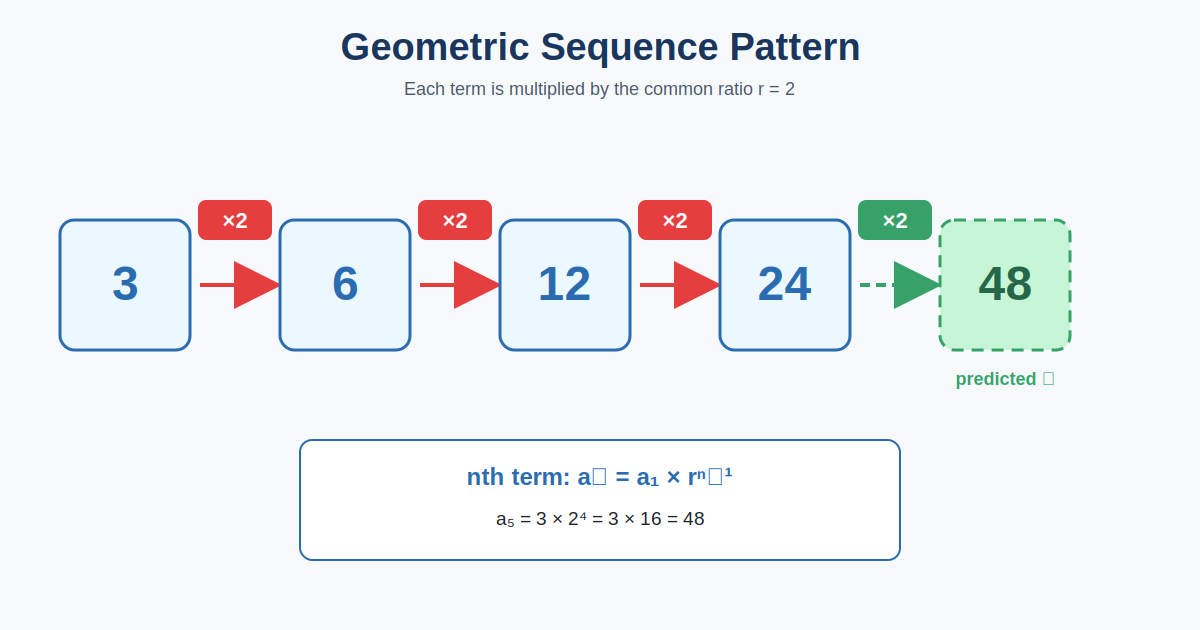
| Geometric | Constant ratio: aₙ = a₁ × r^(n−1) | 3, 6, 12, 24 (r = 2) | 48, 96, 192 |
| Fibonacci-like | Each term = sum of previous two | 2, 5, 7, 12, 19 | 31, 50, 81 |
| Squares | Squares of 1, 2, 3, 4, … | 1, 4, 9, 16 | 25, 36, 49 |
For the Fibonacci-like check, 2 + 5 = 7, 5 + 7 = 12, and 7 + 12 = 19, so the rule holds and the sequence continues 19 + 12 = 31, 31 + 19 = 50, and 50 + 31 = 81.
How Pattern Detection Works
First the finder checks for an arithmetic progression, where each term differs from the last by a constant. Then it checks for a geometric progression with a constant ratio — sequences starting at 0 are skipped here, since nothing can divide into 0. Next it tests a Fibonacci-like rule where each term is the sum of the previous two. Finally it checks for squares of natural numbers, which must start at 1: exactly 1, 4, 9, 16, and so on. If none match, it reports that no simple pattern was found instead of guessing.
Example
The sequence 3, 6, 12, 24 doubles each time, so it is geometric with ratio 2. Continuing the pattern gives 48, then 96, then 192 as the next three terms. An arithmetic example: 3, 7, 11, 15 grows by a steady 4, so the next three terms are 19, 23, and 27.
When the Differences Grow: Quadratic Sequences by Hand
Not every sequence fits the four families. The classic gap case is the quadratic sequence 2, 5, 10, 17, 26 — common in aptitude tests and one this finder reports as “no simple pattern”. Solve it with the method of differences:
- Write the differences between consecutive terms: 3, 5, 7, 9.
- Write the differences of those: 2, 2, 2 — all constant.
- Constant second differences mean quadratic. Extend them: the next first difference is 9 + 2 = 11.
- Add it to the last term: 26 + 11 = 37. Continue the same way for 50, 65, and beyond.
The general rule: when the k-th row of differences becomes constant, the sequence follows a degree-k rule. Arithmetic is degree 1 (constant first differences), quadratic is degree 2, cubic is degree 3. If even the third differences refuse to settle, the rule is something else — or there are simply too few terms to pin it down.
One Sequence, Several Answers
Be careful with short sequences: more than one rule can fit. Take 1, 2, 4, 7. The simplest reading is “add 1, then 2, then 3” — differences of 1, 2, 3 — giving 11 next, and the rule xₙ = n(n−1)/2 + 1. But a rule of “add the two previous, plus 1” fits equally well and gives 12; adding the last three gives 13. All three are mathematically defensible.
The convention is to choose the simplest rule that fits — but also to recognize that three or four terms cannot prove anything. When the finder reports no pattern, or when two answers look right, add another term before trusting a prediction. IQ test designers know this too: they choose problems where the intended rule is clearly the simplest, which is why this finder’s four families solve most of them.
Where Sequences Appear
Number patterns show up far beyond puzzles. Bank interest grows geometrically, which is why compound growth accelerates. Computer scientists analyze algorithm runtimes with sequences, and the Fibonacci pattern appears in sunflower spirals and pinecones. Musicians use geometric ratios for octaves, where each octave doubles frequency. Recognizing the pattern family first makes prediction easy: once you know a sequence is geometric, every future term follows from the ratio.
Frequently Asked Questions
What sequences can it detect?
Arithmetic, geometric, Fibonacci-like, and perfect squares. More exotic patterns are not covered.
Why does it need at least 3 numbers?
Two numbers fit infinitely many patterns. Three terms let the tool verify a rule holds more than once. Four or more terms are even better, since they confirm the pattern is stable and not a coincidence of a short run.
Can it solve IQ test sequences?
Often yes, since IQ items usually use exactly these four pattern families. Test designers favor arithmetic and geometric patterns because they are quick to spot under time pressure. If a sequence mixes operations, try splitting it into alternating subsequences, as odd and even positions sometimes follow separate rules.
What if no pattern is found?
The sequence may follow a complex rule, contain an error, or be random. Double-check your numbers.
Does it handle decimals and negatives?
Yes. Ratios and differences work with any real numbers, including negatives and fractions.
How do I solve a quadratic sequence like 2, 5, 10, 17, 26?
Use the method of differences. First differences are 3, 5, 7, 9; second differences are 2, 2, 2 — constant, so the sequence is quadratic. Extend: the next first difference is 11, so the next term is 26 plus 11, which is 37. This finder detects arithmetic, geometric, Fibonacci-like, and square patterns automatically; quadratic ones you extend by hand this way.
How many terms should I enter for a reliable result?
At least three, and four or more is far better. Short runs fit several different rules — 1, 2, 4, 7 could continue 11, 12, or 13 under different valid rules — while extra terms confirm which single pattern really holds.
Related Calculators
Try our Scientific Calculator and Statistics Calculator for more math tools.