Compare ISO vs NSO tax treatment and estimate net profit from exercising options.
How to Use the Stock Options Calculator
Stock options can build serious wealth — or expire worthless. Whether you hold ISOs or NSOs changes the tax math completely. This calculator models exercise cost, taxes, and net profit for both types.
- Select your option type: ISO (incentive stock options) or NSO (non-qualified stock options).
- Enter the number of options, strike price, and current fair market value per share.
- Enter your state tax rate — the calculator applies the federal treatment that matches the option type you selected.
- Compare exercising now vs later: total cost, tax due, and net profit in each scenario.
Stock Options Tax Formula
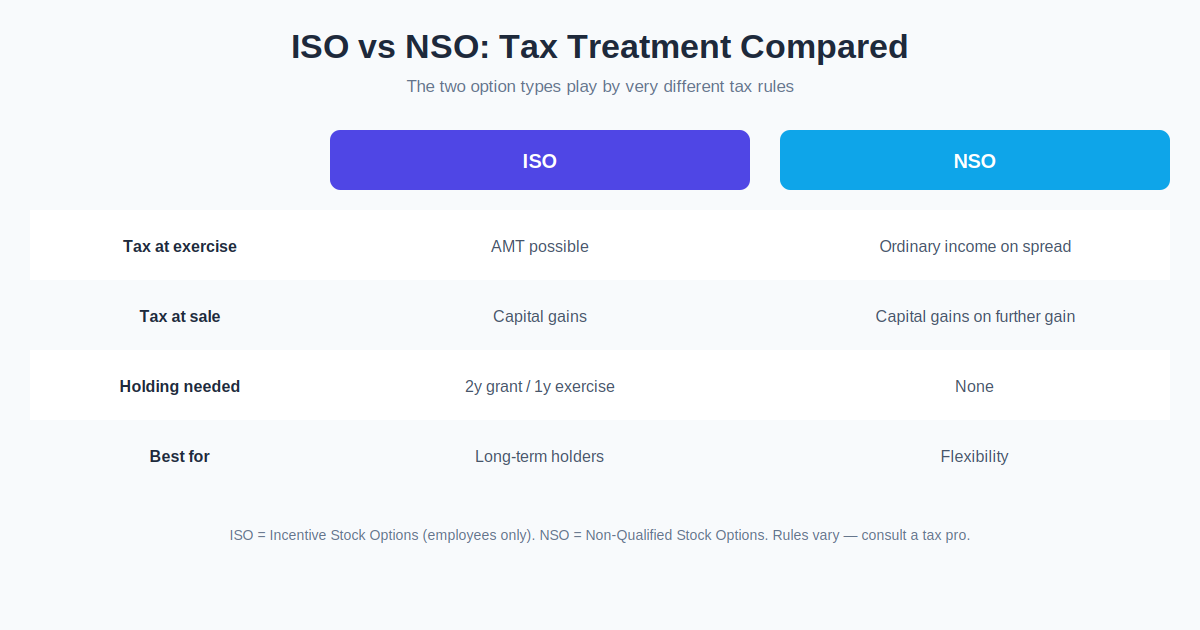
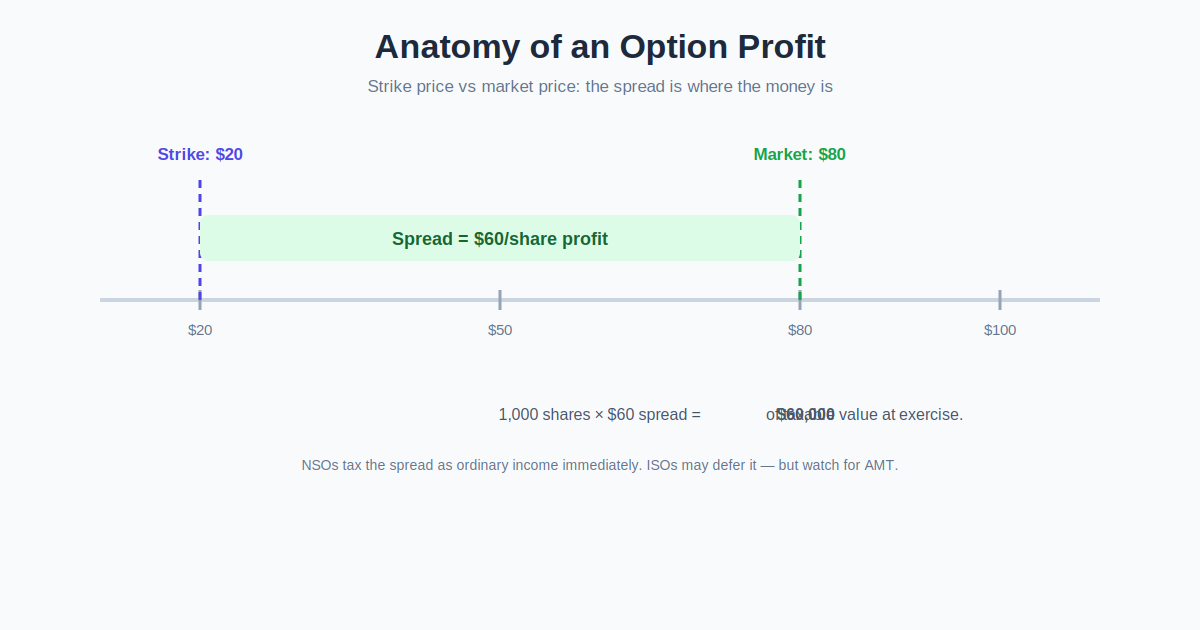
An option’s paper profit is simple: (current share price − strike price) × number of shares. The tax treatment is where ISOs and NSOs diverge. With NSOs, the bargain element — market price minus strike price at exercise — is taxed immediately as ordinary income, and your employer withholds on it. Later sale gains are capital gains measured from the exercise-date price.
ISOs get special treatment: no regular income tax at exercise if you meet the holding rules (sell more than two years after grant and one year after exercise). Instead, the bargain element counts as income for the Alternative Minimum Tax in the exercise year, which surprises many employees with an unexpected AMT bill. Sell ISO shares before meeting the holding periods and it becomes a disqualifying disposition — taxed like an NSO. The golden rule: NSOs tax you at exercise no matter what, while ISOs let you defer tax but demand careful AMT planning.
Example Calculation
Marcus holds 1,000 NSOs with a $20 strike price; the stock now trades at $75. Bargain element: ($75 − $20) × 1,000 = $55,000 taxed as ordinary income at exercise. At a 32% federal rate plus 5% state, he owes about $20,350 in tax, and exercising costs $20,000 for the shares themselves — $40,350 out of pocket before he owns anything. If he later sells at $90, the additional $15,000 gain is capital gains. Had these been ISOs held through the qualifying periods, the $55,000 would escape ordinary income tax entirely (though AMT might apply in the exercise year).
The Stock Options Formulas, Step by Step
Every stock option calculation is the same five lines, worked here with 1,000 NSOs, a $5 strike, a $20 share price, and a 32% combined tax rate:
- Exercise cost = options × strike = 1,000 × $5 = $5,000 — the cash you pay to buy your shares.
- Total value = options × share price = 1,000 × $20 = $20,000 — what the shares are worth on paper.
- Spread (bargain element) = value − cost = $15,000 — taxed as ordinary income for NSOs.
- Tax on the spread = $15,000 × 32% = $4,800.
- Net value = spread − tax = $10,200 — after-tax paper profit, before the $5,000 exercise cost comes out of pocket.
If the share price falls below your strike, the options are underwater: with a $5 strike and the stock at $3, exercising pays $5 for something worth $3, so they are worthless unless the price recovers before expiry.
Frequently Asked Questions
What is the difference between ISOs and NSOs?
NSOs are taxed as ordinary income at exercise on the bargain element. ISOs avoid regular income tax at exercise if you hold the shares long enough (2 years from grant, 1 year from exercise), but the bargain element can trigger Alternative Minimum Tax.
What is the AMT trap with ISOs?
Exercising ISOs creates AMT income equal to the bargain element even though you owe no regular tax. Employees have faced five-figure AMT bills on stock they could not sell (private companies), so model AMT before exercising large ISO blocks.
When should I exercise my options?
Common triggers: approaching expiration, leaving the company (you usually get 90 days post-termination), a liquidity event, or when the spread is small early on — exercising early starts the capital-gains clock and minimizes AMT on ISOs.
What happens to options if I leave my job?
Unvested options are forfeited. Vested options typically must be exercised within 90 days of departure or they expire — a deadline that forces expensive decisions, so plan before resigning.
Are startup options worth anything?
Only if the company succeeds. Value them at zero for planning purposes, understand the 409A valuation behind your strike price, and never turn down salary you need for options you cannot sell.
What does it mean when stock options are underwater?
Options are underwater (out of the money) when the share price is below the strike price — exercising would pay more than the shares are worth. They have no exercise value today, but if the price climbs back above the strike before expiration they become valuable again; otherwise they expire worthless.
What is vesting, and what is a cliff?
Vesting is the schedule that earns you the right to exercise — typically 25% per year over four years. A cliff is an initial wait, commonly one year, during which nothing vests; reach it and the first chunk vests at once, then vesting continues monthly or quarterly. Leave before the cliff and you get zero options.
Related Calculators
Try our Compound Interest Calculator and Income Tax Calculator for more calculations.