Free waist to hip ratio calculator: enter your waist and hip measurements to get your WHR and WHO health risk category for men and women, with guidance.
Results are estimates for planning purposes and are not financial, medical, or professional advice.
How to Use the Waist to Hip Ratio Calculator
Measure your waist and hips with a tape measure, then enter the values to get your waist to hip ratio and health risk category.
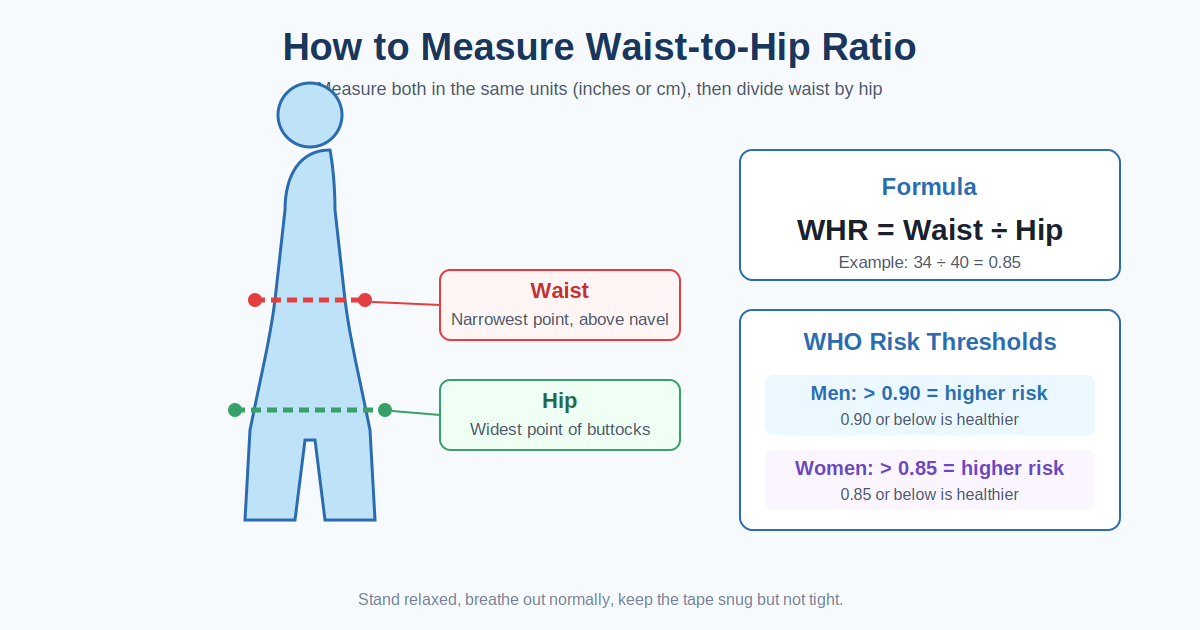
- Measure your waist at the narrowest point, usually just above the belly button.
- Measure your hips at the widest point around the buttocks.
- Select your sex and the units you measured in.
- Press calculate to see your WHR and WHO risk category.
Waist to Hip Ratio Formula
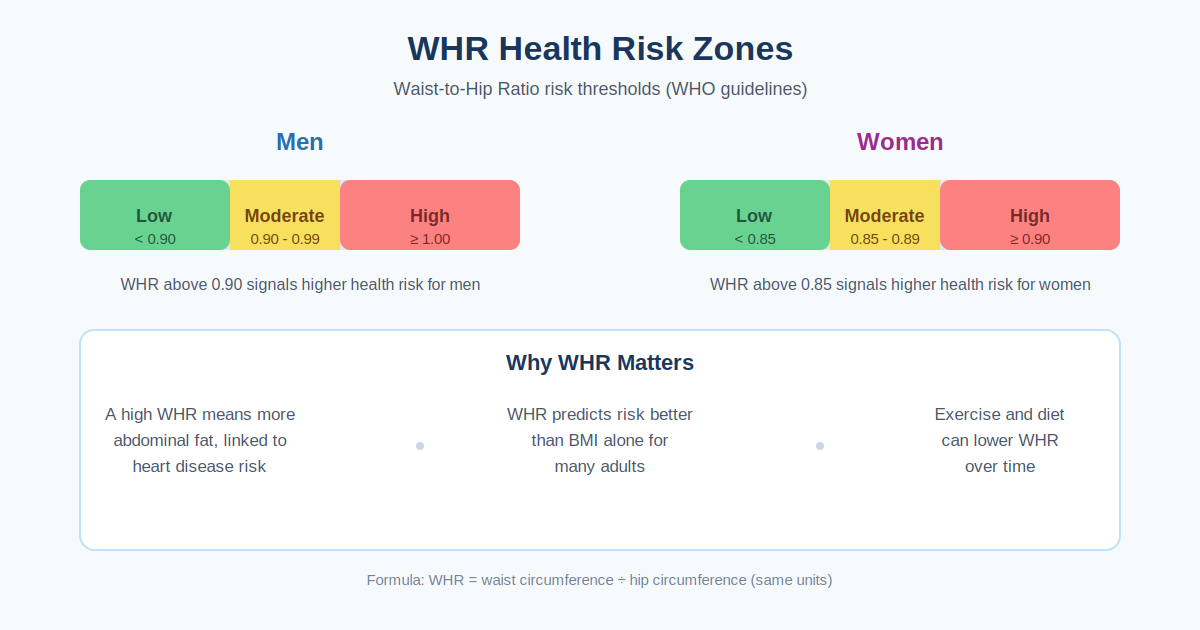
The formula is simple: WHR equals waist circumference divided by hip circumference, using the same units for both. The World Health Organization sets the high-risk cutoff at above 0.90 for men and above 0.85 for women. Values at or below these cutoffs indicate lower risk. Belly fat stored around the waist is linked to higher risk of heart disease and type 2 diabetes than fat stored on the hips and thighs.
Example
A man with a 34 inch waist and 40 inch hips has a WHR of 34 divided by 40, which equals 0.85. For men this is in the moderate risk band, approaching the 0.90 high-risk cutoff, so it is a good signal to watch diet and activity levels.
Why Waist to Hip Ratio Matters
Where your body stores fat influences health more than total weight alone. Visceral fat packed around the abdomen releases inflammatory compounds and is strongly tied to insulin resistance, high blood pressure, and heart disease. Hip and thigh fat is comparatively inert. That is why two people with the same BMI can face very different risks, and why WHR adds useful information on top of BMI. Tracking your ratio monthly is a simple habit: shrinking waistlines show your diet and training plan is working even when the scale stalls. Combine WHR with regular blood pressure checks and blood work for a fuller picture.
Reading Your Result: Risk Bands
The tool uses three bands, slightly different for men and women. For men: below 0.85 is low, 0.85 to 0.90 is moderate, and above 0.90 is high. For women: below 0.80 is low, 0.80 to 0.85 is moderate, and above 0.85 is high. The high band starts at the World Health Organization increased-risk cut-off for each sex. To put your number in the context of daily energy needs, try our Calorie Calculator next.
Measurement Mistakes That Skew Your Ratio
Tape technique matters more than people expect. Measure over bare skin or thin clothing, keep the tape snug but not pressing into the skin, and do not hold your stomach in. Measure twice and average the readings; if they differ by more than half an inch or a centimeter, take a third. Consistent technique turns WHR into a reliable trend tracker instead of a random number.
Frequently Asked Questions
What is a good waist to hip ratio?
For men, 0.90 or below is the WHO target. For women, 0.85 or below is the target.
Is WHR better than BMI?
WHR reflects fat distribution, which BMI ignores. Many researchers consider it a stronger predictor of heart risk, though both have value.
How do I measure my waist correctly?
Stand relaxed, wrap the tape around the narrowest part of your torso, keep it level, and measure after breathing out normally.
Can WHR change with exercise?
Yes. Losing abdominal fat through diet and exercise lowers your waist measurement and therefore your ratio.
Does the unit of measurement matter?
No. Because it is a ratio, inches and centimeters give the same result as long as both use the same unit.
What is the difference between apple and pear body shapes?
Apple shapes carry more fat around the waist, giving a higher waist to hip ratio and more visceral fat. Pear shapes carry more around the hips and thighs, giving a lower ratio. The ratio is simply a number for this pattern.
How often should I measure my waist to hip ratio?
Once every few weeks is enough. Fat distribution changes slowly, so daily measurements just add noise from tape placement.
Related Calculators
Try our BMI Calculator and Body Fat Percentage Calculator for more health tools.