Compare Roth conversion vs staying traditional — taxes now vs taxes later.
How to Use the Roth Conversion Calculator
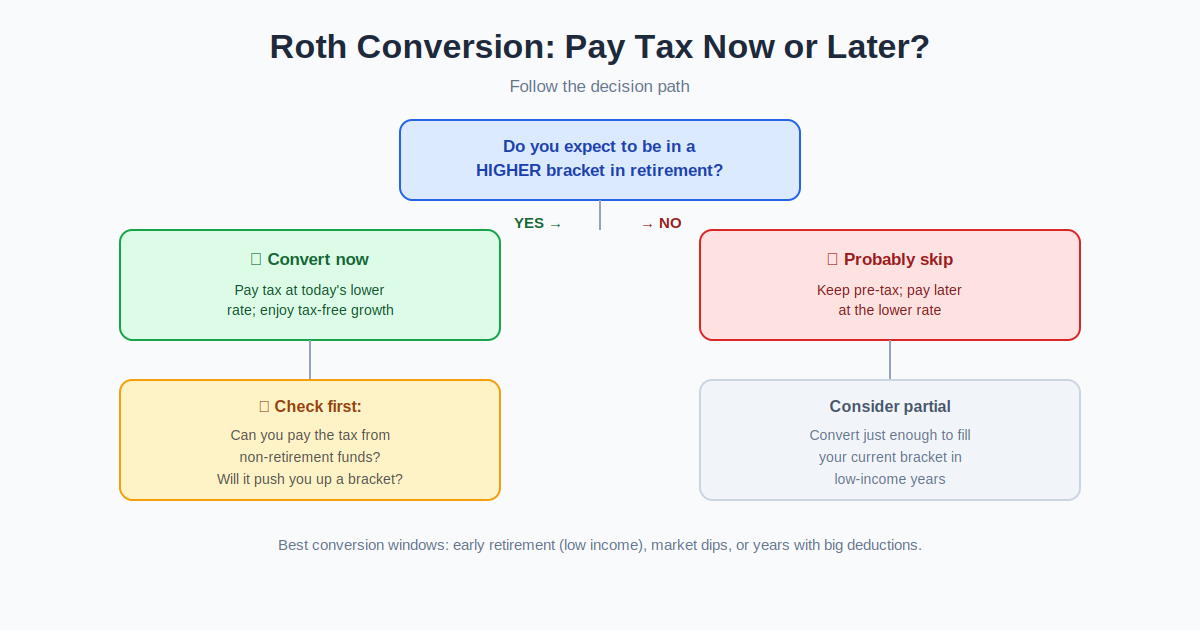
A Roth conversion moves money from a traditional IRA or 401(k) into a Roth IRA. You pay income tax on the converted amount today, and in exchange the money grows tax-free forever. Whether that trade is worth it depends on your tax rates now versus later. This calculator compares both paths side by side.
- Enter the amount to convert. Start with a realistic figure. Many people convert just enough each year to fill up their current tax bracket without spilling into the next one.
- Enter your current age. Younger converters benefit more because the tax-free growth has decades to compound.
- Enter your current marginal tax bracket. This is the rate on your last dollar of income, not your effective rate. The conversion stacks on top of your other income.
- Estimate your retirement tax bracket. Think about pensions, Social Security, and required minimum distributions. Many retirees land in a lower bracket, but large traditional balances can push RMDs surprisingly high.
- Set years until withdrawal and expected return. Longer horizons and higher returns magnify the Roth advantage when your retirement bracket is lower.
- Choose how you will pay the conversion tax. Paying from outside funds is far better because the full converted amount keeps growing tax-free. Paying from the IRA itself shrinks the Roth and can trigger penalties under age 59 and a half.
- Click Calculate. Compare the after-tax values and read the verdict.
The Math Behind Roth Conversions
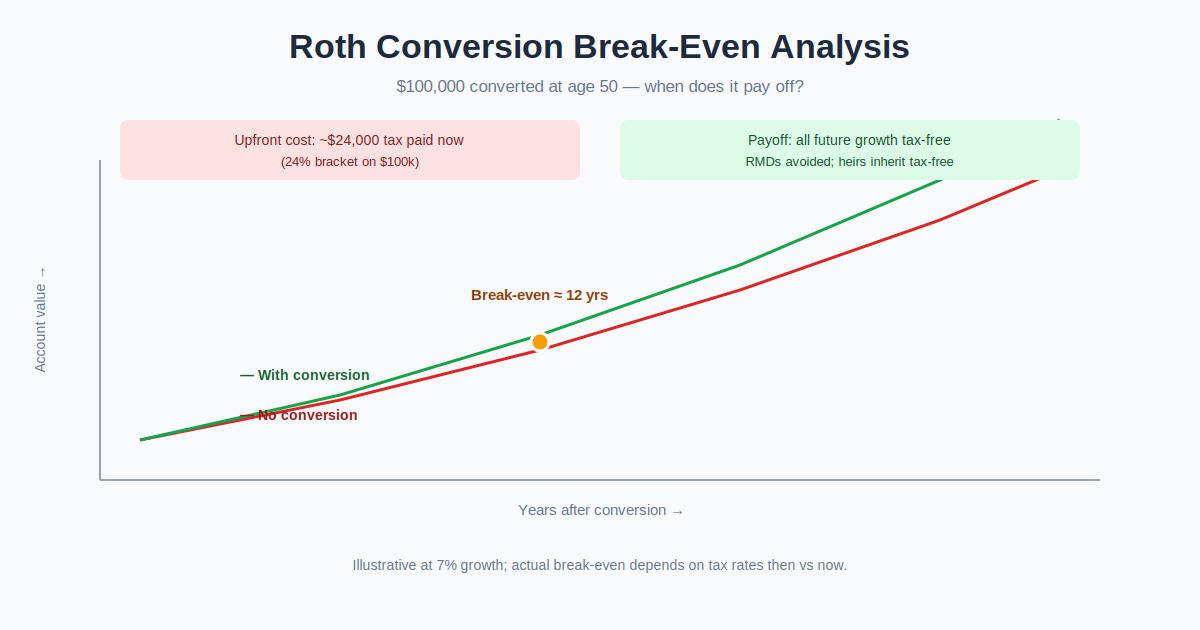
The core comparison is simple. If you convert amount A today at tax rate t1, and it grows at rate r for n years, your Roth ends with A times (1 + r) to the power n, completely tax-free, assuming you pay the tax from outside money. If you leave it traditional, it grows to the same A times (1 + r) to the power n, but you then pay retirement tax rate t2 on withdrawal, leaving A times (1 + r) to the power n times (1 minus t2).
Notice that when t1 equals t2, the two outcomes are identical. The commutative property of multiplication guarantees it: paying 24 percent now versus 24 percent later on the same growing balance gives the same result. The conversion only wins on pure math when your retirement bracket is lower than today, or more precisely when the effective rate on the converted dollars today is lower than the rate those dollars would face later.
Reality adds several wrinkles that often favor the Roth beyond the simple math. Roth IRAs have no required minimum distributions, so the money can compound untouched for your entire life and pass tax-free to heirs. Conversions also shrink your future traditional balance, which lowers future RMDs that could otherwise push you into higher brackets or trigger Medicare IRMAA surcharges. On the other hand, a big conversion in one year can itself push you into a higher bracket, raise Medicare premiums for two years, or reduce ACA subsidies, which is why spreading conversions across low-income years is the classic strategy.
The five-year rule matters too. Each conversion has its own five-year clock before you can withdraw the converted principal penalty-free if you are under 59 and a half, and earnings have their own qualified-distribution rules. Plan conversions at least five years before you need the money.
Worked Example
Consider Jordan, age 45, who wants to convert 50,000 dollars. She is in the 24 percent bracket today and expects to be in the 22 percent bracket in retirement. She plans to let the money grow 20 years at 7 percent and will pay the conversion tax from her savings account.
The tax due today is 50,000 times 0.24, or 12,000 dollars. Her Roth grows to 50,000 times 1.07 to the 20th power, about 193,484 dollars, all tax-free. If she had left it traditional, the same growth gives 193,484 dollars, but a 22 percent tax at withdrawal leaves her 150,918 dollars. The conversion wins by about 42,566 dollars.
Now suppose Jordan instead expects a 28 percent retirement bracket because of large RMDs. The traditional path would leave only 139,309 dollars after tax, and the Roth advantage grows to about 54,175 dollars. Conversely, if she had to pay the 12,000 dollar tax from the converted amount itself, only 38,000 dollars would enter the Roth, growing to about 147,048 dollars, barely ahead of the traditional path. That is why advisors insist: pay the tax from outside funds whenever possible.
The Fill-the-Bracket Strategy, Step by Step
The smartest way to time conversions is to fill up your current tax bracket without spilling into the next one. Each year, convert just enough so your taxable income lands at the top of the bracket you are already in.
Example for 2026: you are single with 60,000 dollars of taxable income, and the 22 percent bracket runs to 105,700 dollars. That leaves 45,700 dollars of room taxed at 22 percent — a conversion tax of 10,054 dollars. Convert 60,000 dollars instead and the extra 14,300 dollars spills into the 24 percent bracket, costing 3,432 dollars more, for 13,486 dollars total.
Repeat the exercise each year, ideally in the gap years between retirement and required minimum distributions, when income is naturally low. Watch for side effects: the extra income can trigger Medicare IRMAA surcharges two years later and push capital gains into higher brackets, so model the full picture before converting the maximum.
Related Calculators
Compare account types first with our Roth IRA Calculator, or project your retirement income with our Social Security Benefits Calculator.
Frequently Asked Questions
What is a Roth conversion?
Moving money from a traditional IRA or 401(k) into a Roth IRA. You pay ordinary income tax on the converted amount now, then it grows and withdraws tax-free forever, with no required minimum distributions.
When does a Roth conversion make sense?
In low-income years (job gap, early retirement before RMDs), when you expect higher taxes later, when you want to reduce future RMDs, or when you want tax-free money for heirs. It rarely makes sense at peak earning years in the top bracket.
Should I pay the conversion tax from the IRA or outside funds?
Outside funds, almost always. Paying from the converted amount shrinks your Roth, wastes tax-free growth space, and triggers a 10% early-withdrawal penalty on the withheld portion if you are under 59 and a half.
Does a Roth conversion affect Medicare premiums?
Yes, potentially. The converted amount raises your modified adjusted gross income, which determines IRMAA surcharges two years later. A large conversion can cost a married couple thousands in extra Part B and D premiums.
Is there a limit on how much I can convert?
No dollar limit and no income limit on conversions themselves. But the tax bill is real, so most people convert strategically in chunks to stay within their target bracket each year.
Can I undo a Roth conversion?
No. Since the 2018 tax law changes, Roth conversions can no longer be recharacterized or reversed. Get the amount right before you convert — model your bracket, IRMAA exposure, and side effects first.
What is the deadline for a Roth conversion?
December 31 of the tax year. Unlike IRA contributions, which get until tax day, a conversion must be completed in the calendar year it counts for. Late-December processing delays can push you into the next year, so convert with margin.