Calculate kWh consumption and electricity cost for home appliances. Enter wattage and daily hours to see what each device really costs you.
Want a cost estimate? Try our Electricity Cost Calculator.
Find out what your appliances cost to run.
How to Use the Electricity Usage Calculator
How much electricity does that old space heater really use? This calculator converts any appliance's wattage and daily usage into kilowatt-hours (kWh) per day, month, and year, so you can track energy consumption and spot the biggest power hogs in your home.
- Pick an appliance. Choose from common presets with typical wattages, or select custom and enter the watts from the device label.
- Enter daily hours. Estimate honestly — the TV might run 4 hours, but the refrigerator cycles on and off, so its average is lower than its label.
- Set your rate. Find dollars per kWh on your electric bill; the US average is around 0.17 dollars.
- Compare. Run the numbers for each suspect appliance and rank them by yearly cost.
Electricity Cost Formula
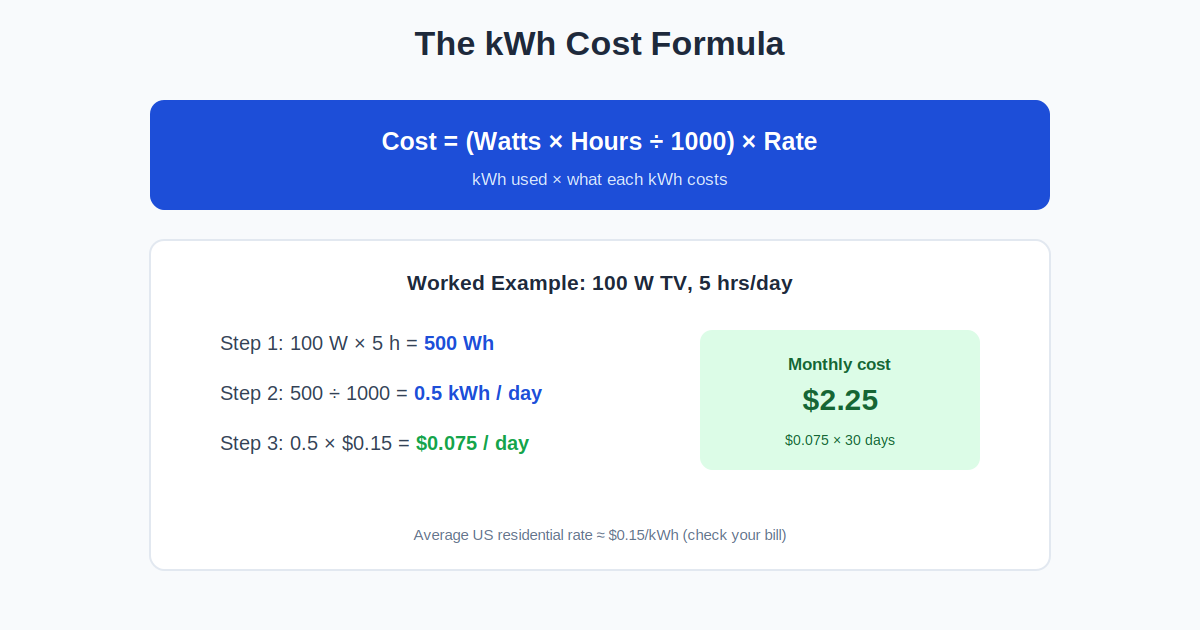
The math has two steps. First, energy: kWh per day = watts x hours / 1000. A 150-watt TV running 4 hours uses 150 x 4 / 1000 = 0.6 kWh daily. Second, cost: multiply by your rate. At 0.17 dollars per kWh, that TV costs about 10 cents a day, 3 dollars a month, 37 dollars a year. Small numbers — until you add every device in the house.
The surprises are heating and cooling: a 1500-watt space heater running 8 hours a day burns 12 kWh daily, costing over 60 dollars a month. Meanwhile your phone charger at 10 watts costs pennies a year. Focus efficiency efforts where the watts are.
Worked Example
A 150-watt LED TV, 4 hours daily, at 0.17 dollars per kWh. Daily energy: 150 x 4 / 1000 = 0.6 kWh. Daily cost: 0.6 x 0.17 = 0.102 dollars. Monthly: 0.102 x 30 = 3.06 dollars. Yearly: 0.102 x 365 = 37.23 dollars. Select the TV preset above with 4 hours to confirm.
What Common Appliances Cost to Run
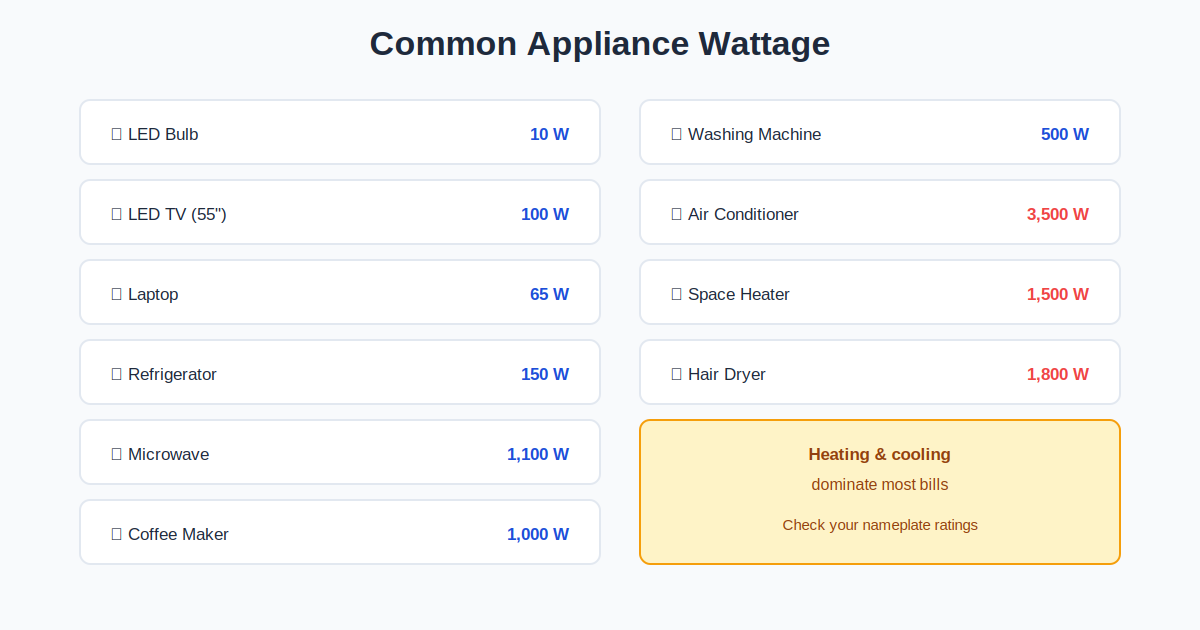
This table uses the same preset wattages as the calculator above, priced at the US average rate of $0.17 per kWh, so you can reproduce every figure in the tool. The last column assumes 8 hours of use a day for 30 days — scale it to your real usage.
| Appliance | Watts | Cost per hour | 8 hrs/day, per month |
|---|---|---|---|
| Space heater | 1,500 W | 25.5 cents | $61.20 |
| Hair dryer | 1,200 W | 20.4 cents | $48.96 |
| Microwave | 1,000 W | 17.0 cents | $40.80 |
| Toaster oven | 800 W | 13.6 cents | $32.64 |
| Refrigerator (average draw) | 500 W | 8.5 cents | $20.40 |
| Desktop computer | 300 W | 5.1 cents | $12.24 |
| TV, LED 55 inch | 150 W | 2.6 cents | $6.12 |
| Light bulb, LED equivalent | 60 W | 1.0 cent | $2.45 |
| Phone charger | 10 W | 0.2 cents | $0.41 |
The pattern matters more than any single row: anything that makes heat (space heater, hair dryer, oven) costs 10 to 100 times more per hour than electronics. An hour of space heating costs about as much as 25 hours of TV.
Finding Your Real Electricity Rate
The rate printed in your plan's headline is rarely the rate you actually pay, because the bill adds delivery charges, taxes, and fixed fees on top of the energy charge. For accurate results in this calculator, work out your all-in rate: take the total amount of your last bill and divide it by the kilowatt-hours you used. If your bill was $153 for 900 kWh, your real rate is $0.17 per kWh — even if the advertised energy charge was lower. Residential rates average roughly $0.16 to $0.18 per kWh across the US but vary widely by state, so your own bill is always the better source. One more caveat: plugged-in devices draw a small standby ("vampire") load around the clock, which this active-use estimate does not include — for most homes it adds another 5 to 10 percent.
Frequently Asked Questions
What uses the most electricity in a home?
Heating and cooling typically top the list (40-50 percent of bills), followed by water heating, then large appliances like dryers and refrigerators. Space heaters are the worst per-hour offenders.
How do I find an appliance wattage?
Check the label on the device or its power adapter — it lists watts (W) or volts x amps. If only amps are shown, watts = volts x amps (120V in the US).
What is a kilowatt-hour?
One kWh is 1,000 watts used for one hour. Utilities bill in kWh because it measures total energy, not just power draw.
Does leaving things plugged in waste electricity?
Yes — "vampire" standby draw from TVs, chargers, and consoles can add 5-10 percent to a bill. Power strips make it easy to cut them off.
How can I lower my electricity bill?
Switch to LED bulbs, use a programmable thermostat, wash in cold water, air-dry clothes when possible, and replace the oldest, least efficient appliances first.
How much does it cost to run a space heater?
A typical 1,500-watt space heater costs about 26 cents per hour at $0.17 per kWh. Run it 8 hours a day and that is $2.04 a day — about $61 a month — which is why space heaters are usually the first suspect when a winter bill spikes.
How many kWh does an average home use per day?
A typical US home uses roughly 30 kWh per day (about 900 kWh per month), though it ranges from under 15 kWh for a small apartment to 50 kWh or more for a large house with electric heating or air conditioning. For your own figure, divide the kWh total on your bill by the number of days in the billing period.
Related Calculators
Looking at the cost side of the same numbers? The Electricity Cost Calculator focuses on the total bill. To work out the savings percentage from an efficiency upgrade, use the Percentage Calculator.