Calculate the true Annual Percentage Rate (APR) of any loan including fees and compounding.

What Is an APR Calculator?
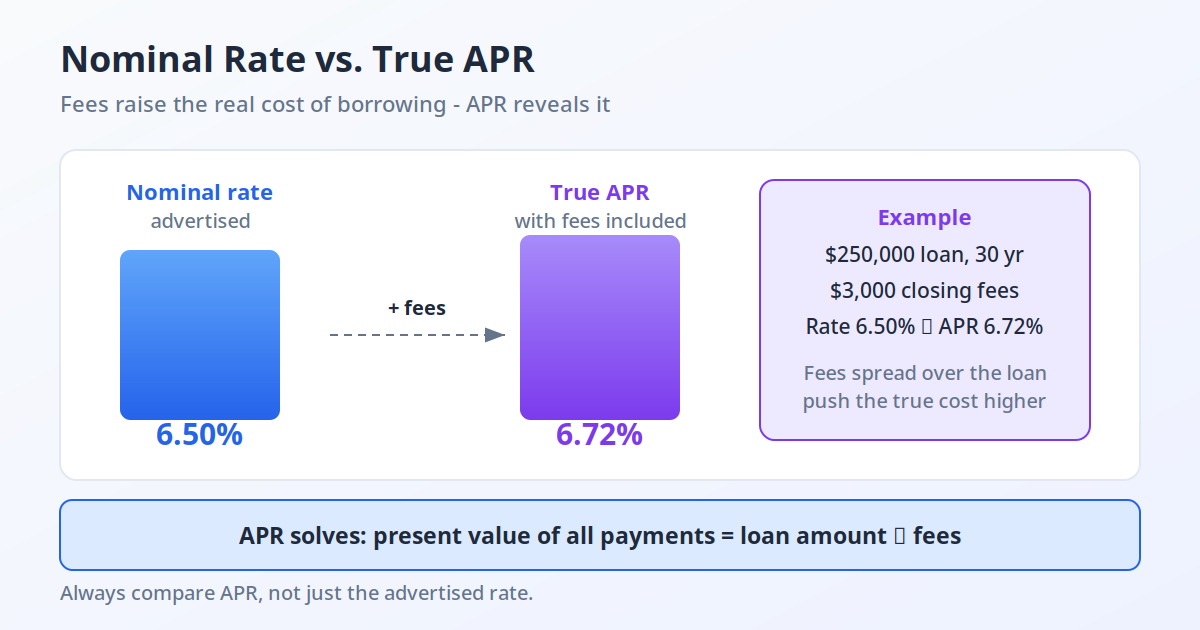
When lenders advertise a loan, the interest rate they quote is only part of the story. Origination fees, closing costs, discount points, and other upfront charges can add thousands of dollars to what you actually pay, yet none of them show up in that headline rate. The Annual Percentage Rate, or APR, solves this problem by folding the interest rate and most upfront fees into one annualized percentage. An APR calculator runs this computation for you, revealing the true yearly cost of borrowing so you can compare competing loan offers on equal footing.
The APR exists because of consumer-protection law. In the United States, the Truth in Lending Act requires lenders to disclose the APR on most consumer loans, precisely so borrowers are not misled by a low nominal rate hiding expensive fees. A loan advertised at 6% with $4,000 in fees may carry an APR of 6.6%, while a competing loan at 6.4% with no fees has an APR of 6.4% and is actually the cheaper deal. Without computing the APR, you would likely pick the wrong loan.
How to Use This APR Calculator
Getting an accurate APR takes less than a minute. Follow these steps:
- Enter the loan amount. This is the principal you are borrowing, for example $300,000 for a mortgage or $25,000 for a car loan. Enter the amount actually financed, after any down payment.
- Enter the nominal interest rate. Use the annual rate quoted by the lender, such as 6.5%. This rate sets your monthly payment before fees are considered.
- Enter the loan term. Use the repayment period in months or years: 360 months for a 30-year mortgage, 60 months for a typical auto loan.
- Enter upfront fees. Add origination fees, closing costs, discount points, and documentation charges. These are the costs that push the APR above the nominal rate.
- Click Calculate. The tool computes your monthly payment from the nominal rate, then solves for the APR that equates the present value of those payments to the cash you actually receive.
- Compare the results. Note the APR, monthly payment, total interest, and total loan cost. Repeat with a competing offer to see which loan is genuinely cheaper.
How APR Is Calculated
The APR is the annualized discount rate that makes the present value of all future loan payments exactly equal to the money you actually receive on day one: the loan amount minus upfront fees. In plain terms, it is the single interest rate that, applied to your net cash received, reproduces your payment schedule. Because fees reduce the cash you receive without reducing your payments, the APR is almost always higher than the nominal interest rate.
Mathematically, the APR is the periodic rate i satisfying: Amount Received = PMT/(1+i) + PMT/(1+i)^2 + … + PMT/(1+i)^n, where PMT is the monthly payment from the nominal rate and n is the number of payments. Since the unknown rate sits inside exponents, no simple algebra isolates it, so this APR calculator uses Newton-Raphson iteration to converge on the precise rate.
Consider a $200,000 mortgage at 6% nominal for 30 years with $5,000 in closing costs. The $1,199 monthly payment is computed on the full $200,000, but you effectively receive only $195,000. The rate equating $195,000 today with 360 payments of $1,199 is about 6.24% per year: that is the APR, and it is the number to use when comparing offers.
The APR Formula
Amount Financed = sum of PMT / (1+i)^t for t = 1 to n; then APR = i x 12 x 100. The calculator derives PMT from the nominal rate via the amortization formula, then solves for i by iteration.
Variables Explained
- Loan amount (P): principal borrowed, before fees are deducted.
- Nominal interest rate: the lender’s quoted annual rate, which sets the payment.
- Upfront fees (F): origination, closing, points, and documentation charges; amount received equals P minus F.
- Term (n): total number of monthly payments.
- Monthly payment (PMT): computed from P, the nominal rate, and n.
Limitations of APR
APR assumes a fixed rate and on-time payments for the full term. It understates adjustable-rate mortgages that reset higher, and overstates cost if you refinance or sell early, since fees spread over fewer years raise the effective rate sharply. Some third-party charges may be excluded from the legal APR figure, and APR ignores tax effects like mortgage-interest deductibility. Use it to compare similar loans, not as a complete affordability measure.
Worked Example: Two Competing Auto Loans
You are financing $25,000 over 60 months. Lender A offers 6.9% with a $495 origination fee plus $200 documentation fee ($695 total). Lender B offers 7.2% with zero fees. Which is cheaper?
For Lender A, the monthly payment at 6.9% nominal is about $494.16, and you receive $25,000 – $695 = $24,305. Solving the present-value equation gives an APR of about 7.34%: the fees add roughly 0.44 points to the effective rate. Lender B’s APR is simply 7.20%, since there are no fees.
| Lender A | Lender B | |
|---|---|---|
| Loan amount | $25,000 | $25,000 |
| Nominal rate | 6.9% | 7.2% |
| Upfront fees | $695 | $0 |
| Monthly payment | $494.16 | $497.70 |
| APR | 7.34% | 7.20% |
| Total cost | $30,344.60 | $29,862.00 |
Despite the lower advertised rate, Lender A costs about $483 more overall. This is exactly the trap an APR calculator helps you avoid: the nominal rate is marketing, the APR is the math.
Practical Tips for Comparing Loan APRs
When you line up competing offers, make sure every APR you compare was computed the same way: same term, same fee inclusions, same payment timing. A 15-year and a 30-year mortgage will show very different APRs even at identical nominal rates, because fees amortize faster over the shorter term. If you expect to refinance or sell within a few years, ask each lender for the APR-equivalent cost over your actual holding period; the headline 30-year APR understates what short-term borrowers really pay.
Watch for lender credits that offset fees. A “no closing cost” loan is not free: the lender typically charges a higher nominal rate to fund the credit, and the APR captures this trade-off honestly. Run the calculator twice, once with the credit entered as a negative fee, to see whether the higher rate or the upfront cash costs you more. Finally, never compare a fixed-rate APR against an adjustable-rate APR at face value; the ARM figure usually reflects only the introductory period and will understate your likely cost if rates rise.
How Fees Move the APR: A $200,000 Mortgage at 6%
Fees are the whole difference between the interest rate and the APR, and their effect is easy to underestimate because a few thousand dollars looks small next to a loan. For a $200,000, 30-year mortgage at a 6% nominal rate (monthly payment $1,199.10), here is how upfront fees change the APR:
| Upfront fees | Net amount received | APR | Spread over 6% rate |
|---|---|---|---|
| $0 | $200,000 | 6.000% | — |
| $2,000 | $198,000 | 6.094% | +0.094 |
| $3,000 | $197,000 | 6.142% | +0.142 |
| $5,000 | $195,000 | 6.238% | +0.238 |
| $8,000 | $192,000 | 6.385% | +0.385 |
Two lessons: fees spread over a 30-year term move the APR modestly, but the same fees on a 5-year loan would move it roughly six times as much, because there are fewer payments to absorb them. That is why short-term loans with “low rates” and high fees deserve the closest APR scrutiny.
Frequently Asked Questions
What is the difference between APR and interest rate?
The interest rate is the percentage charged on the loan balance to compute your payment; it ignores fees. The APR starts from that payment and asks what annualized rate, applied to the cash you actually receive after fees, would produce it. Because fees shrink the amount received, APR is higher than the nominal rate whenever upfront charges exist, and identical when they do not.
Why is my APR higher than the rate my lender quoted?
The quoted rate prices only the borrowed principal. The APR additionally spreads your upfront fees, such as origination, points, and closing costs, across the loan term as an annualized cost. The more fees you pay, the wider the gap. A large gap signals you should scrutinize the fee breakdown, not necessarily reject the loan.
Which fees are included in the APR?
Generally, charges the lender requires as a condition of the loan: origination fees, discount points, mortgage insurance premiums, and prepaid interest. Third-party charges like appraisals, title searches, and credit reports may or may not be included depending on jurisdiction. When comparing APRs, confirm both lenders used the same inclusions.
Can I use this APR calculator for credit cards?
Not directly. Credit-card APRs reflect a nominal periodic rate with no fixed payoff schedule and no amortized upfront fees. This tool is designed for installment loans, such as mortgages, auto loans, and personal loans, where a fixed payment schedule and upfront fees make the APR computation meaningful.
What is a good APR right now?
It depends on loan type, credit score, and market conditions. Borrowers with strong credit should look for mortgage APRs within about 0.25 to 0.5 points of the best advertised nominal rates. The real question is comparative: get three quotes, compute each APR, and pick the lowest total cost.
Do discount points lower the APR?
Paying points usually raises the disclosed APR, because points are an upfront fee. Points lower your nominal rate and monthly payment, and they pay off if you keep the loan long enough for monthly savings to exceed the upfront cost. Use the calculator with and without points to see the trade-off and find the break-even point.
Is the loan with the lowest APR always the best choice?
For otherwise identical loans, yes. But APR does not capture everything: a lower-APR loan with a higher monthly payment could strain your budget, and if you will sell or refinance early, a no-fee loan at a slightly higher APR often wins in practice. Compare APR first, then sanity-check against your plans.
How do I compare a 15-year and a 30-year mortgage by APR?
A 15-year loan almost always shows a lower APR than a 30-year loan at the same nominal rate, because identical fees are spread over fewer payments and the rate itself is usually lower. But APR alone should not drive the choice: the 15-year loan’s monthly payment is much higher, which affects your cash flow and emergency reserves. Compare APRs within the same term first, then weigh the payment difference separately.
What is APR?
APR stands for Annual Percentage Rate. It represents the true yearly cost of borrowing, expressed as a percentage, and it includes not just the nominal interest rate but also most lender fees and closing costs. Because of this, the APR is usually slightly higher than the stated interest rate and gives you a fairer way to compare loan offers.
How do you calculate APR manually?
To calculate APR manually, you find the discount rate that makes the present value of all future loan payments equal to the amount you actually receive (loan amount minus upfront fees). In practice this requires iteration, which is why the APR formula is normally solved with a calculator or spreadsheet rather than by hand. Our tool does this math for you instantly.
What is the difference between APR and APY?
APR annualizes the periodic rate without compounding it (monthly rate × 12), which is the legal standard for loan disclosures. APY (annual percentage yield) does compound: APY = (1 + APR/12)^12 − 1, so a 6.24% APR corresponds to a 6.42% APY. Lenders quote APR for loans; banks quote APY for savings accounts, where compounding works in your favor.
Related Calculators
Try our Mortgage Calculator, Loan Calculator, and Compound Interest Calculator.
Related: Interest Rate Calculator, Estate Tax Calculator.