a² + b² = c² — enter any two sides of a right triangle to find the third.
Results are estimates for planning purposes and are not financial, medical, or professional advice.
How to Use the Pythagorean Theorem Calculator
The Pythagorean theorem is one of the most famous formulas in mathematics. Enter the two sides you know and get the missing side in one click.
- Identify the two known sides: the two legs, or one leg and the hypotenuse (c).
- Type them into the boxes, in any unit.
- Leave the unknown side blank.
- Click Calculate for the missing side length.
Pythagorean Theorem Calculator Formula
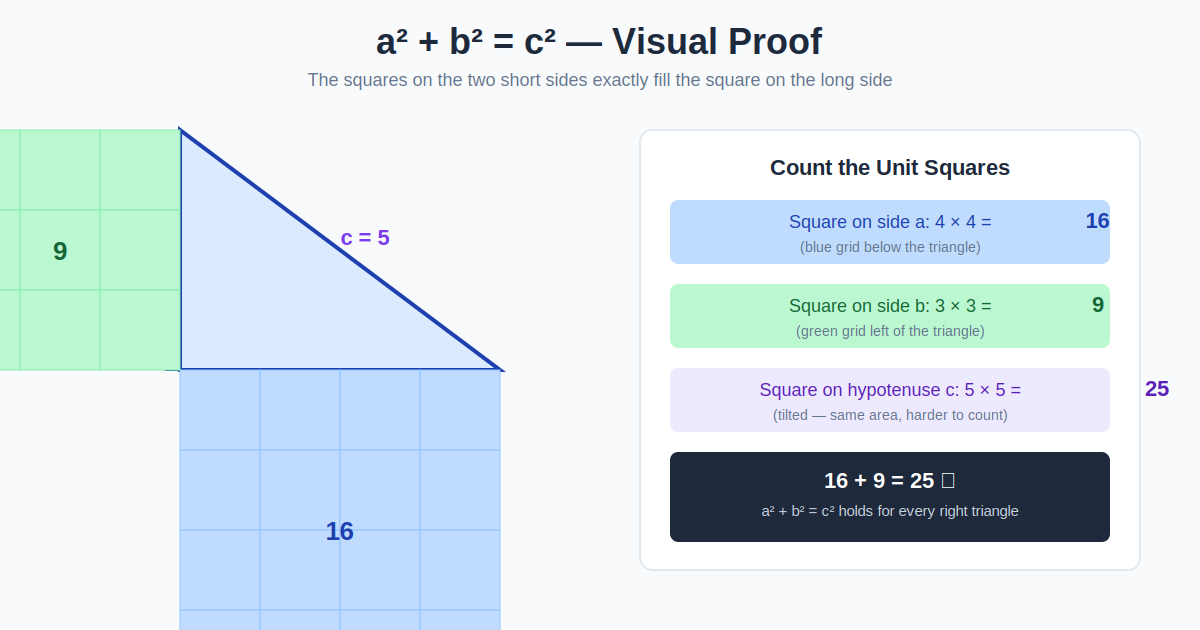
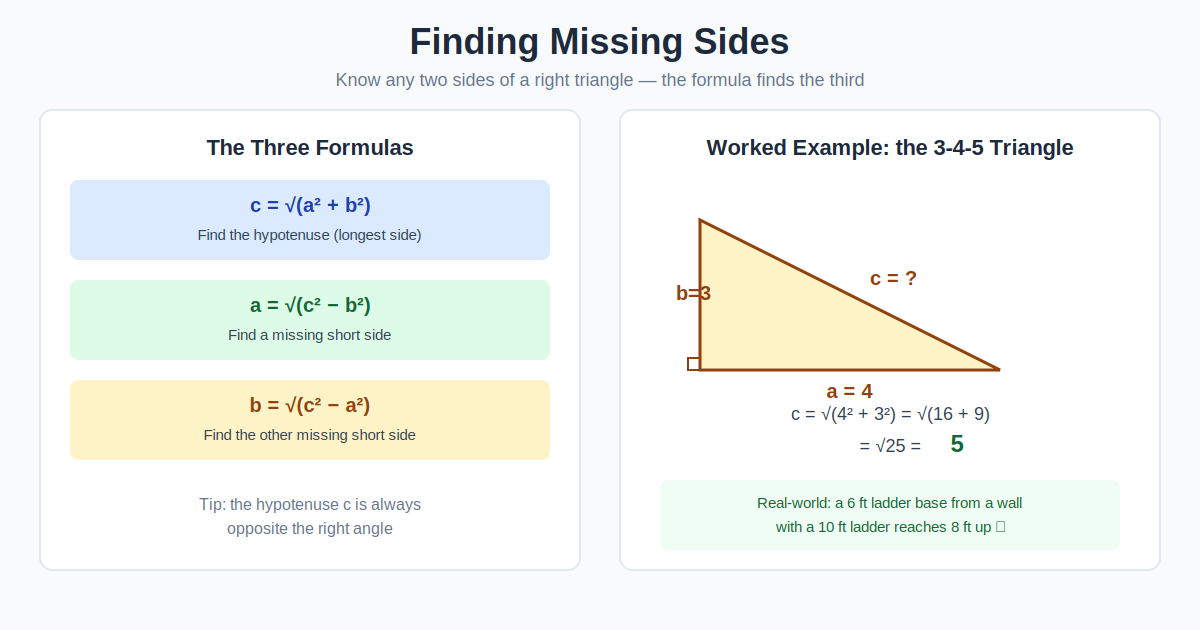
In a right triangle, the hypotenuse squared equals the sum of the squares of the two legs: a squared plus b squared equals c squared, where c sits opposite the right angle. With both legs, the hypotenuse is the square root of (a squared plus b squared). With the hypotenuse and one leg, the missing leg is the square root of (c squared minus the known leg squared) – always subtract here, since adding is the most common error. Babylonian tablets and Egyptian surveyors used this relationship over a thousand years before Pythagoras lived.
Example Calculation
A 10-foot ladder stands 6 feet from a wall. How high does it reach? The ladder is the hypotenuse (c = 10) and the base is one leg (b = 6), so the height is the square root of (100 minus 36) – the square root of 64, which is 8 feet. Enter 10 and 6, leaving leg a blank, to confirm.
The Converse: Testing Whether a Triangle Is Right
The theorem also runs backwards: if the square of the longest side equals the sum of the other two squares, the triangle is right-angled. Builders use this 3-4-5 check to confirm a corner is square before concrete is poured.
Pythagorean Triples Worth Memorizing
Some right triangles have whole-number sides: 3-4-5 (9 plus 16 equals 25), 5-12-13 (25 plus 144 equals 169), 8-15-17 (64 plus 225 equals 289), and 7-24-25 (49 plus 576 equals 625). Multiples of a triple also work, so 6-8-10 and 9-12-15 behave like 3-4-5 at any scale.
From the Theorem to the Distance Formula
The distance formula is the theorem in different clothes: between two points, the horizontal and vertical gaps are the legs, and the distance is the hypotenuse. For (1, 2) and (4, 6), the gaps are 3 and 4, so the distance is the square root of (9 plus 16) – exactly 5.
Frequently Asked Questions
What is the Pythagorean theorem used for in real life?
Builders use it to square up foundations, navigators use it for straight-line distances, and it appears in physics, graphics, and engineering wherever right triangles appear.
Can I use this calculator on a triangle that is not a right triangle?
No – the formula only holds when one angle is exactly 90 degrees. For other triangles, use the law of sines or the law of cosines.
What should I enter if I know the hypotenuse and one leg?
Enter the hypotenuse as c and the known leg as a or b, then solve for the remaining leg. The calculator subtracts the squares instead of adding them.
What is a Pythagorean triple?
Three whole numbers that satisfy the theorem, such as 3-4-5 or 5-12-13 – handy for quick mental checks of your work.
Why does my answer have so many decimal places?
Most hypotenuses are irrational, so the decimal never ends. Rounding to two or three decimal places is standard for practical work.
What is the converse of the Pythagorean theorem?
If the longest side’s square equals the sum of the other two squares, the triangle is right. Builders use this as the 3-4-5 squaring check.
How is the distance formula related to the Pythagorean theorem?
The horizontal and vertical gaps between two points are its legs, and the distance is the hypotenuse: the square root of (change in x squared plus change in y squared).
Related Calculators
Try our Triangle Calculator and Slope Calculator for more geometry tools.