Calculate your accumulated sleep debt and how long recovery will take.
How to Use the Sleep Debt Calculator
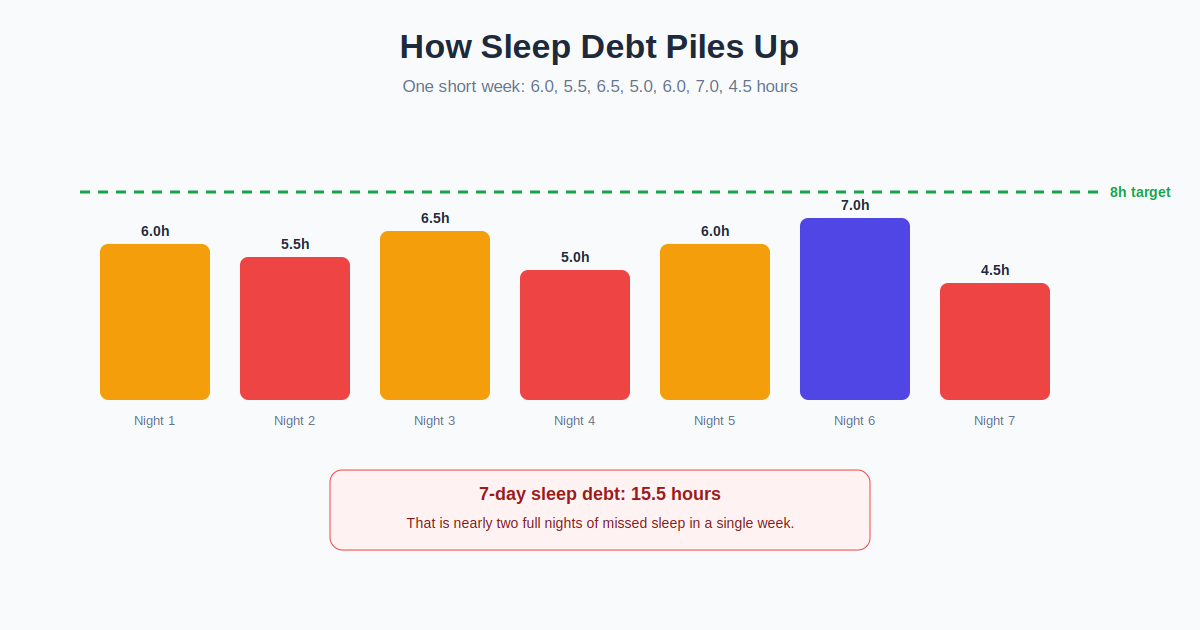
Sleep loss accumulates like financial debt — five short nights leave you functioning like someone legally drunk, even if you feel ‘used to it.’ This calculator totals your sleep deficit and maps a realistic recovery plan.
- Enter your nightly sleep need (most adults need 7–9 hours).
- Enter your average actual sleep per night, and the number of nights you have kept roughly that pattern.
- See your total sleep debt in hours, your average nightly shortfall, and the cognitive equivalent.
- Get a payback schedule: extra sleep per night to clear the debt without wrecking your schedule.
Sleep Debt Formula
Sleep debt is the cumulative gap between sleep needed and sleep obtained. Each night’s deficit equals your sleep need minus actual sleep; total debt is the sum across days. Miss 90 minutes nightly for a week and you have accumulated 10.5 hours of debt — the research-backed equivalent of pulling an all-nighter in terms of reaction time and decision quality, even though you never stayed up all night at once.
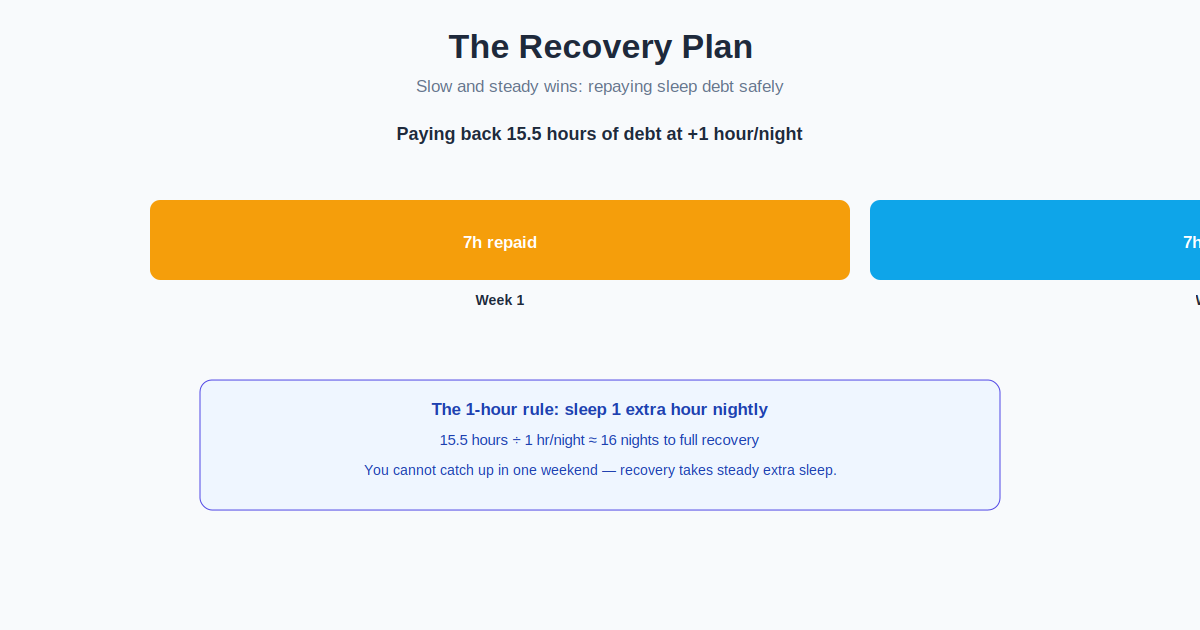
Recovery is not one-to-one. You cannot repay a week of short sleep with one 14-hour marathon — the body caps catch-up sleep, and oversleeping disrupts circadian rhythm. Studies suggest repaying over several nights at 1–2 extra hours per night, plus protecting a consistent wake time, clears debt fastest. One all-nighter wipes out the equivalent of about a week of mild restriction, which is why chronic short sleepers test as impaired as the totally sleep-deprived while insisting they feel fine — the subjective feeling adapts, but performance does not.
Example Calculation
David needs 8 hours but slept 6, 6.5, 5.5, 7, 6, 5, and 8 hours over the past week — 44 hours total against a 56-hour need. Sleep debt: 12 hours. Research equates this to the impairment of staying awake 24+ hours straight: reaction times slow ~30%, and risky decisions increase. The recovery plan: add 90 minutes nightly for 8 nights (12 ÷ 1.5 = 8) while keeping his 7 AM wake time fixed, rather than one weekend sleep-a-thon that would only recover a fraction and shift his body clock.
How Much Sleep You Need by Age — and How Long Recovery Takes
The calculator’s first input — your nightly sleep need — should come from guidance, not guesswork. The National Sleep Foundation recommends 9 to 11 hours for school-age children, 8 to 10 for teenagers, 7 to 9 for adults, and 7 to 8 for adults 65 and older.
Recovery is then simple division: total debt divided by extra sleep per night equals recovery nights. A 10-hour debt at 1 extra hour a night takes 10 nights; at 90 extra minutes, about a week. Adding time gradually beats a weekend binge — sleeping far past your wake time shifts your body clock, the social jetlag behind rough Monday mornings.
Frequently Asked Questions
Can you really catch up on sleep?
Partially. Extra sleep over several nights repays most of a short-term debt, but chronic restriction causes deficits — metabolic and cognitive — that weeks of normal sleep may not fully reverse. Consistency beats catch-up.
How much sleep do I actually need?
Most adults need 7–9 hours; teenagers 8–10. The real test: do you wake without an alarm feeling rested, and stay alert through a boring afternoon meeting? If not, you need more than you are getting.
Is 6 hours of sleep enough if I feel fine?
Probably not. In lab studies, people restricted to 6 hours for two weeks performed as badly as those kept awake 48 hours — yet rated themselves only slightly sleepy. Feeling adapted is not the same as performing well.
Does napping reduce sleep debt?
Yes — a 20–30 minute nap repays a slice of debt and boosts afternoon alertness without grogginess. Longer naps help more but can cause sleep inertia and steal from nighttime sleep.
Why do I sleep 10 hours on weekends?
That overshoot is your body collecting on the week’s debt. Regularly needing 2+ extra weekend hours is a reliable sign your weekday sleep is insufficient.
How long does it take to recover from sleep debt?
Divide your total debt by the extra sleep you add nightly: a 10-hour debt takes about 10 nights at one extra hour, or about a week at 90 extra minutes. One or two short nights clear quickly, but chronic debt built over months takes longer — studies find weeks of extended sleep before performance fully normalizes.
Can caffeine cancel out sleep debt?
No — caffeine masks sleep debt rather than repaying it. It blocks the adenosine signals that make you feel tired, so you feel alert while the debt and its effects remain. When it wears off, the tiredness returns at once — and caffeine lingers 8 to 10 hours, so a late coffee creates the next night’s debt.
Related Calculators
Try our BMI Calculator and Calorie Calculator for more calculations.