Convert °F, °C, and Gas Mark for any recipe.
How to Use the Oven Temperature Converter
American recipes speak Fahrenheit, the rest of the world speaks Celsius, and older British cookbooks speak Gas Mark. This converter translates instantly between all three scales so you can follow any recipe with the oven you own.
- Enter the temperature. Type the number exactly as the recipe states it.
- Choose the starting unit. Select Fahrenheit (°F), Celsius (°C), or Gas Mark — the tool detects which scale your number belongs to.
- Pick the target unit. Choose the scale your oven dial uses.
- Read the converted value. The result appears rounded to a practical oven setting, since most dials move in 5–10 degree steps anyway.
Oven Temperature Converter Formula
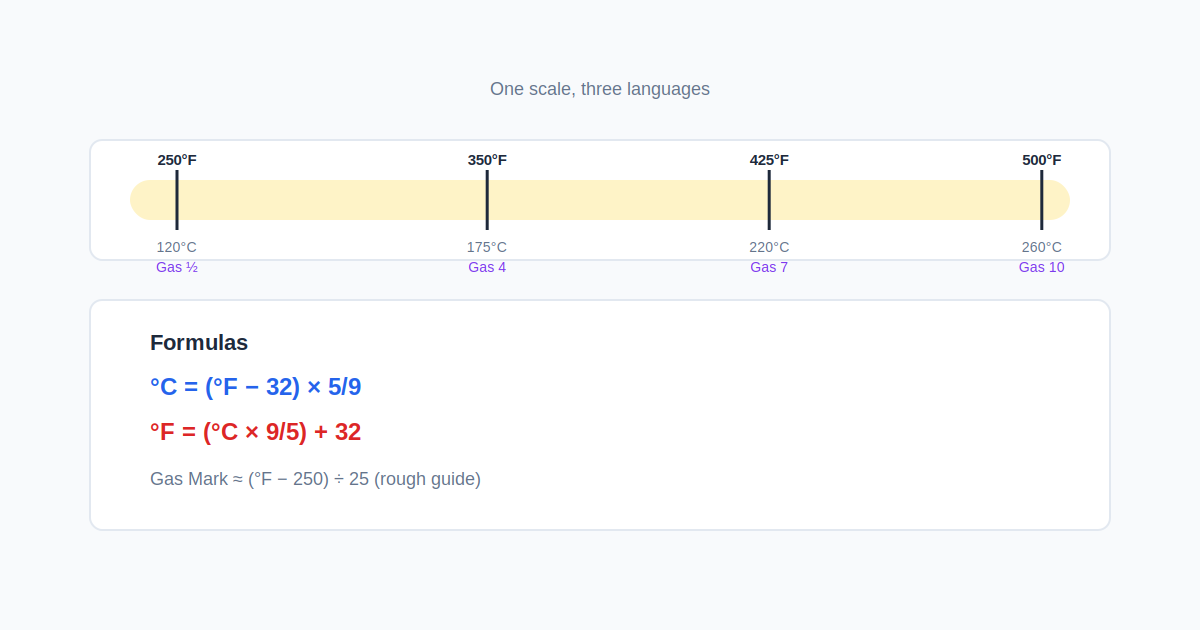
Fahrenheit and Celsius are linked by two simple formulas: °C = (°F − 32) × 5/9 and °F = °C × 9/5 + 32. The 32 accounts for the different zero points (water freezes at 32°F but 0°C), and the 5/9 ratio reflects the different degree sizes (180 Fahrenheit degrees span the same range as 100 Celsius degrees between freezing and boiling).
Gas Mark is the older British scale, invented for gas ovens with numbered dials. It runs from Gas Mark 1 (275°F / 140°C, very slow) to Gas Mark 9 (475°F / 245°C, very hot). The steps are roughly 25°F apart, which is why conversions land on round numbers: Gas Mark 4 is the beloved 350°F / 180°C that anchors countless recipes. Our converter uses the standard Gas Mark table rather than a formula, since the scale is defined by convention.
In practice, ovens are imprecise instruments — most run 15–25°F hot or cold, and dial markings are approximate. So while the converter gives exact mathematical equivalents, rounding to the nearest 5 or 10 degrees is perfectly fine. An inexpensive oven thermometer hung from the rack tells you more about your actual baking conditions than any conversion ever will.
Oven Temperature Conversion Chart
Keep this ladder handy — it covers every standard oven setting. The Celsius column uses the rounded values recipes actually print, and the fan column applies the standard rule of thumb explained below.
| Gas Mark | Fahrenheit | Celsius (conventional) | Celsius (fan) | Typical use |
|---|---|---|---|---|
| 1 | 275°F | 140°C | 120°C | Slow casseroles, meringues |
| 2 | 300°F | 150°C | 130°C | Rich fruit cakes |
| 3 | 325°F | 165°C | 145°C | Sponge cakes, slow roasts |
| 4 | 350°F | 180°C | 160°C | Most baking and roasting |
| 5 | 375°F | 190°C | 170°C | Roasting, scones, pies |
| 6 | 400°F | 200°C | 180°C | Roast potatoes, pastry |
| 7 | 425°F | 220°C | 200°C | Puff pastry, bread |
| 8 | 450°F | 230°C | 210°C | Bread, pizza |
| 9 | 475°F | 245°C | 225°C | Hottest setting on most home ovens |
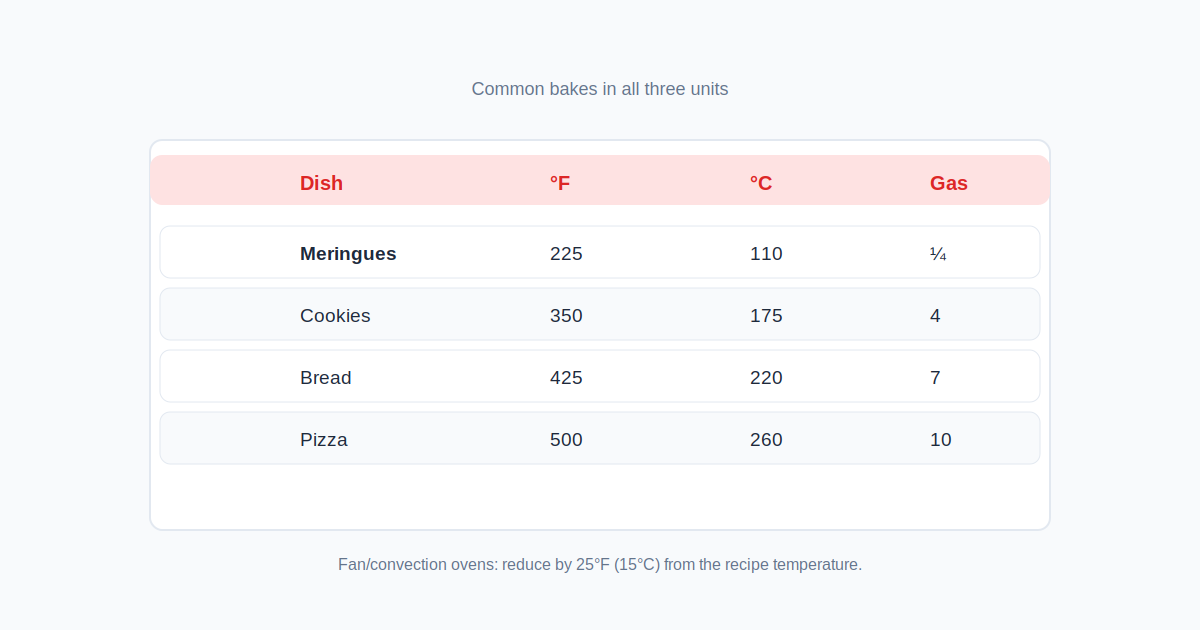
Very low settings exist too: Gas Mark ¼ (225°F / 110°C) for drying herbs and meringues, and Gas Mark ½ (250°F / 120°C) for the slowest cooking.
Example Calculation
A classic American cookie recipe calls for 350°F. Converting to Celsius: (350 − 32) × 5/9 = 318 × 5/9 ≈ 177°C, which you would round to 180°C on a metric oven. On the Gas Mark scale, 350°F is exactly Gas Mark 4.
Going the other way: a French recipe says 200°C. Converting: 200 × 9/5 + 32 = 360 + 32 = 392°F, rounded to 400°F in practice — or Gas Mark 6. The 8-degree rounding difference is far smaller than your oven’s own inaccuracy.
Converting for a Fan (Convection) Oven
A fan oven circulates hot air, so it delivers heat to food more efficiently than a conventional oven at the same dial setting. The standard adjustment is simple: set the fan oven 20°C lower than the conventional temperature in the recipe (the chart above already includes this column). If the recipe was written in Fahrenheit for a conventional oven, convert to Celsius first, then subtract 20. In practice some manufacturers suggest 10°C and others 25°C, so if a recipe repeatedly over-browns, check your manual and split the difference. Also start checking for doneness about 10% earlier than the recipe states: for quick-cooked and surface-browned foods — biscuits, pastry, roast potatoes — the fan shortens the effective time. Long, slow dishes barely notice the difference.
What Temperature Does Each Dish Need?
When a recipe names a dish but no temperature, these are the settings bakers reach for. All values are for conventional ovens; subtract 20°C for fan.
| Dish | Fahrenheit | Celsius |
|---|---|---|
| Meringues and macarons | 200–275°F | 95–135°C |
| Cheesecake | 325°F | 165°C |
| Cakes and cupcakes | 325–350°F | 165–175°C |
| Cookies | 350–375°F | 175–190°C |
| Muffins and quick breads | 350–400°F | 175–200°C |
| Pies | 375–425°F | 190–220°C |
| Bread | 400–450°F | 200–230°C |
| Pizza | 450–500°F | 230–260°C |
Frequently Asked Questions
What is Gas Mark?
The traditional British oven scale for gas ovens, numbered 1–9. Gas Mark 4 (350°F / 180°C) is the most common moderate-oven setting. It predates thermostatic electric ovens and survives in older UK cookbooks.
Should I round converted temperatures?
Yes. Oven dials and thermostats work in coarse steps, and most ovens are off by ±15°F anyway. Round to the nearest 5°C or 10°F — the difference is negligible in real baking.
Do I need to adjust for a convection (fan) oven?
Generally set the fan oven about 20°C lower than the conventional temperature (some manuals suggest 10–25°C), or follow your oven’s built-in conversion. Convection’s circulating air transfers heat more efficiently, so food cooks faster and browns more at the same setting.
Why is 350°F (180°C) so common in recipes?
It is the sweet spot for most baking: hot enough to set structure and brown surfaces through the Maillard reaction, gentle enough not to burn outsides before insides cook. Generations of recipes were calibrated around it.
How do I know if my oven is accurate?
Hang an inexpensive oven thermometer on the middle rack, preheat for 20 minutes, and compare. If it reads consistently high or low, adjust all recipe temperatures by that offset — this matters more than any conversion.
What does a ‘moderate oven’ mean in old recipes?
Older cookbooks often describe heat in words instead of numbers. As a guide: a very slow oven is about 225–275°F (110–140°C, Gas Mark ¼–1), a slow oven 300–325°F (150–165°C, Gas Mark 2–3), a moderate oven 350–375°F (180–190°C, Gas Mark 4–5), a hot oven 400–450°F (200–230°C, Gas Mark 6–8), and a very hot oven 475°F and above (245°C+, Gas Mark 9). When in doubt, moderate — 350°F / 180°C / Gas Mark 4 — is the safe default for most baking.
What is 200°C in Fahrenheit?
200°C is exactly 392°F (200 × 9/5 + 32). Because Fahrenheit oven dials step in 25-degree marks, you would set 400°F in practice. On the Gas Mark scale, 200°C is Gas Mark 6 — the standard setting for roast potatoes and pastry.
Related Calculators
Try our Cooking Time Converter to rescale cooking times by weight, or the Cooking Measurement Converter for cups, grams, and spoons.