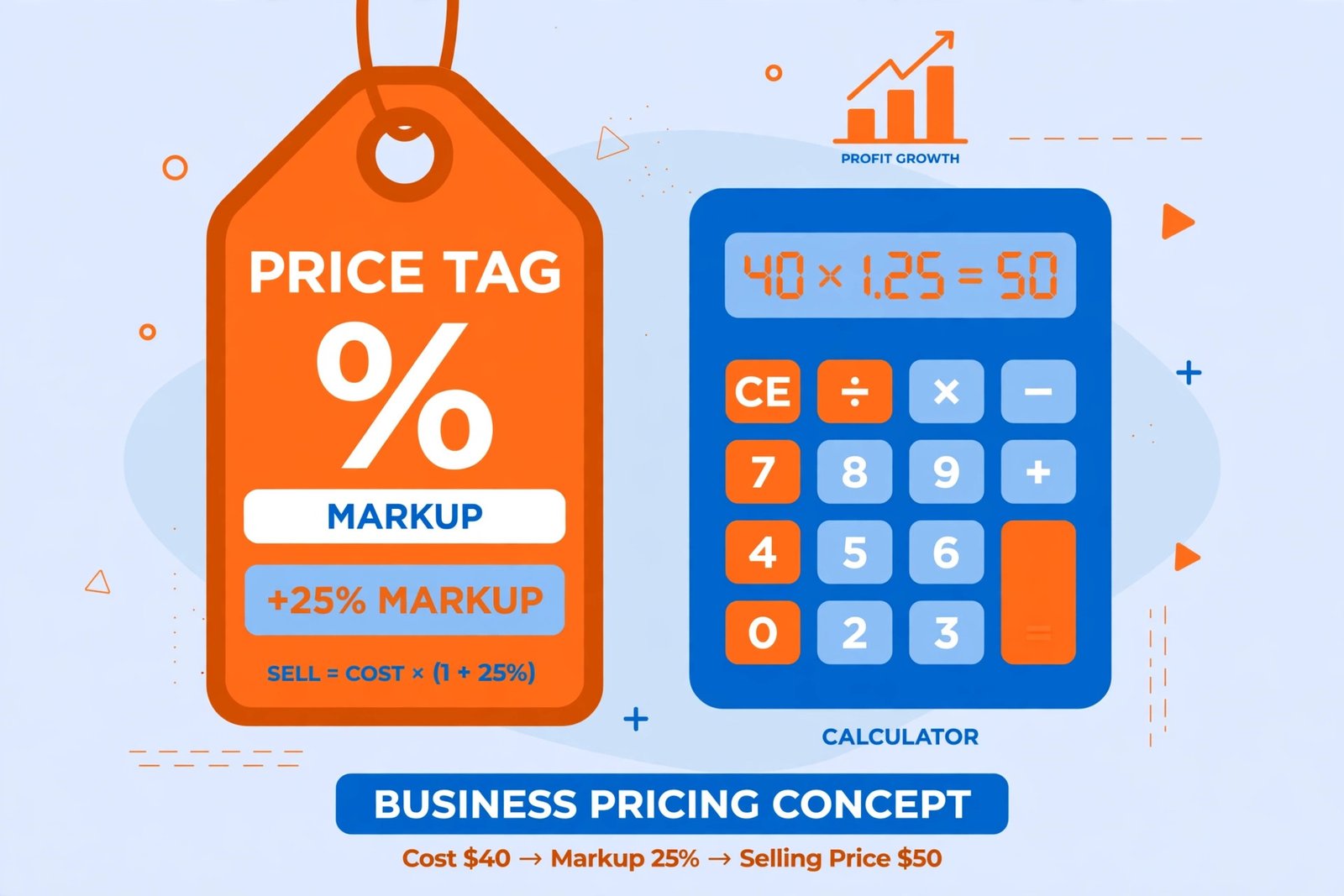
What Is Markup?
Markup is the amount added to the cost of a product to arrive at its selling price. If you buy a widget for $40 and sell it for $60, your markup is $20. Expressed as a percentage, markup is always calculated on the cost price: $20 divided by $40 equals a 50% markup. Our markup calculator above computes this instantly, and also works in reverse — enter any selling price and cost to find the markup percentage.
Markup is the foundation of retail pricing. Every store, from corner shops to global chains, sets prices by adding a markup to what goods cost them. Understanding markup is essential whether you run a business, sell products online, or simply want to understand how prices are built.
Markup vs. Margin: The Critical Difference
Markup and margin are the most confused pair in business math, and mixing them up costs real money. Both describe profit, but they use different denominators.
Markup is profit as a percentage of cost. A $40 item sold for $60 has a $20 profit, which is 50% of the $40 cost.
Margin (profit margin) is profit as a percentage of the selling price. The same $20 profit is only 33.3% of the $60 selling price.
This means the same transaction always has a higher markup percentage than margin percentage. A 50% markup equals a 33.3% margin. A 100% markup (doubling the cost) equals a 50% margin. The two are never equal except at zero profit, yet business owners routinely quote one when they mean the other — a mistake that can silently erase expected profits.
| Markup % | Equivalent Margin % | Example ($40 cost) |
|---|---|---|
| 25% | 20.0% | Sell at $50 |
| 50% | 33.3% | Sell at $60 |
| 100% | 50.0% | Sell at $80 |
| 150% | 60.0% | Sell at $100 |
| 200% | 66.7% | Sell at $120 |
| 300% | 75.0% | Sell at $160 |
The conversion formulas: margin equals markup divided by (1 plus markup), and markup equals margin divided by (1 minus margin). So a 25% margin converts to a 33.3% markup, because 0.25 divided by 0.75 is 0.333.
The Markup Formulas
Three formulas cover every markup calculation you will ever need. Our calculator applies them automatically, but knowing them helps you sanity-check any price.
Selling price from cost and markup: Selling Price = Cost times (1 + Markup%). A $40 cost with 50% markup: $40 times 1.50 = $60.
Markup percentage from cost and price: Markup% = (Selling Price minus Cost) divided by Cost, times 100. A $60 price on a $40 cost: ($60 – $40) / $40 = 50%.
Cost from price and markup: Cost = Selling Price divided by (1 + Markup%). A $60 price with 50% markup: $60 / 1.50 = $40. This reverse formula is handy when a supplier quotes retail prices and you need to back out your cost basis.
A popular shortcut is the markup multiplier: Selling Price = Cost × Multiplier, where the multiplier is simply 1 plus the markup as a decimal. A 50% markup means a 1.5× multiplier, so a $40 cost becomes $40 × 1.5 = $60. A 150% markup is a 2.5× multiplier.
What Markup Percentages Are Typical?
Markup varies enormously by industry because it must cover each sector’s operating costs. Grocery stores run on thin markups of 10% to 25% but sell huge volumes. Clothing retailers typically mark up 100% to 200% (the classic “keystone” 100% markup doubles wholesale cost). Restaurants mark up food 200% to 400% to cover labor, rent, and waste — that $4 coffee cost under $1 to make. Jewelry and furniture often carry 100% to 300% markups, while electronics are notoriously thin at 5% to 15%.
Services price differently: consultants and agencies often target 50% to 100% markup on labor cost to cover overhead and profit. Digital products like software and ebooks can sustain 500%+ markups because the marginal cost of each sale is near zero. When setting your own markup, research competitors first — price too high and you lose sales, too low and you work for nothing.
Trades and services cluster lower than retail because labor, not merchandise, dominates their costs. General contractors typically add 10% to 30%, electricians and handymen 15% to 35%, and plumbers, roofers, and HVAC contractors 20% to 40%, where liability exposure and material costs run highest. If you sell services, build your markup from labor cost plus overhead rather than copying a retail number.
Worked Examples
Example 1 — Basic markup: A boutique buys dresses at $35 wholesale and applies a 120% markup. Markup amount: $35 times 1.20 = $42. Selling price: $35 + $42 = $77. Margin: $42 / $77 = 54.5%.
Example 2 — Reverse calculation: A laptop sells for $899 and cost the retailer $720. Markup: ($899 – $720) / $720 = 24.9%. Margin: $179 / $899 = 19.9%. This thin margin is typical for electronics.
Example 3 — Target margin to markup: You want a 40% profit margin on handmade candles that cost $6 each. Convert margin to markup: 0.40 / (1 – 0.40) = 66.7% markup. Selling price: $6 times 1.667 = $10. If you had mistakenly used 40% as the markup, you would have priced at $8.40 and earned only a 28.6% margin — leaving real money on the table.
Example 4 — Contractor job (materials plus labor): A plumbing job costs $500 in materials and $400 in labor, a total cost of $900. Applying a 30% markup: $900 times 1.30 = $1,170 quoted price. Profit is $1,170 minus $900 = $270, and the margin is $270 divided by $1,170 = 23.1%. This is the classic trap: a 30% markup produces only a 23.1% margin, so quote with markup and judge the job with margin.
Common Markup Mistakes
The number one mistake is using markup and margin interchangeably, as Example 3 shows. Always clarify which one a supplier, partner, or course means. The second mistake is forgetting that markup must cover more than the product cost — shipping, packaging, payment processing fees, returns, and your own labor all belong in the “cost” figure, or your markup is an illusion. Third, many sellers set one markup for everything; smarter pricing varies markup by product based on demand, competition, and price sensitivity. Finally, never set prices and forget them — review markups quarterly as supplier costs change, or inflation will quietly eat your profits.
Markup Pricing Strategy
Smart sellers do not pick a markup number out of thin air — they build a pricing strategy. Start with your true all-in cost: product cost plus shipping, packaging, marketplace fees, payment processing (typically 2-3%), expected returns, and a share of overhead. Many beginners forget these extras and discover their “50% markup” is really 20% after fees.
Next, check what the market will bear. Search your product category and note the price range of comparable items. If competitors sell at $50 and your cost demands $55, you have a sourcing problem, not a pricing problem — either find cheaper supply or differentiate enough to justify a premium. Price positioning also signals quality: suspiciously cheap prices can actually reduce sales for premium goods.
Consider tiered markups across your catalog. Use lower markups on high-volume traffic drivers to attract customers, and higher markups on accessories, add-ons, and exclusive items where price sensitivity is lower. This is why printers are cheap and ink is expensive — the razor-and-blades model is markup strategy in action.
How Discounts Affect Your Markup
Planned promotions must be baked into your markup from the start. If you intend to run 20% off sales, a 50% markup leaves you with only a 20% effective markup during the sale — and possibly a loss after fees. Work backwards: decide the lowest price you will ever charge, ensure that price still covers costs with acceptable margin, then set your regular price higher to create discount headroom.
For example, if your cost is $40 and you never want to sell below $56 (a 40% markup floor), set the regular price at $70. A 20% sale then brings it exactly to $56. Customers love the deal, and you never sell at a loss. Businesses that discount without this math are the ones quietly going broke during every holiday sale.
Key Takeaways
Markup is profit measured against cost; margin is profit measured against price — learn both and never confuse them. Build prices from true all-in costs, verify against competitor pricing, leave headroom for planned discounts, and review your numbers quarterly. A disciplined approach to markup is one of the simplest ways to protect and grow your profits, whether you sell handmade crafts or run a retail chain.
Frequently Asked Questions
What is a good markup percentage?
It depends on your industry. Retail clothing often uses 100-200%, groceries use 10-25%, and restaurants use 200-400% on food. Research competitors in your niche and make sure your markup covers all costs plus your target profit.
How do I calculate markup on a product?
Subtract the cost from the selling price, divide by the cost, and multiply by 100. For a $60 selling price and $40 cost: ($60 – $40) / $40 times 100 = 50% markup.
What is the difference between markup and margin?
Markup is profit as a percentage of cost; margin is profit as a percentage of selling price. A $20 profit on a $40 cost sold at $60 is a 50% markup but only a 33.3% margin.
Can markup be more than 100%?
Yes, absolutely. A 100% markup simply means you doubled the cost. Markups of 200%, 300%, or more are common in jewelry, furniture, restaurants, and digital products.
How do I convert margin to markup?
Divide the margin by (1 minus the margin). A 40% margin converts to a 66.7% markup: 0.40 / 0.60 = 0.667.
Should I price based on markup or margin?
Use markup when setting prices from known costs (simple and practical). Use margin when analyzing profitability or comparing against industry benchmarks, since financial statements report margins. Understand both and convert freely between them.
How do I convert markup to margin?
Divide the markup by (1 plus the markup). A 50% markup becomes 0.50 ÷ 1.50 = 33.3% margin, and a 100% markup becomes 1.00 ÷ 2.00 = 50% margin. To go the other way, divide the margin by (1 minus the margin): a 25% margin equals 25 ÷ 75 = 33.3% markup.
What markup do contractors typically charge?
Most trades work between 10% and 40%: general construction runs 10-30%, electrical and handyman services 15-35%, and plumbing, roofing, and HVAC 20-40%, where liability and material costs are highest. Base your figure on your overhead and the labor-to-materials mix of each job.