Convert numbers between binary, octal, decimal and hexadecimal.
Results are estimates for planning purposes and are not financial, medical, or professional advice.
How to Use the Binary Converter
Binary is the number system computers run on: ones and zeros only. This converter turns a number between binary, octal, decimal, and hexadecimal, showing all four.
- Type the number.
- Select its current base.
- Press Calculate to see it in all four bases.
Binary Converter Formula
Each base uses place values that are powers of the base. To read binary as decimal, multiply each bit by its power of two and add, so 1011 equals 11. For decimal to binary, divide by 2 repeatedly and read the remainders in reverse. Hexadecimal uses powers of 16, with A to F for 10 to 15.
Example Calculation
Convert 42 to binary by dividing: 42 ÷ 2 = 21 remainder 0; 21 ÷ 2 = 10 remainder 1; 10 ÷ 2 = 5 remainder 0; 5 ÷ 2 = 2 remainder 1; 2 ÷ 2 = 1 remainder 0; 1 ÷ 2 = 0 remainder 1. The remainders, read last to first, give 101010. So 42 = 101010 binary, 52 octal, 2A hexadecimal.

Place Values: The Powers of Two
One byte is eight bits, each worth twice the one to its right:
| Power | 2^7 | 2^6 | 2^5 | 2^4 | 2^3 | 2^2 | 2^1 | 2^0 |
|---|---|---|---|---|---|---|---|---|
| Value | 128 | 64 | 32 | 16 | 8 | 4 | 2 | 1 |
To read 10110011, add the values under the ones: 128 + 32 + 16 + 2 + 1 = 179.
Binary to Hexadecimal by Hand
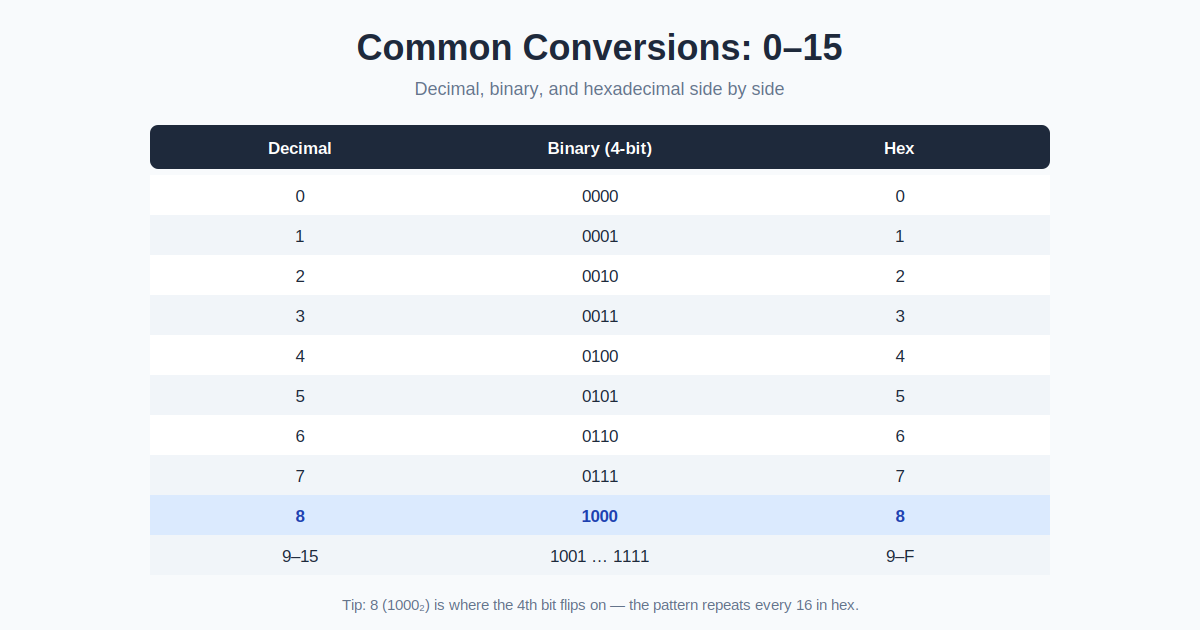
One hex digit covers four bits, called a nibble: split the binary into groups of four from the right and write each group as a hex digit. For 101111001010, the groups 1011, 1100, and 1010 are worth 11, 12, and 10: B, C, and A — BCA in hexadecimal, 3018 in decimal.
Common Mistakes to Avoid
- Group from the right, padding the leftmost group with zeros.
- Keep all four bits of each nibble: 1A3 is 0001 1010 0011, not 1 1010 11.
- Use only digits the base allows; this converter takes whole numbers only.
Frequently Asked Questions
What is binary used for?
Binary represents data inside computers, whose circuits have two states, on and off. All digital data is stored as binary.
Why do programmers also use hexadecimal?
Hexadecimal is compact shorthand for binary: each hex digit stands for exactly four bits, so long strings become far easier to read.
How many numbers can 8 bits represent?
Eight bits, called a byte, can represent 256 values, from 0 to 255. Each extra bit doubles the range.
What is the difference between signed and unsigned binary?
Unsigned binary covers zero and positives only, and this converter uses it. Signed forms, such as two’s complement, use the leftmost bit for negatives, so 8 bits run from −128 to 127.
Can I convert fractions to binary?
Not here: this converter takes whole numbers only. By hand, multiply the fraction by 2 and record each whole part: 0.625 becomes 0.101.
How do you convert decimal to binary by hand?
Divide by 2 repeatedly, noting each remainder, until you reach zero, then read the remainders last to first. For 25, that gives 11001.
How do you convert binary to hexadecimal?
Split the bits into fours from the right, padding the leftmost group with zeros. Write each group as a hex digit, using A to F for 10 to 15.
Related Calculators
Try our Percentage Calculator and Scientific Calculator for more math tools.