Estimate quarterly taxes, self-employment tax, and take-home pay for freelancers.
QBI estimate: 20% of net self-employment income, capped at taxable income after the standard deduction. Simplified estimate only — income-threshold phase-outs, W-2 wage / property limits and specified-service (SSTB) rules are not modelled.
How to Use the Freelance Tax Calculator
Freelancers pay tax differently from employees. Nobody withholds it from your invoices, so you must estimate and pay it yourself four times a year. This calculator shows your total burden including the often-overlooked self-employment tax, and tells you exactly how much to set aside each quarter.
- Enter your annual freelance income. Use your gross receipts before expenses. If your income varies, use a realistic annual estimate based on recent months.
- Enter business expenses. Home office, software, equipment, mileage, professional dues, and health insurance premiums all reduce your taxable profit. Track everything.
- Choose your filing status. Married filing jointly roughly doubles the brackets and the standard deduction.
- Enter your state income tax rate. Use your marginal state rate. If your state has no income tax, enter zero.
- Add other income if you have a day job too. W-2 wages stack with freelance profit and can push you into higher brackets.
- Click Calculate. You will see self-employment tax, federal and state income tax, total tax, take-home pay, and your quarterly payment amount.
How Freelancer Taxes Work
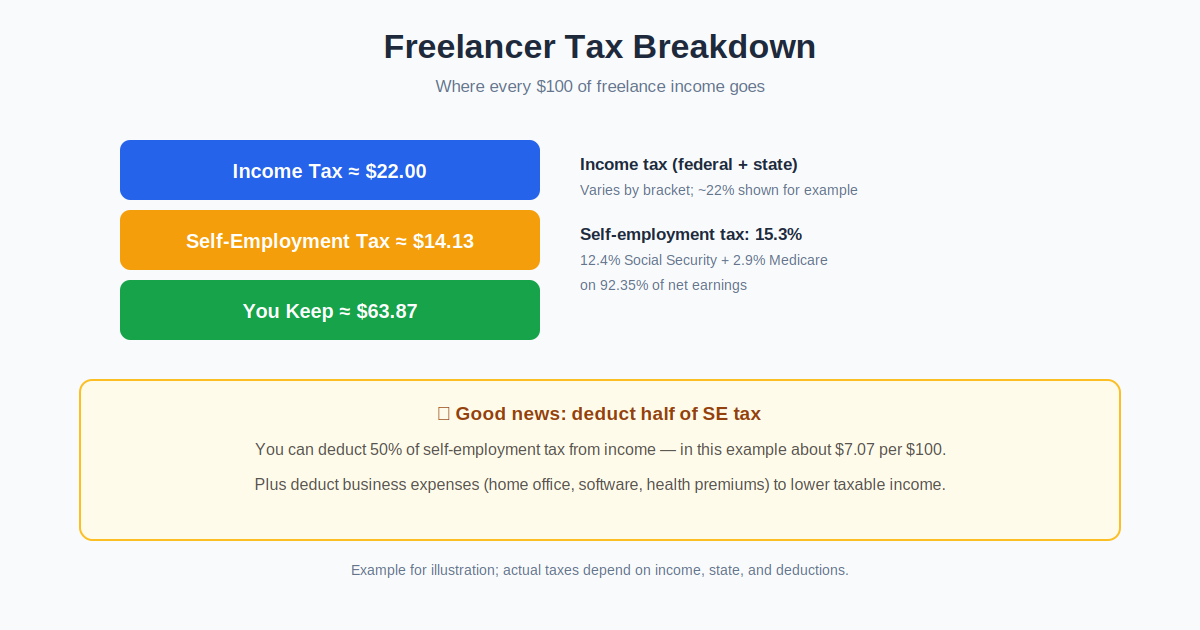
The biggest shock for new freelancers is self-employment tax. Employees split Social Security and Medicare taxes with their employer, each paying 7.65 percent. Freelancers pay both halves: 15.3 percent on the first 184,500 dollars of net earnings (12.4 percent Social Security plus 2.9 percent Medicare), then 2.9 percent Medicare on everything above that, plus an extra 0.9 percent Medicare surtax past 200,000 dollars single or 250,000 joint. The IRS lets you deduct half of this tax from your income, which softens the blow slightly.
Self-employment tax applies to 92.35 percent of your net profit, not the full amount. That odd percentage exists because the law treats the employer half as if it were never your income. On top of that, you owe ordinary federal income tax on your profit after the standard deduction (16,100 dollars single or 32,200 joint for 2026) and the half-SE-tax deduction.
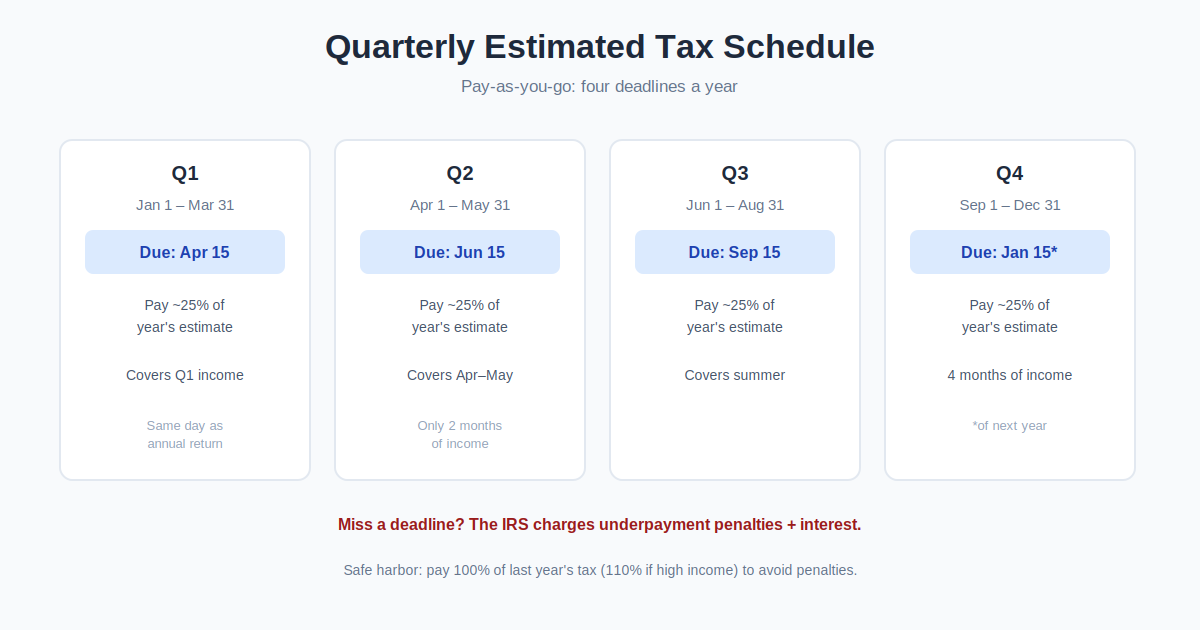
Because nobody withholds for you, the IRS requires quarterly estimated payments if you expect to owe 1,000 dollars or more. The due dates are April 15, June 15, September 15, and January 15. Miss them and you face underpayment penalties, even if you pay in full at filing time. A safe harbor: pay at least 100 percent of last year’s total tax (110 percent if your income was over 150,000 dollars) across the four quarters and you avoid penalties regardless of what you actually owe.
Good records are your best tax shelter. The home office deduction, Simplified at 5 dollars per square foot up to 300 square feet, retirement contributions to a SEP IRA or Solo 401(k), and the qualified business income deduction worth up to 20 percent of profit for eligible freelancers can each save thousands.
Worked Example
Consider Alex, a single freelance designer earning 80,000 dollars with 8,000 dollars of business expenses. Net profit is 72,000 dollars. Self-employment tax applies to 92.35 percent of that, or 66,492 dollars. Social Security takes 12.4 percent (8,245 dollars) and Medicare takes 2.9 percent (1,928 dollars), for total SE tax of about 10,173 dollars.
Alex deducts half the SE tax (5,087 dollars) from income, leaving adjusted gross income near 66,913 dollars. After the 16,100 dollar standard deduction, taxable income is about 50,813 dollars. Federal income tax on that is about 5,891 dollars. With a 5 percent state rate, state tax adds about 2,541 dollars. Total tax lands near 18,600 dollars, an effective rate of about 23 percent on gross freelance income.
Alex should send the IRS and state about 4,650 dollars every quarter. His take-home after expenses and taxes is roughly 53,400 dollars. Setting up a separate savings account and moving 25 percent of every invoice there the day it arrives makes quarterly payments painless.
A Full Tax Breakdown: $80,000 of Freelance Profit
Freelancers pay in three layers: self-employment tax, income tax, and the quarterly cadence that collects both. Watch how an 80,000 dollar profit breaks down for a single filer in 2026.
Layer 1 — self-employment tax. Multiply profit by 92.35 percent (the taxable portion), then by 15.3 percent: 80,000 x 0.9235 x 0.153 = 11,304 dollars. This covers Social Security and Medicare.
Layer 2 — income tax. Half of the SE tax (5,652 dollars) is deductible, so adjusted gross income is 74,348 dollars. Subtract the 16,100 dollar standard deduction for a single filer: taxable income of 58,248 dollars. Through the 2026 brackets that produces 7,527 dollars of income tax.
Total and quarterly. 11,304 plus 7,527 equals 18,830 dollars — an effective rate of 23.5 percent on the profit, or 4,708 dollars per quarter. This is before the qualified business income (QBI) deduction, which may reduce the income-tax layer further if you qualify.
Related Calculators
Figuring out your rate? Our Freelance Rate Calculator helps you price profitably, and our Salary Raise Calculator compares freelance income to employment offers.
Frequently Asked Questions
What is self-employment tax and how much is it?
It is Social Security plus Medicare tax for the self-employed: 15.3% on the first $184,500 of net earnings (2026), then 2.9% Medicare on the rest, plus 0.9% extra Medicare above $200k single or $250k joint. You pay both the employee and employer halves.
When are quarterly estimated taxes due?
April 15, June 15, September 15, and January 15. You must pay if you expect to owe $1,000 or more. Pay at least 100% of last year’s tax (110% for higher earners) to avoid underpayment penalties.
What expenses can freelancers deduct?
Home office, equipment, software, internet and phone portion, mileage, travel, professional development, business insurance, retirement contributions, and health insurance premiums for the self-employed.
Should I form an LLC or S corp for taxes?
An LLC alone does not change federal taxes. An S corp election can save SE tax once profits are consistently above roughly $60-80k, because only your salary (not distributions) faces payroll tax. It adds payroll costs and complexity.
How much should I set aside from each payment?
A common rule is 25-30% of net profit in a separate account. Higher earners in high-tax states may need 35%. The calculator above gives your personalized quarterly number.
What is the QBI deduction for freelancers?
The qualified business income deduction lets many freelancers deduct up to 20 percent of business profit before computing income tax. Service businesses face income phase-outs, and it never reduces self-employment tax — only income tax.
What happens if I miss a quarterly payment?
The IRS can charge an underpayment penalty, computed quarterly at the current rate. Pay as soon as you can — the penalty stops accruing on what you have paid. The safe-harbor rule (100 percent of last year’s tax, 110 percent for higher earners) may still protect you.