Acceleration Calculator
Solve for acceleration, initial velocity, final velocity, or time. Choose the velocity-change formula or the distance-from-rest formula.
g-force uses standard gravity, 9.80665 m/s². Results assume constant acceleration along a straight line.
What Is Acceleration?
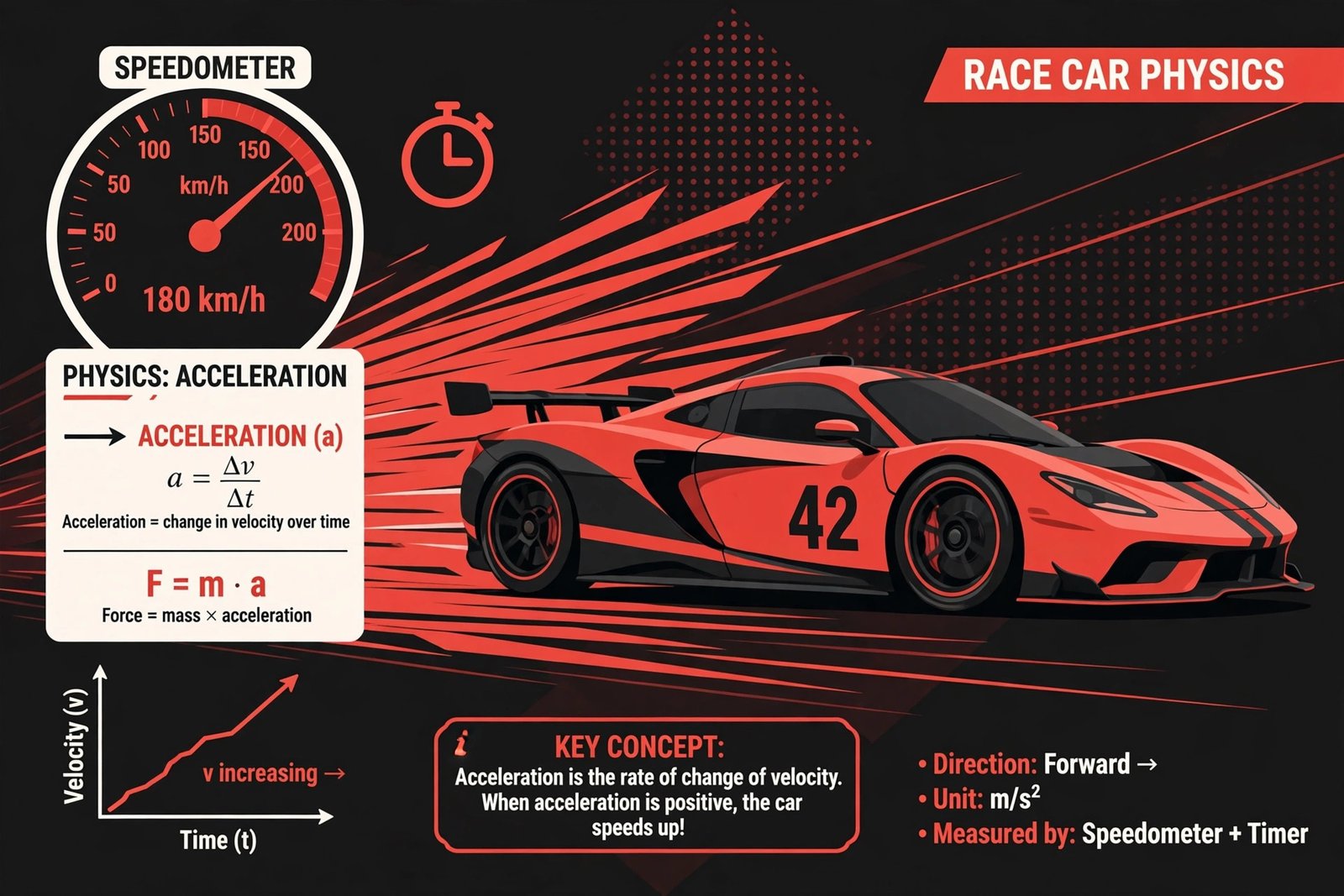
Acceleration is the rate at which an object's velocity changes over time. When a car pulls away from a traffic light, a ball falls toward the ground, or a sprinter explodes out of the starting blocks, acceleration is at work. It tells you how quickly motion itself is changing — not just how fast something is moving, but how fast its speed or direction is increasing or decreasing.
Acceleration is a vector quantity, which means it has both a size (magnitude) and a direction. A car speeding up in a straight line, a car braking, and a car turning a corner at constant speed are all accelerating, because in each case the velocity vector is changing. Speeding up is positive acceleration, slowing down is negative acceleration (often called deceleration), and changing direction at constant speed is also acceleration, since the direction of the velocity vector changes.
In everyday language people often say "acceleration" when they only mean "going faster," but in physics the term is broader. Understanding this distinction is the key to knowing how to calculate acceleration correctly and to interpreting what an acceleration calculator tells you.
The Acceleration Formulas
There are two standard formulas for acceleration, and each one fits a different situation. Our acceleration calculator supports both, and it always shows you which formula is being used.
Formula 1: a = Δv / Δt
The most common acceleration formula is:
a = (vf − vi) / t
Here, a is acceleration, vf is final velocity, vi is initial velocity, and t is the time over which the change happens. The symbol Δ (delta) means "change in," so Δv = vf − vi is the change in velocity and Δt is the change in time. In words: acceleration equals the change in velocity divided by the time it took.
This is the formula to use whenever you know how fast an object was moving at the start and at the end of a time interval. For example, if a car goes from 0 to 27.78 meters per second in 5 seconds, its acceleration is (27.78 − 0) / 5 = 5.556 m/s².
Formula 2: a = 2d / t²
When an object starts from rest and you know how far it traveled and how long it took, you can use:
a = 2d / t²
Here, d is the distance traveled and t is the time. This formula comes from the distance equation d = ½ × a × t², rearranged to solve for a. It only applies when the object starts from rest (initial velocity equals zero) and the acceleration is constant.
For example, if a drag racer covers 100 meters in 6.5 seconds starting from a standstill, its average acceleration is 2 × 100 / 6.5² = 200 / 42.25 = 4.734 m/s².
How to Use This Acceleration Calculator
Follow these steps to calculate acceleration — or any related quantity — with the calculator above:
Step 1: Choose what to solve for. Pick Acceleration, Initial Velocity, Final Velocity, or Time from the "Solve for" menu. The calculator rearranges the formula automatically, so you can work any variable.
Step 2: Choose the formula mode. Use "a = Δv / t" when you know velocities and time. Use "a = 2d / t²" when the object starts from rest and you know distance and time. The active formula is always displayed so you know exactly how the result is computed.
Step 3: Enter your values. Type velocities in meters per second (m/s), time in seconds (s), and distance in meters (m). If you have speeds in km/h, divide by 3.6 to convert to m/s first.
Step 4: Press Calculate. The result appears instantly. When you solve for acceleration, you also get the equivalent g-force, which expresses the acceleration as a multiple of Earth's gravity.
Step 5: Check the answer. Compare the result with your expectations. A typical car accelerates at 2 to 5 m/s², a sprinter at 3 to 4 m/s², and a commercial airplane at takeoff at about 2.5 m/s². If your answer is wildly different, recheck your inputs and units.
Worked Examples
Example 1: Car accelerating from 0 to 100 km/h
A sports car reaches 100 km/h from a standstill in 5 seconds. What is its acceleration?
First convert the speed to meters per second: 100 km/h ÷ 3.6 = 27.78 m/s. Then apply a = (vf − vi) / t = (27.78 − 0) / 5 = 5.556 m/s². As a g-force, that is 5.556 ÷ 9.80665 = 0.57 g. This is a brisk but comfortable acceleration — a Formula 1 car, by contrast, can exceed 1.5 g off the line.
Example 2: Distance covered from rest
A cyclist starts from rest and covers 100 meters in 6.5 seconds. What was the average acceleration?
Use a = 2d / t² = 2 × 100 / 6.5² = 200 / 42.25 = 4.734 m/s², or about 0.48 g. Note that this is the average acceleration over the whole run; the real acceleration was probably higher at the start and lower near the end.
Example 3: Solving for time
A train accelerates at a constant 1.2 m/s² from 10 m/s to 34 m/s. How long does it take?
Rearrange the formula to t = (vf − vi) / a = (34 − 10) / 1.2 = 24 / 1.2 = 20 seconds. This shows the value of a solve-for-any-variable tool: you enter the acceleration and the two speeds, and the calculator gives you the time directly.
Units of Acceleration and Conversions
The SI unit of acceleration is the meter per second squared (m/s²). It means the velocity changes by that many meters per second, every second. An acceleration of 5 m/s² means the object gains 5 m/s of speed each second.
Other units you may encounter include:
Kilometers per hour squared (km/h²): sometimes used in traffic contexts. 1 m/s² = 12,960 km/h².
Feet per second squared (ft/s²): common in the United States. 1 m/s² = 3.28084 ft/s².
g-force (g): acceleration expressed as a multiple of standard Earth gravity, where 1 g = 9.80665 m/s². Fighter pilots may experience 9 g in sharp maneuvers, while a roller coaster typically peaks around 3 to 4 g. G-force is useful because it connects directly to what your body feels — 2 g feels like weighing twice as much.
To convert, divide m/s² by 9.80665 to get g, or multiply g by 9.80665 to get m/s². As a rough estimate, 1 g is about 10 m/s².
Typical Acceleration Values for Reference
Numbers mean more with something to compare them against. The table below collects familiar accelerations, including the two worked examples from this page, so you can sanity-check your own results at a glance.
| Situation | Acceleration (m/s²) | In g-force |
|---|---|---|
| Elevator starting or stopping | about 1 | about 0.1 g |
| Commercial airliner taking off | about 2.5 | about 0.25 g |
| Family car, brisk pull-away | 3 to 5 | 0.31 to 0.51 g |
| Sports car, 0 to 100 km/h in 5 s | 5.556 | 0.57 g |
| Free fall near Earth's surface | 9.81 | 1 g |
| Formula 1 car launching | about 15 | about 1.5 g |
| Roller coaster peaks | 29 to 39 | 3 to 4 g |
Two patterns are worth remembering. First, anything at or above 1 g feels dramatic, because your body is used to gravity as the reference. Second, braking numbers matter just as much as launch numbers: a car stopping from 100 km/h in 3 seconds decelerates at about 9.26 m/s², close to a full g, which is near the limit of what tires can grip on dry asphalt.
Real-World Applications
Cars: acceleration and braking
Car manufacturers quote 0–100 km/h (or 0–60 mph) times, which are really acceleration figures in disguise. Dividing the speed gain by the time gives the average acceleration. Braking is the same physics with a negative sign: a car stopping from 27.78 m/s in 3 seconds experiences an average deceleration of −9.26 m/s², or about −0.94 g. Safety engineers use these numbers to design crumple zones, airbags, and stopping distances.
Sports
In sprinting, the first steps out of the blocks produce the highest acceleration of the race — elite sprinters reach around 3 to 4 m/s² in the first second. Coaches use acceleration data to measure explosiveness and technique.
Roller coasters and amusement rides
Ride designers live by acceleration. A launch coaster that hits 30 m/s in 2 seconds subjects riders to about 1.5 g of forward acceleration, and loops and drops are shaped to keep g-forces in a thrilling but safe range, typically under 4 to 5 g. Too much sustained g-force causes greyouts or blackouts, so these calculations are safety-critical.
Engineering and everyday technology
Elevators accelerate gently (around 1 m/s²) so passengers barely notice, and smartphones contain tiny accelerometers that rotate the screen, count steps, and detect falls.
Common Mistakes When You Calculate Acceleration
Mixing up speed and velocity. Speed is a single number; velocity includes direction. An object moving in a circle at constant speed is still accelerating, because its direction keeps changing.
Forgetting to convert units. The most frequent error is plugging km/h directly into a formula that expects m/s. Always convert: divide km/h by 3.6 to get m/s.
Dividing by zero time. Acceleration over zero seconds is undefined. If your time interval is zero, the formula cannot give an answer — and physically, an "instantaneous" change in velocity would require infinite acceleration.
Sign errors. Slowing down means acceleration points opposite to the direction of motion, so it is negative if forward is positive. Keep your sign convention consistent or your answers will be wrong.
Using a = 2d / t² when the object was already moving. That formula assumes the object started from rest. If there was an initial velocity, use a = (vf − vi) / t instead.
Treating average and instantaneous acceleration as the same. These formulas give average acceleration over an interval. If the acceleration changed during that time — as it usually does in real life — the instantaneous value at any moment may differ.
Limitations of These Formulas
The formulas on this page assume constant acceleration in a straight line. Real motion is often messier: a car's acceleration fades as it approaches top speed, air resistance grows with speed, and curved paths add sideways acceleration. For motion with changing acceleration, physicists use calculus — acceleration is the derivative of velocity with respect to time.
At everyday speeds, Newtonian mechanics is perfectly accurate. These formulas only break down near the speed of light, where relativity takes over, or at atomic scales, where quantum effects dominate. For cars, sports, rides, and homework problems, a = Δv / t and a = 2d / t² are exactly what you need.
Key Takeaways
Acceleration measures how quickly velocity changes, in meters per second squared. Use a = (vf − vi) / t when you know the starting and ending speeds, and a = 2d / t² when an object starts from rest and you know the distance and time. Keep your units consistent, watch your signs, and remember that g-force simply expresses your answer as a multiple of Earth's gravity. With those habits, this acceleration calculator will give you reliable answers for school, work, and curiosity alike.
Frequently Asked Questions
What is the formula for acceleration?
The basic acceleration formula is a = (vf − vi) / t, where a is acceleration, vf is final velocity, vi is initial velocity, and t is the time taken. In words, acceleration equals the change in velocity divided by the time. If an object starts from rest and you know the distance traveled, you can instead use a = 2d / t², where d is distance and t is time.
What units is acceleration measured in?
The standard (SI) unit of acceleration is meters per second squared, written m/s². It means the velocity changes by that many meters per second every second. Other common units include feet per second squared (ft/s²), kilometers per hour squared (km/h²), and g-force (g), where 1 g equals 9.80665 m/s², the acceleration of Earth's gravity.
What is the difference between acceleration and velocity?
Velocity tells you how fast an object is moving and in which direction, measured in m/s. Acceleration tells you how quickly that velocity is changing, measured in m/s². A car cruising at a steady 60 km/h has velocity but zero acceleration. When the driver presses the gas pedal or the brake, the velocity starts changing, and that change is the acceleration.
What does negative acceleration mean?
Negative acceleration means the velocity is decreasing in the chosen positive direction — in plain terms, the object is slowing down (often called deceleration). For example, if forward is positive, a braking car has negative acceleration. The sign depends on your coordinate choice: the same physical slowdown is positive acceleration if you define backward as positive.
What is g-force?
G-force expresses acceleration as a multiple of Earth's gravity, where 1 g = 9.80665 m/s². At 2 g you feel twice as heavy as normal. Typical cars reach about 0.5 g when accelerating hard, roller coasters peak around 3 to 4 g, and fighter pilots may endure up to 9 g in sharp turns. Our calculator shows the g-force equivalent of every acceleration result.
How does this acceleration calculator work?
First choose which variable to solve for: acceleration, initial velocity, final velocity, or time. Then pick a formula mode: a = Δv / t using the two velocities and time, or a = 2d / t² using distance and time for motion starting from rest. Enter your values in m/s, seconds, and meters, press Calculate, and the tool rearranges the formula and shows the answer along with the g-force equivalent when you solve for acceleration.
How do I calculate acceleration if I do not know the time?
Use the velocities and the distance instead: a = (vf² − vi²) / (2d), the rearrangement of v² = u² + 2as. For example, a car speeding up from 10 m/s to 30 m/s over 100 m has a = (900 − 100) / 200 = 4 m/s². From there the time follows from t = (vf − vi) / a = 20 / 4 = 5 seconds, which you can then enter into this calculator.
What is the difference between average and instantaneous acceleration?
Average acceleration is the total change in velocity divided by the total time, which is what the formulas on this page calculate. Instantaneous acceleration is the value at one specific moment — the slope of a velocity-time graph at that point. A car's average over a 0 to 100 km/h run might be 5 m/s² even though it peaked higher in first gear and faded near the end.