Student loan calculator: find your monthly payment and see how extra payments shorten payoff. Enter loan amount, APR, term, and extra payment to save interest.
Results are estimates for planning purposes and are not financial, medical, or professional advice.
How to Use the Student Loan Calculator
Student loans can linger for a decade or more, but even a modest extra payment shortens the payoff and cuts interest. This calculator compares your standard plan against a plan with extra monthly payments.
- Enter your total student loan balance and interest rate (APR).
- Enter the repayment term in years, such as 10 for the standard federal plan.
- Enter any extra amount you can pay each month, or zero to see the standard plan.
- Compare payoff time, total interest, and interest saved.
Student Loan Payment Formula
The standard monthly payment uses the amortization formula: M = P x (r(1+r)^n) / ((1+r)^n – 1), where P is the loan amount, r is the monthly rate (APR divided by 1200), and n is the number of payments. A 30,000 dollar loan at 6 percent for 10 years gives a payment of about 333.06 dollars. Extra payments go straight to principal, so the calculator simulates month-by-month payoff with the higher payment to find the true payoff date and interest saved. Note what this tool does not model: a single fixed-rate level payment schedule, so income-driven plans, loan forgiveness, and interest capitalization are outside its scope.
Example
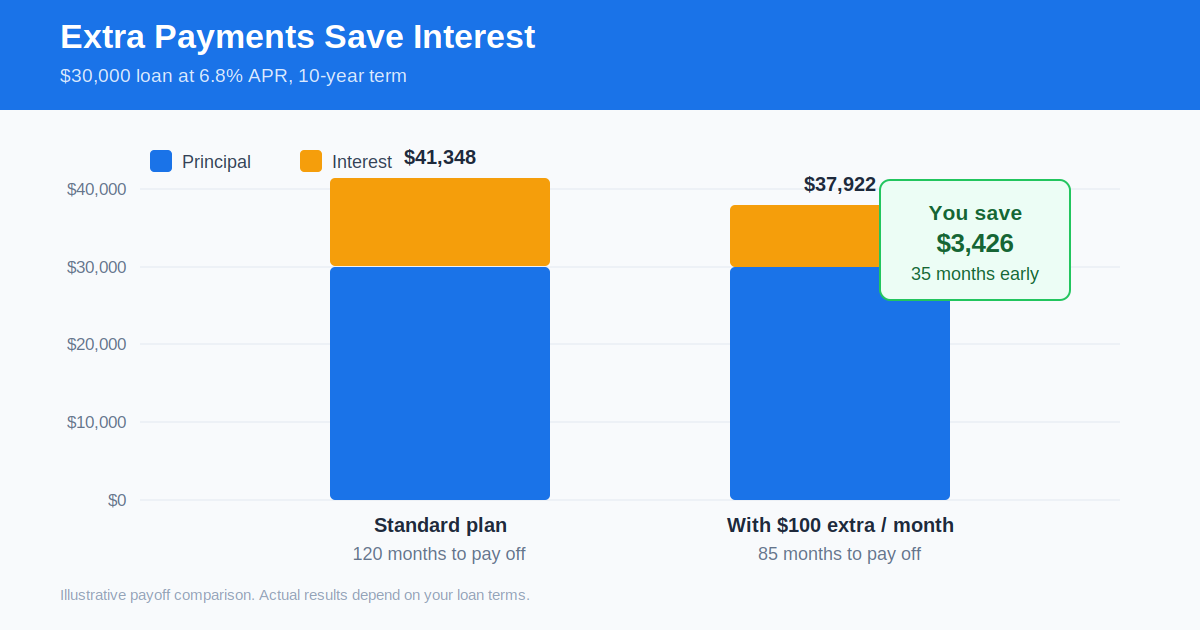
Alex owes 30,000 dollars at 6 percent on a 10-year term, with a standard payment of about 333.06 dollars and total interest of 9,967.38 dollars. By adding 100 dollars extra each month, the loan is paid off in 86 months instead of 120, total interest drops to about 6,921.10 dollars, and Alex saves roughly 3,046.28 dollars in interest.
Payoff Strategies That Cut Interest
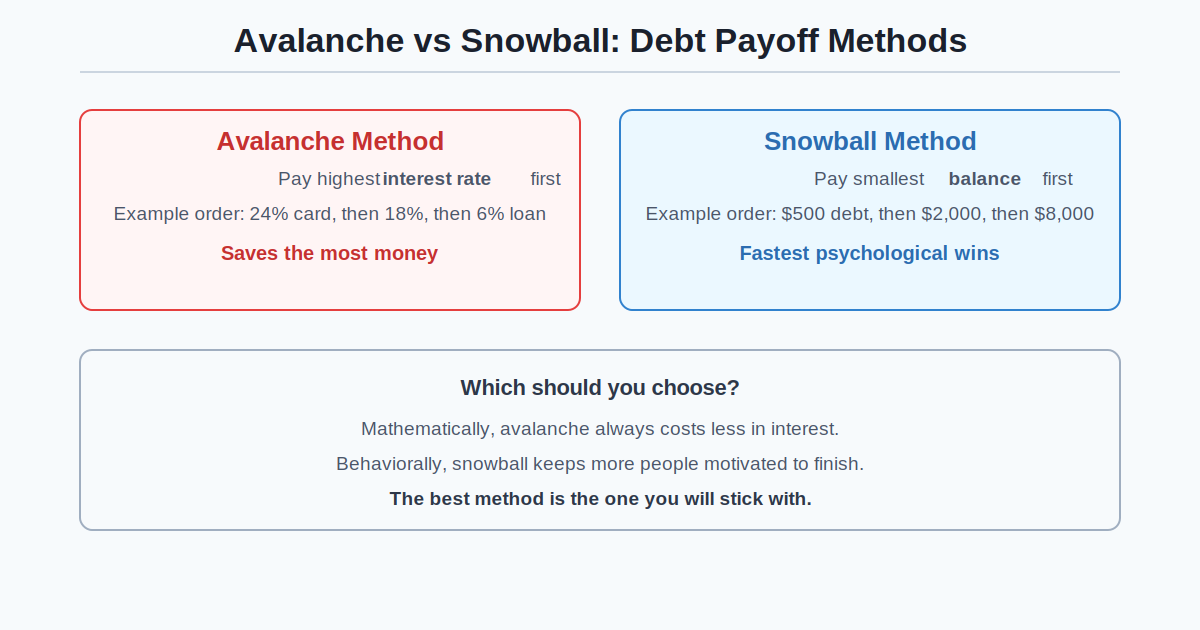
Two tactics beat the standard schedule. The avalanche method pays minimums on every loan and throws all extra money at the highest-rate loan first, which minimizes total interest. And extra payments only help if they actually reach principal: tell your servicer to apply them to principal on the loan you are targeting rather than advancing your due date.
Frequently Asked Questions
Is it better to pay extra on student loans or invest?
Compare your loan rate to expected investment returns. Paying extra on a 6 to 7 percent loan is a guaranteed return, while investing is uncertain. Many people split the difference.
Do extra payments really go to principal?
On most federal and private loans, yes, once the monthly interest is covered. Confirm with your servicer that extra payments are applied to principal and not treated as early future payments.
What is the standard repayment term?
Federal student loans default to a 10-year standard plan. Income-driven plans stretch to 20 or 25 years with lower payments but much higher total interest.
Should I refinance my student loans?
Refinancing federal loans into a private loan can lower your rate but you lose federal protections like income-driven repayment and forgiveness programs. Run the numbers here first.
How much interest will I pay overall?
Enter your exact figures above. As a rule of thumb, a 10-year loan at 6 percent costs about one-third of the borrowed amount in interest with no extra payments.
What is interest capitalization?
Capitalization adds unpaid interest to your principal balance, so you start paying interest on interest. It typically happens when loans enter repayment or leave forbearance, which is why unpaid interest during school costs more than it looks.
How do I calculate several loans at different rates?
Run each loan separately for exact numbers, or use a balance-weighted average rate for a quick estimate: multiply each loan’s rate by its balance, add those up, and divide by the total balance.
Related Calculators
Plan other borrowing with the Loan Calculator and map every payment with the Amortization Schedule Calculator.