Estimate body fat percentage with the official US Navy circumference method. Just a tape measure and your height — no calipers or scales needed.
Take measurements with a tape measure, then enter them below.

How to Use the Navy Body Fat Calculator
- Select your sex. The Navy formula differs for men and women because fat distributes differently.
- Enter your height in centimeters, standing straight against a wall without shoes.
- Measure your neck just below the Adam’s apple with the tape level all around. Look straight ahead and do not shrug.
- Measure your waist at the navel (belly button) level. Breathe normally and do not suck in your stomach.
- Women also measure hips at the widest point around the buttocks. This field appears automatically when you select female.
- Click Calculate. You will get your estimated body fat percentage, a fitness category, and a check against Navy limits.
The Navy Body Fat Formula
The US Navy developed this circumference method in the 1980s as a practical field test, and it remains in use because it needs only a tape measure. For men, the formula is: body fat percent equals 86.010 times log base ten of (waist minus neck), minus 70.041 times log base ten of height, plus 36.76. For women it is: 163.205 times log base ten of (waist plus hip minus neck), minus 97.684 times log base ten of height, minus 78.387. All measurements must use inches in the formula itself, because the Navy fitted its constants on inch data, so this calculator converts your centimeter entries to inches automatically before computing. The logarithmic terms capture how body proportions scale: a large waist relative to the neck signals abdominal fat in men, while the waist plus hip combination captures it in women. Validation studies against underwater weighing and DEXA scans typically find the Navy method accurate within about three to four percentage points for most people, which is good enough for tracking trends. It is less reliable for very muscular athletes, whose thick necks can distort the result, and for people with unusual fat distribution. The Navy itself sets maximum body fat at twenty two percent for men and thirty three percent for women, with stricter goals by age group.
Worked Example
Take a man who is 178 centimeters tall with a 40 centimeter neck and a 90 centimeter waist. The calculator first converts to inches: height 70.1, neck 15.7, waist 35.4. Waist minus neck is 19.7 inches. Log base ten of 19.7 is about 1.294, times 86.010 gives 111.3. Log base ten of 70.1 is about 1.846, times 70.041 gives 129.3. Body fat equals 111.3 minus 129.3 plus 36.76, about 18.8 percent, in the average range and within the Navy maximum of 22 percent. If the same man trims his waist to 84 centimeters (33.1 inches), waist minus neck becomes 17.3 inches, log ten is 1.239, times 86.010 is 106.5, and body fat becomes 106.5 minus 129.3 plus 36.76, about 14.0 percent, now in the fitness range. For a woman 165 centimeters tall with a 34 centimeter neck, 76 centimeter waist, and 98 centimeter hips, converting to inches gives height 65.0, neck 13.4, waist 29.9, hip 38.6. Waist plus hip minus neck is 55.1 inches; log ten is 1.741, times 163.205 is 284.2. Log ten of 65.0 is 1.813, times 97.684 is 177.1. Body fat equals 284.2 minus 177.1 minus 78.387, about 28.7 percent, in the average range for women. These examples show why the calculator converts your centimeter entries to inches internally: the Navy constants were fitted on inch measurements, and skipping the conversion would inflate results.
How to Take Measurements That Don’t Lie
The formula is only as good as your tape work. Use a flexible tape on bare skin, standing relaxed, at the same time of day (mornings work best), and average two or three readings per site. The landmarks are specific: neck — just below the larynx (Adam’s apple), keeping the tape level; waist (men) — at the level of the navel; waist (women) — at the narrowest part of the torso, usually just above the hip bones; hips (women only) — around the widest part of the hips and buttocks, feet together. Keep the tape snug without compressing the skin, breathe normally, and never measure while holding your stomach in — a 1 cm error at the waist can move the result by roughly half a percentage point.
Body Fat Categories at a Glance
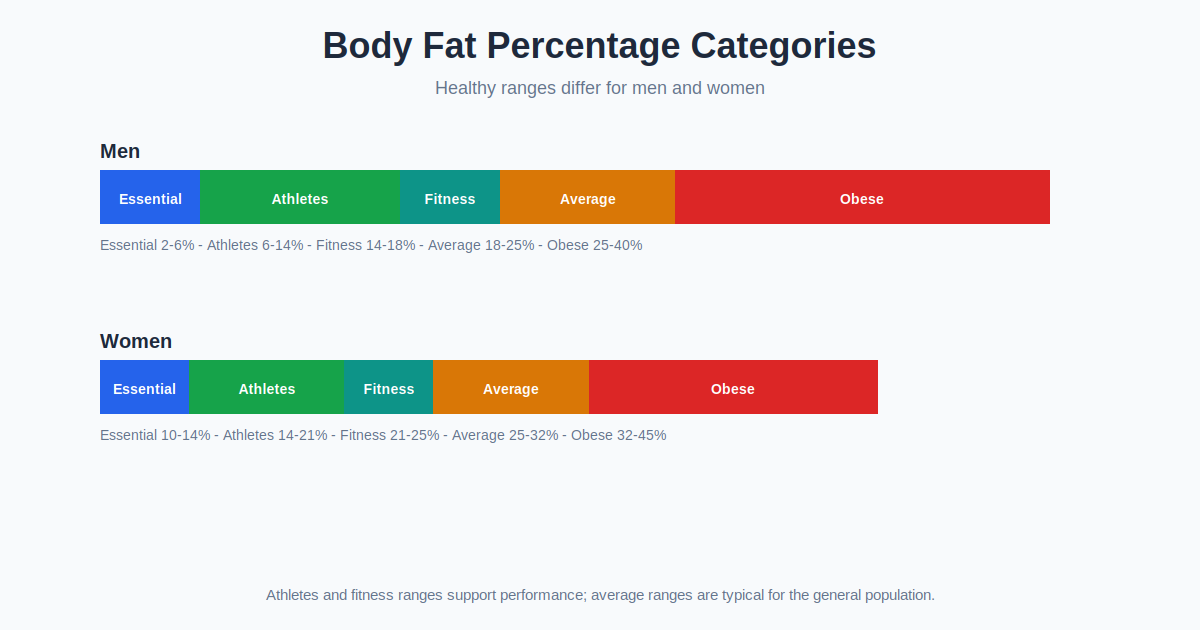
The widely used American Council on Exercise (ACE) ranges put your percentage in context:
| Category | Men | Women |
|---|---|---|
| Essential fat | 2–5% | 10–13% |
| Athletes | 6–13% | 14–20% |
| Fitness | 14–17% | 21–24% |
| Average | 18–24% | 25–31% |
| Obese | 25%+ | 32%+ |
Navy Standards and the Method’s History
The circumference equations were developed for the US Navy by Hodgdon and Beckett in 1984 and validated against hydrostatic (underwater) weighing, which is why the service still uses tape measurements for fitness screening. In the Navy’s own standards, the maximum allowed body fat is about 22% for men and 33% for women under 40 (the limits ease slightly with age), and those are pass/fail ceilings, not health targets — the fit bands above are well below them. The method’s great practical advantage is that it responds to actual fat distribution rather than weight alone, so a muscular person is not penalized the way BMI penalizes them; its known weakness is the opposite case, where unusual fat distribution or extremely high body fat can push the estimate outside its usual ±3–4 point accuracy.
Frequently Asked Questions
How accurate is the Navy body fat method?
Within about 3 to 4 percentage points of lab methods like DEXA for most people. It is best for tracking changes over time rather than as a single precise number.
Why does the formula use logarithms?
Body proportions do not scale linearly, so the log terms model how circumference differences relate to fat mass. The constants were fitted by the Navy using regression against underwater weighing data.
Can muscular people use this calculator?
With caution. A thick muscular neck or very lean waist can skew results. Athletes often get more useful numbers from skinfold calipers or DEXA scans.
How often should I remeasure?
Every 2 to 4 weeks is plenty. Daily fluctuations from food, water, and bloating add noise, so measure under consistent conditions, ideally in the morning.
What is a healthy body fat percentage?
For men, roughly 14 to 24 percent is typical for fitness to average; for women, roughly 21 to 31 percent. Athletes run lower. Essential fat is about 2 to 5 percent for men and 10 to 13 percent for women.
What body fat percentage does the Navy require?
Navy fitness standards allow about 22% body fat for men and 33% for women under 40, with slightly easier limits at older ages. These are pass/fail ceilings, not fitness targets — the healthy ranges on this page are well below them.
Why do women add a hip measurement?
Fat distribution differs by sex: women typically store more fat around the hips, so adding the hip circumference captures fat the waist-and-neck formula would miss. The women’s equation was validated separately against the same underwater-weighing data.
Can I measure in inches instead of centimetres?
The calculator takes centimetres — if you measured in inches, multiply by 2.54 (1 inch = 2.54 cm) and enter the converted value. The Navy equations were built in inches, so the calculator converts your centimetres internally.
Related Calculators
Compare with the standard BMI Calculator and check your abdominal risk with our Waist to Hip Ratio Calculator for a fuller body composition picture.