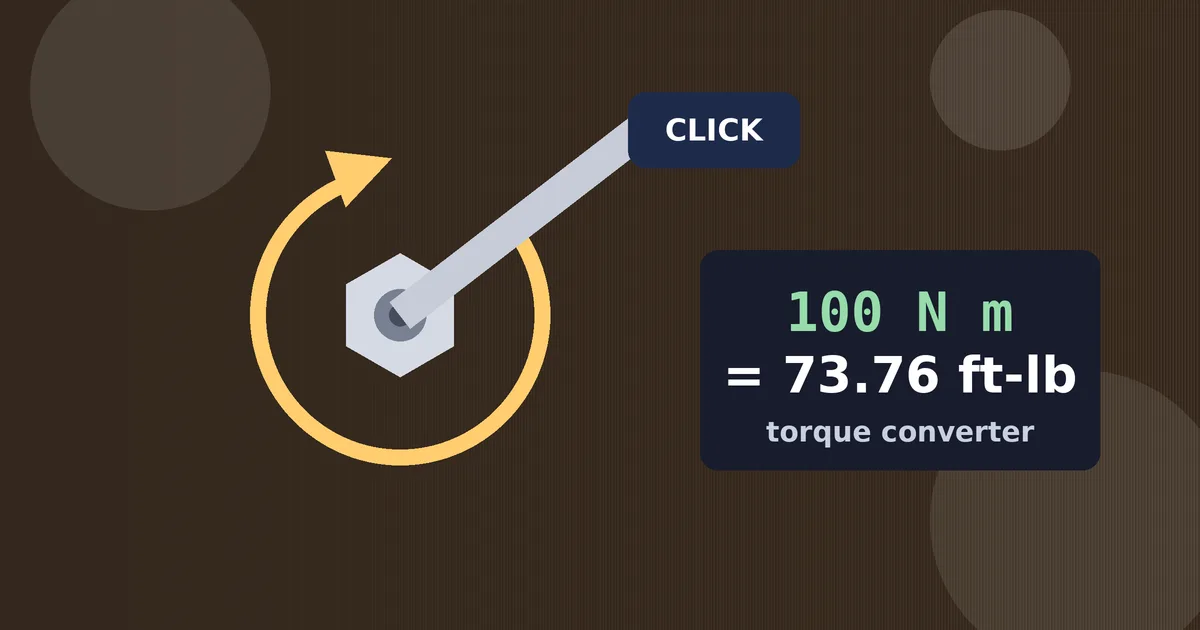
Convert torque between eight units — newton meters, kilonewton meters, newton centimeters, kilogram-force meters and centimeters, foot-pounds, inch-pounds and inch-ounces — using exact factors. It is built around the conversion mechanics ask for most, how to convert n m to ft lbs, but every pair of units works in both directions. Enter an amount, pick its unit and the unit your wrench or manual uses, and the answer updates as you type, with the working shown underneath. The table below then shows the same torque in all eight units at once.
Your amount in every unit
| Unit | Value |
|---|
All conversions run through newton meters using exact defined factors, for example 1 foot-pound = 1.3558179483314004 newton meters. Results are rounded to at most four decimal places.
What Torque Is and Why the Units Differ
Torque is a twisting effect: the tendency of a force to turn something around a pivot, depending on how hard the force pushes and how far from the pivot it is applied. Push a door near its hinges and it barely moves; push at the handle and it swings easily. A torque figure is always a force multiplied by a distance, which is why every torque unit pairs a force unit with a length unit. Fifty pounds of force on a one-foot wrench produces 50 foot-pounds of torque, and the same fifty pounds on a two-foot wrench produces 100 foot-pounds: the lever doubled the effect for the same effort.
A newton meter is the torque from one newton of force applied one meter from the pivot, the standard unit in the SI system used by European and Asian manufacturers; a foot-pound is the same idea in the long-standing United States unit, one pound of force applied one foot from the pivot. A foot-pound is the larger unit (1.3558 newton meters), so the same job reads as a bigger number in newton meters than in foot-pounds. Neither system is wrong, and anyone who works on imported cars, motorcycles or bicycles meets both, often in the same manual.
Inch-pounds and inch-ounces serve small fasteners, where a foot-pound is too coarse a step: bicycle components, electronics and instruments live in that range. Kilogram-force meters and centimeters survive from older metric documents; the kilogram-force is the weight of a one-kilogram mass under standard gravity, which is why its factor carries the 9.80665 figure. This converter covers all three families in one place.
How to Use This Torque Converter
- Enter the amount from your manual, label or wrench. It starts at 100 newton meters, the headline conversion, straight away.
- Choose the From and To units. Eight units run from kilonewton meters for heavy machinery down to inch-ounces for delicate work. Results update live as you type; the Convert button re-runs the same calculation on demand.
- Use Swap to reverse the direction. Swap exchanges the two units, the quickest way to check a conversion both ways.
- Read the result and the working. The large line gives the answer; the line underneath shows the exact multiplication used, so you can verify it by hand.
- Check the all-units table. Under the result, the same torque appears in every unit at once — the fastest way to set a wrench scaled in a different unit, or to spot a figure that was meant in inch-pounds, not foot-pounds.
The Newton Meter and Foot-Pound Formulas, Both Ways
Every conversion in this tool passes through newton meters, the shared reference unit. Each unit has an exact factor stating how many newton meters it contains, and converting is one multiplication followed by one division. For the headline pair, that collapses into two numbers worth memorizing:
Foot-pounds = newton meters x 0.737562
Newton meters = foot-pounds x 1.355818
Result = amount x factor of the From unit / factor of the To unit
One foot is exactly 0.3048 meters and one pound-force is exactly 4.4482216152605 newtons, so one foot-pound is exactly 1.3558179483314004 newton meters, and its reciprocal, 0.7375621492772654, is the exact newton meter to foot-pound factor. The converter carries the full values and rounds only the display, to four decimal places. The shorter 0.7376 and 1.3558 forms are fine for hand work.
Worked example: 100 newton meters in foot-pounds. Multiply by 0.737562: 100 x 0.737562 = 73.7562, so 100 N·m = 73.76 ft·lb to two decimal places. It is the value the converter shows on opening, behind a large share of wheel and engine-bracket specifications.
Worked example: 50 foot-pounds in newton meters. Multiply by 1.355818: 50 x 1.355818 = 67.7909, so 50 ft·lb = 67.79 N·m. This is the direction you need when an American manual meets a metric wrench.
Two more checks against the table. A wheel lug nut specification of 120 N·m is 120 x 0.737562 = 88.5074 ft·lb, about 88.51 ft·lb. A bicycle stem bolt at 5 N·m is 5 x 8.850746 = 44.2537 inch-pounds, about 44.25 in·lb — small specifications belong on an inch-pound wrench. One kilogram-force meter is exactly 9.80665 N·m, which is 9.80665 x 0.737562 = 7.2330 ft·lb.
Common Torque Specs in Real Life
Most conversions happen because a real job is waiting — a wheel, a plug, a stem clamp. These are typical published ranges, in both scales — orientation figures only. The specification in your vehicle or component manual always wins: stud size, thread condition and material all move the correct figure.
| Job | Newton meters | Foot-pounds | Inch-pounds |
|---|---|---|---|
| Car wheel lug nuts (family car) | 100 to 140 | 73.76 to 103.26 | 885.07 to 1,239.10 |
| Spark plug, 14 mm flat seat, aluminium head | 25 to 30 | 18.44 to 22.13 | 221.27 to 265.52 |
| Engine oil drain plug | 25 to 40 | 18.44 to 29.50 | 221.27 to 354.03 |
| Bicycle stem and handlebar bolts | 5 to 7 | 3.69 to 5.16 | 44.25 to 61.96 |
| Bicycle seatpost clamp | 5 to 8 | 3.69 to 5.90 | 44.25 to 70.81 |
| Motorcycle axle nut | 50 to 150 | 36.88 to 110.63 | 442.54 to 1,327.61 |
Two habits protect parts at these figures. Tighten wheel lug nuts in a star pattern, in stages, and re-check them after about 50 miles, as a wheel settles against the hub. And respect the bottom of the range on bicycle and carbon parts: 5 N·m is a gentle setting a large automotive wrench can overshoot before it clicks.
The Eight Units in This Converter
Each unit below is defined by its exact factor to newton meters, the same factors the converter uses. Choosing the wrong row — inch-pounds read as foot-pounds, above all — is the most expensive conversion error in the workshop.
| Unit | One unit in newton meters | Where it is used |
|---|---|---|
| Newton meter (Nm) | 1 | The SI standard; European and Asian manuals and bicycles |
| Kilonewton meter (kNm) | 1,000 | Heavy machinery, structural bolts and large engines |
| Newton centimeter (Ncm) | 0.01 | Small fasteners, precision screwdrivers and electronics |
| Kilogram-force meter (kgf m) | 9.80665 | Older metric manuals and machinery |
| Kilogram-force centimeter (kgf cm) | 0.0980665 | Older small-fastener specs, especially Japanese |
| Foot-pound (ft-lb) | 1.3558179483314004 | United States automotive and general workshop use |
| Inch-pound (in-lb) | 0.1129848290276167 | Bicycles, small covers and fine mechanical work |
| Inch-ounce (in-oz) | 0.0070615518335488 | Tiny mechanisms, instruments and model making |
One note on the kilogram-force rows: the letter f matters. A kilogram is a mass, not a force, so a bare kg m is loose writing; the kilogram-force meter is the real unit, the weight of one kilogram acting one meter from the pivot. That is why its factor is the gravity figure, 9.80665, not a round number.
Common Mistakes to Avoid
- Arguing over ft·lb versus lb·ft. For torque, foot-pounds and pound-feet are exactly the same amount. SAE practice prefers lb·ft for torque and keeps foot-pound for the energy unit — but if a wrench says ft-lb and a chart says lb-ft, set the same number on both.
- Confusing torque with energy. Torque and energy share dimensions — a newton meter and a joule look alike — but they are different quantities: torque is force around a pivot, energy is force along a movement. A bolt held at 100 N·m without turning does no work. Never convert a tightening specification as if it were an energy figure, or the other way round.
- Mixing up inch-pounds and foot-pounds. One foot-pound is exactly 12 inch-pounds, so setting 44 ft·lb on a bolt specified at 44 in·lb applies twelve times the intended torque and will strip threads or snap the bolt. When a specification looks surprisingly large or small, check the unit before you check the number.
- Using a big wrench at the bottom of its range. Torque wrenches are least accurate near the ends of their scale. A 5 N·m bicycle bolt belongs on a small inch-pound wrench, not on an automotive wrench whose scale starts at 20 ft·lb.
- Ignoring thread condition. Published figures usually assume clean, dry threads. Oil or anti-seize reduces friction, so the same wrench reading produces considerably more clamping force. Convert the unit, then apply the figure under the conditions the manual specifies.
- Rounding the factor too early. Multiplying by 0.74 instead of 0.737562 is fine for a rough estimate, but on a 140 N·m lug nut it already shifts the setting by about half a foot-pound. Use the exact factors for final settings, as this converter does.
More Tools on This Site
Torque sits between two simpler quantities, and this site covers both. The Force Calculator works with force alone, before any lever distance is involved, while the Length Converter handles the distance side. The Weight Converter covers the mass side behind kilogram-force figures. For the wheels themselves, the Batch 15 companion Tire Size Converter compares tire dimensions, and the Speed Converter covers the other conversion drivers ask for.
Frequently Asked Questions
How do I convert newton meters to foot-pounds?
Multiply the newton meter value by 0.737562. For example, 100 newton meters multiplied by 0.737562 is 73.7562, so 100 N·m = 73.76 ft·lb. The converter above uses the exact factor, 0.7375621492772654, and rounds only the displayed result.
How do I convert foot-pounds to newton meters?
Multiply the foot-pound value by 1.355818. For example, 50 foot-pounds multiplied by 1.355818 is 67.7909, so 50 ft·lb = 67.79 N·m. The Swap button in the converter reverses the direction in one click.
Is ft-lb the same as lb-ft?
Yes, for torque they are exactly the same amount, because force multiplied by distance gives the same product in either order. Careful manuals and SAE practice prefer lb-ft for torque and reserve foot-pound for the unit of energy. If your wrench is marked ft-lb and your chart says lb-ft, set the same number on both.
What is the difference between torque and energy if both can be written in newton meters?
Torque is a force acting around a pivot; energy is a force acting along a distance actually travelled. They share dimensions on paper, but a torque that holds a bolt still without turning it does no work and transfers no energy. Treat them as separate quantities and never convert one into the other.
How many inch-pounds are in a foot-pound?
Exactly 12, because there are 12 inches in a foot. It follows that 1 newton meter is 8.8507 inch-pounds, so a 5 N·m bicycle bolt is about 44.25 in·lb. Small specifications use inch-pounds because the numbers stay readable and a small wrench can be set more precisely at that scale.
What torque do car wheel lug nuts need?
A typical family car specifies about 100 to 140 newton meters, which is 73.76 to 103.26 foot-pounds, but the correct figure is the one in your vehicle handbook. Tighten in a star pattern, in stages, with a torque wrench rather than an impact gun alone, and re-check the nuts after roughly 50 miles.