Estimate monthly Social Security benefits based on earnings history and claiming age.
How to Use the Social Security Benefits Calculator
Social Security will likely be a major part of your retirement income, but the monthly check varies enormously based on your earnings and when you claim. This calculator estimates your benefit using the same formula the Social Security Administration applies, so you can compare claiming early versus waiting.
- Enter your average annual earnings. Use your average indexed earnings across your career. If you do not know it, your recent salary is a reasonable starting point.
- Enter years worked. Benefits are based on your 35 highest-earning years. Fewer than 35 years means zeros get averaged in, which lowers your benefit.
- Enter your current age. This helps frame the timeline but does not change the math directly.
- Choose a claiming age. Compare 62 (earliest, reduced), 67 (full retirement age for most workers now), and 70 (maximum credits). The difference between 62 and 70 is enormous.
- Click Calculate. You will see monthly and annual amounts at each key age, plus lifetime totals if you live to 82 or 90.
How Social Security Benefits Are Calculated
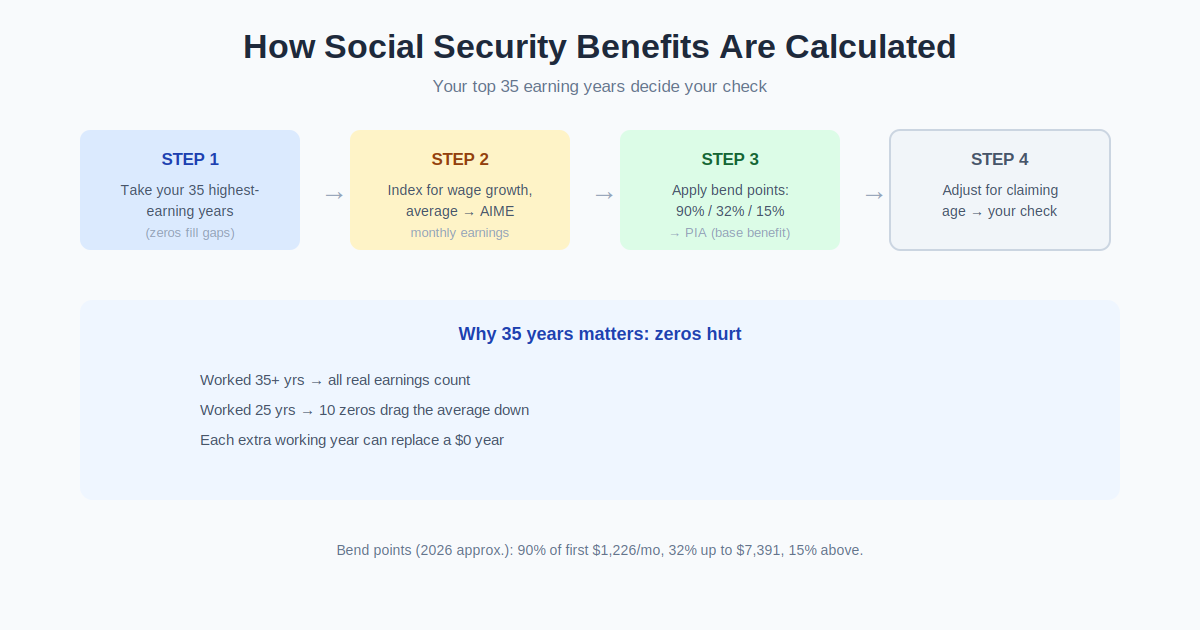
Your benefit starts with your Average Indexed Monthly Earnings, or AIME. The SSA takes your 35 highest-earning years, indexes older earnings for wage growth, averages them, and divides by 12 to get a monthly figure. Someone who earned 75,000 dollars for 35 years has an AIME of 6,250 dollars.
Next comes the Primary Insurance Amount, the monthly benefit at full retirement age. The formula is progressive, replacing a bigger share of low earnings. For 2026, you get 90 percent of the first 1,226 dollars of AIME, 32 percent of the amount between 1,226 and 7,391 dollars, and 15 percent of anything above that. These bend points mean lower earners get a higher replacement rate, which is the social-insurance heart of the program.
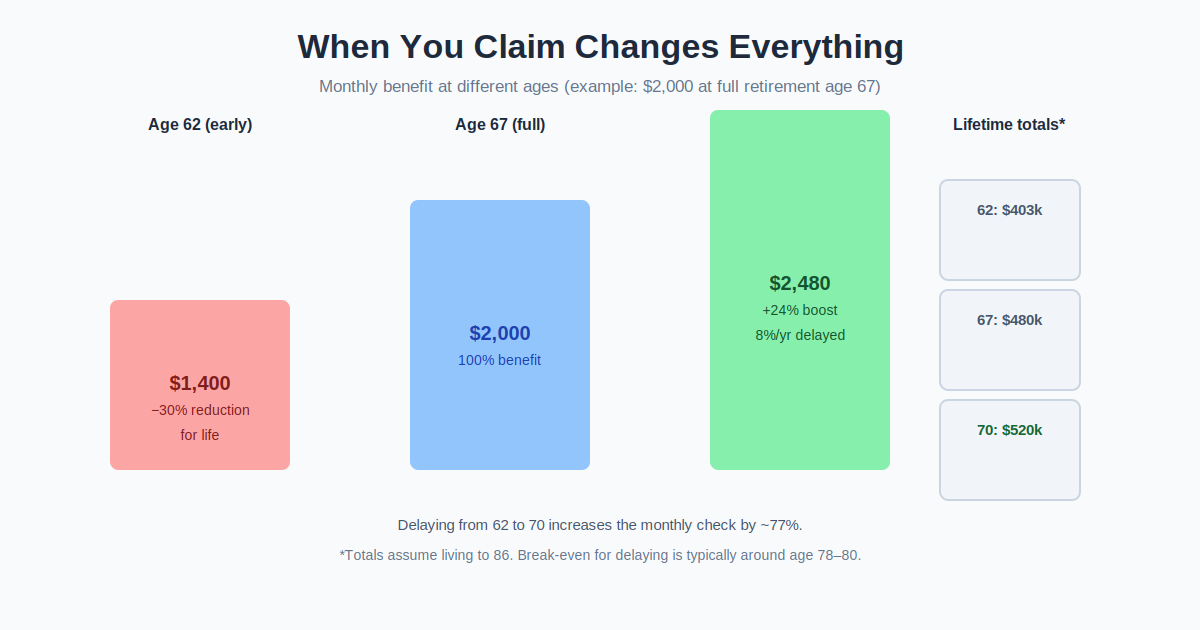
Claiming age then adjusts the PIA. Claim at 62 and benefits shrink about 30 percent below full. Each month you delay past 62 recovers some of that reduction. Wait past full retirement age and you earn delayed retirement credits of 8 percent per year until 70, when benefits max out at about 124 percent of your PIA. There is no advantage to waiting past 70.
Two more rules matter. If you claim early and keep working, the earnings test withholds benefits above an annual limit until you reach full retirement age. And up to 85 percent of your benefits can be taxable if your combined income crosses certain thresholds, a detail many retirees discover too late.
Worked Example
Take Robert, who averaged 75,000 dollars over 35 working years. His AIME is 75,000 times 35 divided by 35 divided by 12, which is 6,250 dollars per month. Applying the bend points: 90 percent of the first 1,226 dollars is 1,103 dollars, 32 percent of the next 5,024 dollars (up to 7,391) is 1,608 dollars, and nothing falls in the 15 percent band. His PIA is about 2,711 dollars per month.
If Robert claims at 62, the early reduction of roughly 30 percent leaves him about 1,898 dollars per month, or 22,776 dollars per year. At full retirement age 67 he gets the full 2,711 dollars, or 32,532 dollars per year. If he waits until 70, delayed credits lift him to about 3,362 dollars per month, or 40,344 dollars per year. The gap between 62 and 70 is over 1,400 dollars every month for life.
Lifetime math tells the rest. If Robert lives to 82, claiming at 62 pays about 455,000 dollars total, claiming at 67 pays about 488,000, and claiming at 70 pays about 484,000. If he lives to 90, the late claimer pulls far ahead: roughly 638,000 at 62 versus 807,000 at 70. The break-even age where waiting beats claiming early is typically around 78 to 80. Health, work plans, and survivor benefits for a spouse should all weigh into the real decision.
Full Retirement Age and How Your Benefit Is Calculated
Your benefit starts from your average indexed monthly earnings, or AIME — the average of your 35 highest-earning years, adjusted for wage growth. Years with no earnings still count as zeros if you have fewer than 35 years of work, so each extra working year can replace a zero.
From AIME, Social Security applies the 2026 bend points: 90 percent of the first 1,286 dollars, 32 percent of the amount from 1,286 to 7,749 dollars, and 15 percent above 7,749 dollars. With an AIME of 5,000 dollars: 90 percent of 1,286 is 1,157.40 dollars, plus 32 percent of the remaining 3,714 dollars, which is 1,188.48 dollars — a primary insurance amount of 2,345.88 dollars a month at full retirement age.
Full retirement age itself depends on birth year: 1943 through 1954 means age 66; 1955 through 1959 phase upward by two months a year to 66 and 10 months; anyone born in 1960 or later waits until 67. Claiming early reduces the check (about 70 percent at 62 for a full retirement age of 67) and delaying raises it to about 124 percent at 70. The calculator above applies these factors to your estimate automatically.
Related Calculators
Planning the full picture? Our Roth IRA Calculator projects your savings alongside benefits, and our 401(k) Calculator estimates employer-plan income in retirement.
Frequently Asked Questions
What is full retirement age?
It depends on birth year. For anyone born in 1960 or later it is 67. Those born 1955 to 1959 phase from 66 and 2 months to 66 and 10 months. Claiming at full retirement age gets you 100% of your primary insurance amount.
Is it better to claim at 62 or wait until 70?
Waiting raises your monthly check about 77% versus claiming at 62. If you live past roughly 78 to 80, waiting pays more lifetime. But health, employment, and survivor benefits matter. There is no universal answer.
Can I work while collecting Social Security?
Yes. Before full retirement age, earnings above about $23,400 (2026) reduce benefits $1 for every $2 earned. In the year you reach full retirement age the limit is higher. After full retirement age there is no limit.
Are Social Security benefits taxed?
Up to 85% can be taxable depending on combined income. Single filers above $34,000 and joint filers above $44,000 of combined income hit the 85% tier. Many retirees are surprised by this.
What happens to my spouse’s benefits?
Spouses can claim up to 50% of your full benefit, and survivors up to 100%. Coordinating spousal claims, especially with age gaps, can add tens of thousands in lifetime benefits.
How does the cost-of-living adjustment (COLA) work?
Each October, Social Security announces a COLA based on third-quarter inflation, applied to benefits starting in January. It is meant to protect purchasing power, not raise real income — and Medicare premium increases can absorb part of it.
Can I withdraw my Social Security claim after filing?
Yes, but only within 12 months of first filing, and you must repay every dollar received, including spousal and family benefits. You get one withdrawal per lifetime, after which you can refile later for a higher benefit.