Assess your 10-year type 2 diabetes risk from lifestyle factors.

How to Use the Diabetes Risk Calculator
This tool estimates your 10-year risk of developing type 2 diabetes using the FINDRISC questionnaire — eight simple questions developed in Finland and validated across many countries. No blood test needed; honest answers are all it takes.
- Enter age, height, and weight. The calculator derives your BMI and assigns points for your age bracket automatically.
- Measure your waist. Wrap a tape around your waist at navel level after breathing out. Waist cutoffs differ for men and women.
- Answer the lifestyle questions. Daily physical activity of 30 minutes, daily fruit and vegetable intake, blood pressure medication use, and any history of high blood sugar each add or skip points.
- Note family history. A parent or sibling with diabetes adds the most points of any single question. Your total score from 0 to 26 maps to a 10-year risk band.
Diabetes Risk Calculator Formula
The scoring follows the Finnish Diabetes Risk Score (FINDRISC), the world's most widely validated diabetes questionnaire. This calculator uses six of its questions, each contributing weighted points: age (0–4 points across brackets), BMI (0–3), waist circumference (0–4, with sex-specific cutoffs at 94 and 102 cm for men, 80 and 88 cm for women), physical inactivity (2 points), blood pressure medication (2 points), and family history (3 points for extended family such as a grandparent, aunt, uncle, or cousin; 5 points for a parent, sibling, or child). The full clinical FINDRISC adds two more questions — daily fruit and vegetable intake (1 point) and any history of elevated blood glucose (5 points) — which this simplified version omits, so scores here run from 0 to 20 rather than 0 to 26.
The total maps to the validated 10-year risk bands: under 7 is low (about 1 in 100 go on to develop type 2 diabetes), 7 to 11 slightly elevated (about 1 in 25), 12 to 14 moderate (about 1 in 6), and 15 to 20 high (about 1 in 3). These probabilities come from following the original Finnish cohort, confirmed in later studies. Because this version skips the two extra questions, treat a score near the top of 'high' as a prompt to take the full questionnaire or, better, get a blood test.
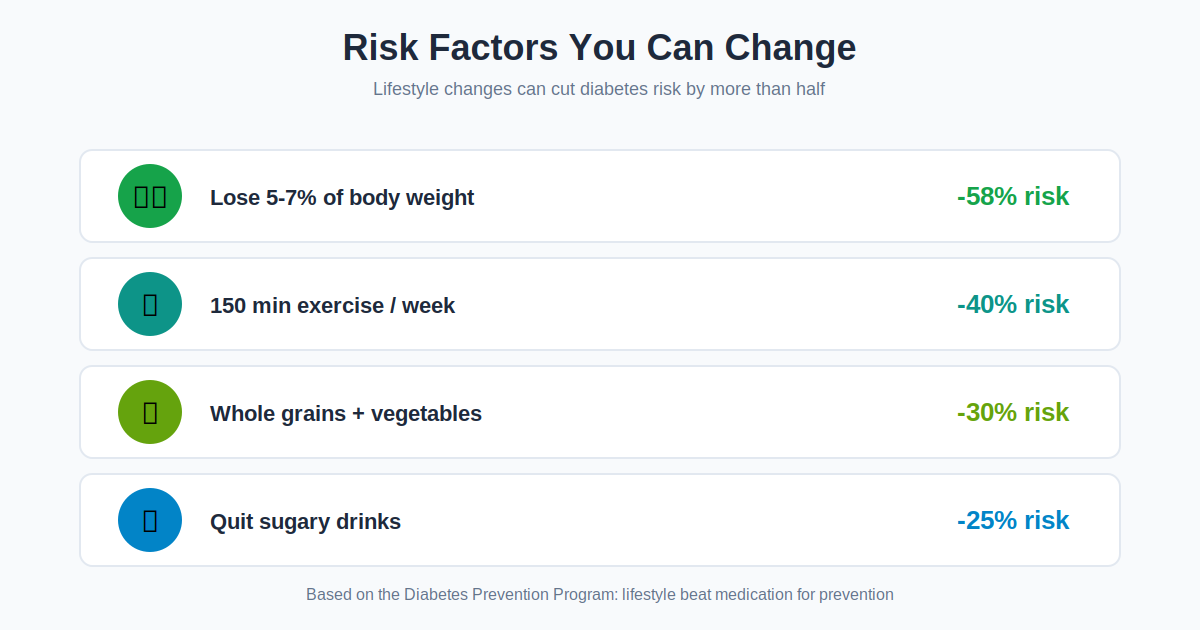
The most empowering fact about this score is how modifiable it is. The landmark Diabetes Prevention Program showed that losing 5 to 7 percent of body weight and getting 150 minutes of weekly activity cut progression to diabetes by 58 percent in high-risk adults — more than medication. Several inputs on this test (weight, waist, activity) move together when you change your habits.
The Scoring Table Behind Your Result
| Factor | Your situation | Points |
|---|---|---|
| Age | Under 45 / 45–54 / 55–64 / 65+ | 0 / 2 / 3 / 4 |
| BMI | Under 25 / 25–30 / over 30 | 0 / 1 / 3 |
| Waist — men | Under 94 cm / 94–102 cm / over 102 cm | 0 / 3 / 4 |
| Waist — women | Under 80 cm / 80–88 cm / over 88 cm | 0 / 3 / 4 |
| Physical activity | Less than 30 minutes a day | +2 |
| Blood pressure medication | Taking it | +2 |
| Family history | Grandparent, aunt, uncle, or cousin with diabetes | +3 |
| Family history | Parent, sibling, or child with diabetes | +5 |
Family history carries the heaviest single weight — you cannot change it, which is exactly why the modifiable rows (BMI, waist, activity) matter so much: they are the only levers you control.
Example Calculation
Take a 52-year-old man with BMI 29, a 102 cm waist, no daily 30-minute activity, blood pressure medication, and a father with diabetes. Score him with the table: age 52 → 2, BMI 29 → 1, waist 102 (the top of the middle band for men) → 3, inactivity → 2, medication → 2, and a first-degree relative → 5. Total: 15 points.
A score of 15 lands in the high band: roughly a 1-in-3 chance of developing type 2 diabetes within 10 years. But notice how much is changeable. Bringing BMI under 25 and waist under 94 cm, and adding daily activity, removes 1 + 3 + 2 = 6 points and lands at 9 — the slightly-elevated band, roughly 1 in 25. That swing, from choices rather than genetics, is the calculator's real message.
What To Do With Your Result
Low or slightly elevated (under 12). Keep doing what you are doing. Recheck yearly, and sooner if your weight, waist, or activity changes materially.
Moderate (12–14). This is the prevention sweet spot: the lifestyle changes in the Diabetes Prevention Program — 5–7% weight loss, 150 minutes of weekly activity — were proven in exactly this risk zone. Ask your doctor about a baseline blood test.
High (15–20). Book the blood test rather than just retaking questionnaires: a fasting glucose or HbA1c settles the question. For reference, an HbA1c under 5.7% is normal, 5.7–6.4% indicates prediabetes, and 6.5% or above indicates diabetes (confirmed on a repeat test). Prediabetes is not a life sentence — it is the stage where intervention works best.
Frequently Asked Questions
What is FINDRISC?
The Finnish Diabetes Risk Score is an 8-question screening tool developed from a large Finnish population study. It estimates 10-year type 2 diabetes risk without any blood work, and it has been validated in European, Asian, and American populations. Doctors use it to decide who needs closer screening.
Does a high score mean I will definitely get diabetes?
No. A score in the high band (15–20 here) means about a 1-in-3 chance over 10 years — serious, but far from certain. More importantly, the score measures modifiable risk. Lifestyle intervention has been proven to cut that risk dramatically, so a high score is best read as an early warning, not a prediction.
What lowers diabetes risk the most?
The biggest proven lever is modest weight loss — 5 to 7 percent of body weight — combined with 150 minutes per week of brisk activity. In clinical trials this outperformed medication. Cutting sugary drinks, adding fiber, and building muscle through resistance training all help independently.
How often should I retake this test?
Once a year is reasonable, or after any major change in weight, activity, or medication. Because most inputs shift gradually, annual checks let you see whether your trend is improving. If your score is 15 or above, discuss screening blood tests like fasting glucose or HbA1c with your doctor.
Does this cover type 1 diabetes?
No. This calculator estimates type 2 diabetes risk only, which is driven by insulin resistance and lifestyle factors. Type 1 diabetes is an autoimmune condition with different risk factors and typically appears earlier in life. If you have symptoms like extreme thirst, frequent urination, or unexplained weight loss, see a doctor promptly regardless of score.
Can this calculator diagnose diabetes?
No. This is a screening questionnaire — it estimates the probability of developing type 2 diabetes over the next 10 years from risk factors alone, without any blood measurement. Only blood tests (HbA1c, fasting glucose, or an oral glucose tolerance test) can diagnose diabetes or prediabetes. A high score is a reason to get tested, not a diagnosis, and a low score does not rule diabetes out if you have symptoms.
Related Calculators
Try our BMI Calculator and Calorie Calculator for more calculations.