Convert raw test scores to percentages and letter grades. Apply curves, drop lowest scores, and see exactly where you stand.
Enter your score and the total possible points.
How to Use the Test Score Calculator
Turn any raw score into a percentage and letter grade in seconds. Whether you are a student checking your standing or a teacher grading a stack of papers, this tool handles standard scales, plus/minus scales, pass/fail, and curve adjustments.
- Enter points earned. Your raw score, such as 42.
- Enter total possible points. The test's maximum, such as 50.
- Pick a grading scale. Standard 90/80/70/60 is the default; switch to plus/minus for finer distinctions or pass/fail for threshold courses.
- Add a curve if needed. If the teacher adds points to everyone, enter that number and watch grades shift.
How Test Scores Become Grades
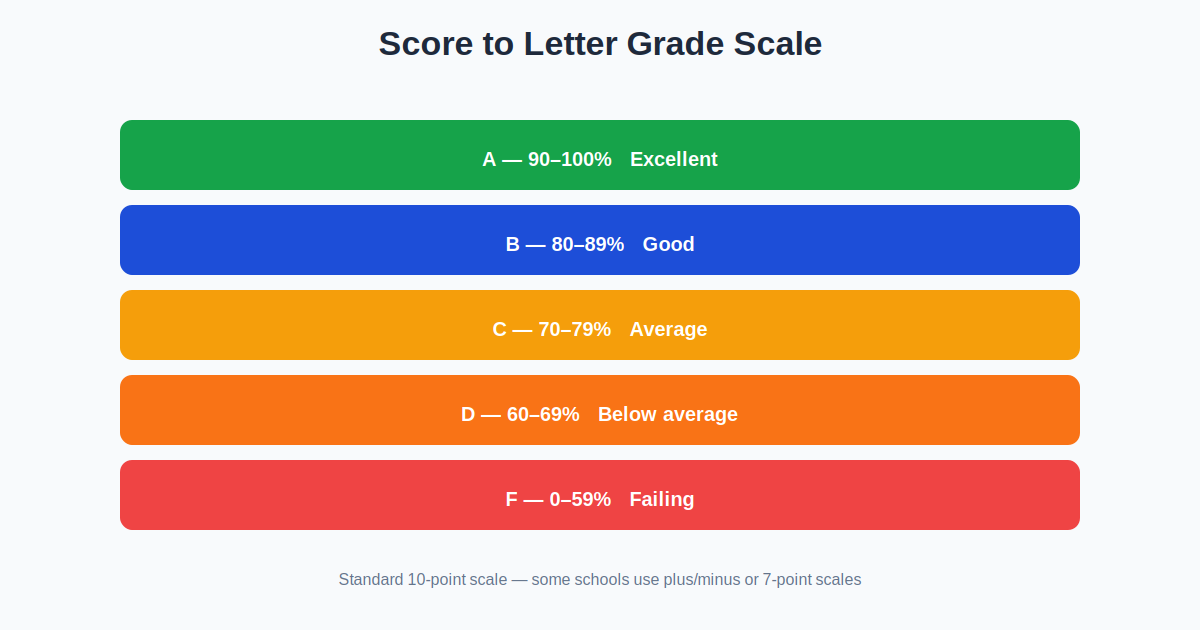
The core math is one division: percentage = (points earned / total points) x 100. A 42 out of 50 becomes 84 percent, a solid B on the standard scale. Letter boundaries are conventions, not laws of nature — the familiar 90/80/70/60 cutoffs dominate American schools, while plus/minus systems slice each band into thirds for more precision.
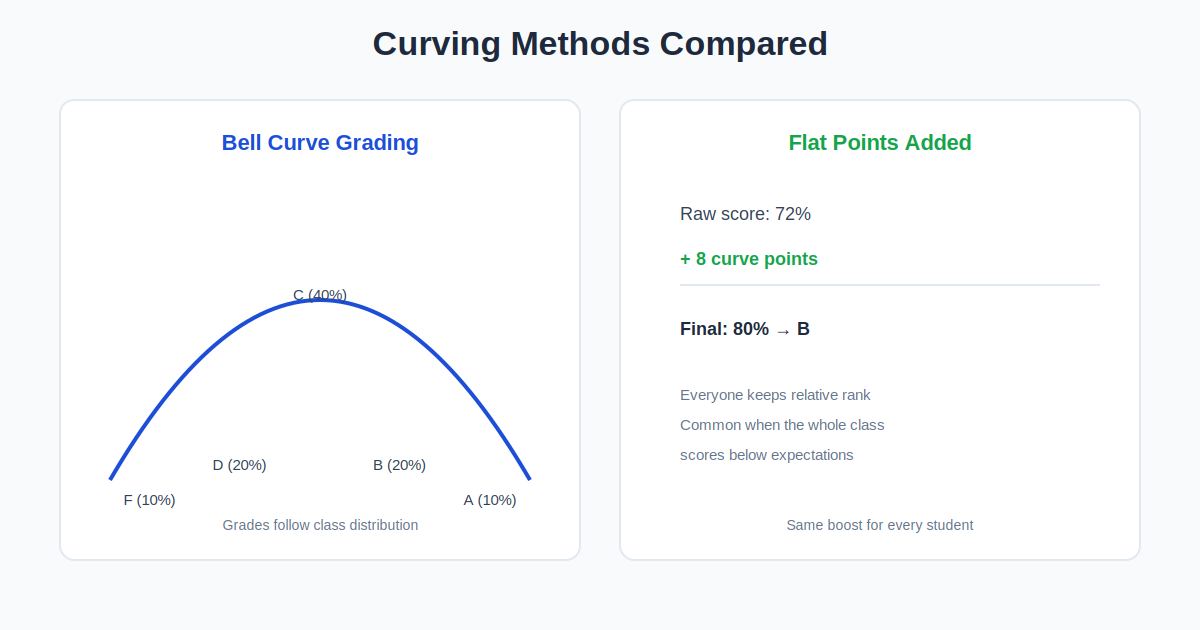
Curving adjusts for unusually hard tests. The simplest curve adds a flat number of points to every score. A more sophisticated approach, rarely needed for quick checks, rescales so the class average hits a target like 75 percent. Whatever the method, the goal is fairness: grades should reflect what you learned relative to what the test actually measured.
Worked Example
You score 42 out of 50. Percentage: 42 / 50 = 0.84, times 100 = 84 percent. On the standard scale, 84 falls in the 80-89 band: a B. With a 3-point curve, your adjusted score is 45 / 50 = 90 percent — an A. That three-point bump moved you a full letter grade, which shows why curves matter on tough exams. Reproduce this above by entering 42, 50, and a curve of 3.
The Plus/Minus Grading Scale
If your school slices each letter grade into plus and minus bands, select the plus/minus scale in the calculator — it uses exactly these cutoffs:
| Grade | Percentage |
|---|---|
| A+ | 97 to 100% |
| A | 93 to 96% |
| A- | 90 to 92% |
| B+ | 87 to 89% |
| B | 83 to 86% |
| B- | 80 to 82% |
| C+ | 77 to 79% |
| C | 73 to 76% |
| C- | 70 to 72% |
| D+ | 67 to 69% |
| D | 63 to 66% |
| D- | 60 to 62% |
| F | Below 60% |
On the standard scale the same score is simpler: 90 and up is an A, 80 a B, 70 a C, 60 a D, and below 60 an F. The pass/fail option in the calculator uses a single 60 percent line.
Quick Grading Chart: A 25-Question Test
Teachers grading a stack of identical tests think in wrong answers, not percentages. On a 25-question test each question is worth 4 percent, so the whole grading chart fits in one small table:
| Wrong | Correct | Score | Grade |
|---|---|---|---|
| 0 | 25 | 100% | A |
| 1 | 24 | 96% | A |
| 2 | 23 | 92% | A |
| 3 | 22 | 88% | B |
| 4 | 21 | 84% | B |
| 5 | 20 | 80% | B |
| 6 | 19 | 76% | C |
| 7 | 18 | 72% | C |
| 8 | 17 | 68% | D |
| 9 | 16 | 64% | D |
| 10 | 15 | 60% | D |
The pattern generalizes: each question on any test is worth 100 divided by the number of questions, so on a 20-question test every miss costs 5 percent and on a 50-question test only 2 percent. That is why one careless mistake hurts far more on a short quiz than on a long exam.
Frequently Asked Questions
How do I calculate my test percentage?
Divide points earned by total possible points and multiply by 100. For example, 42/50 = 0.84, which is 84 percent.
What is a good test score?
On the standard scale, 90+ is an A, 80+ a B, 70+ a C. But "good" depends on context — an 84 on a brutal organic chemistry exam may top the class.
How does curving work?
The simplest curve adds the same points to everyone. If the highest score was 88/100, a teacher might add 12 points so the top becomes 100 and everyone rises equally.
What is the plus/minus grading scale?
It splits each letter into three: A (93-96), A- (90-92), B+ (87-89), and so on. It rewards scores near the top of each band more precisely.
Can a score exceed 100 percent?
With extra credit, yes. This calculator caps curved scores at the total possible, which matches how most teachers handle it.
How many questions can I get wrong and still pass?
It depends on the passing line. On a 40-question test with a 60 percent pass mark, you need 24 correct answers (24 out of 40 = 60 percent), so you can afford to miss 16. At a 70 percent pass mark you need 28 correct and can miss only 12. To find your exact cutoff, enter your score in the calculator and lower it until the grade flips.
How many questions can I miss and still get an A?
On the standard scale an A starts at 90 percent. On a 50-question test that means at least 45 correct answers, so you can miss at most 5. On a 20-question test you need 18 correct and can miss only 2 — the shorter the test, the more each question costs you.
Related Calculators
Tracking semester performance? The College GPA Calculator combines all your grades. For quick percent math, use the Percentage Calculator. Wondering what you need on the final exam? The Final Grade Calculator works that out.