nPr (ordered) and nCr (unordered) — how many ways to choose r from n.
Results are estimates for planning purposes and are not financial, medical, or professional advice.
How to Use the Permutation and Combination Calculator
Counting problems show up in probability, statistics, and games of chance. Enter how many items you have and how many you are choosing, pick permutation or combination, and the calculator returns the number of possible arrangements.
- Enter n, the total number of items to choose from.
- Enter r, how many items you are selecting.
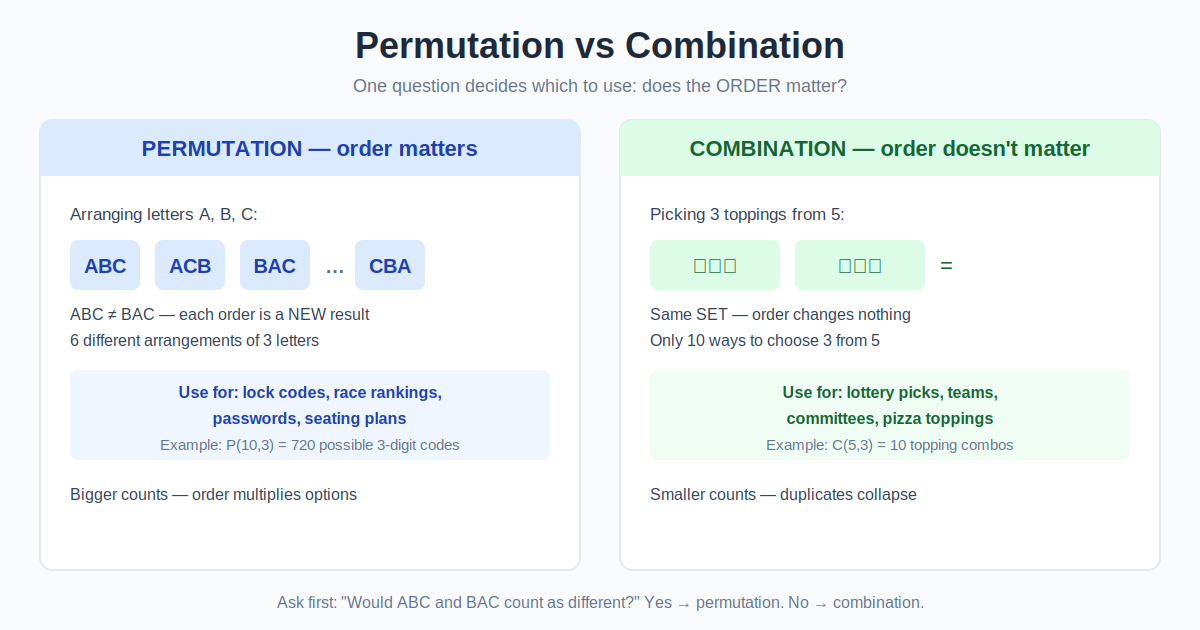
- Choose permutation if order matters, like awarding gold, silver, and bronze medals.
- Choose combination if order does not matter, like picking lottery numbers.
Permutation and Combination Calculator Formula
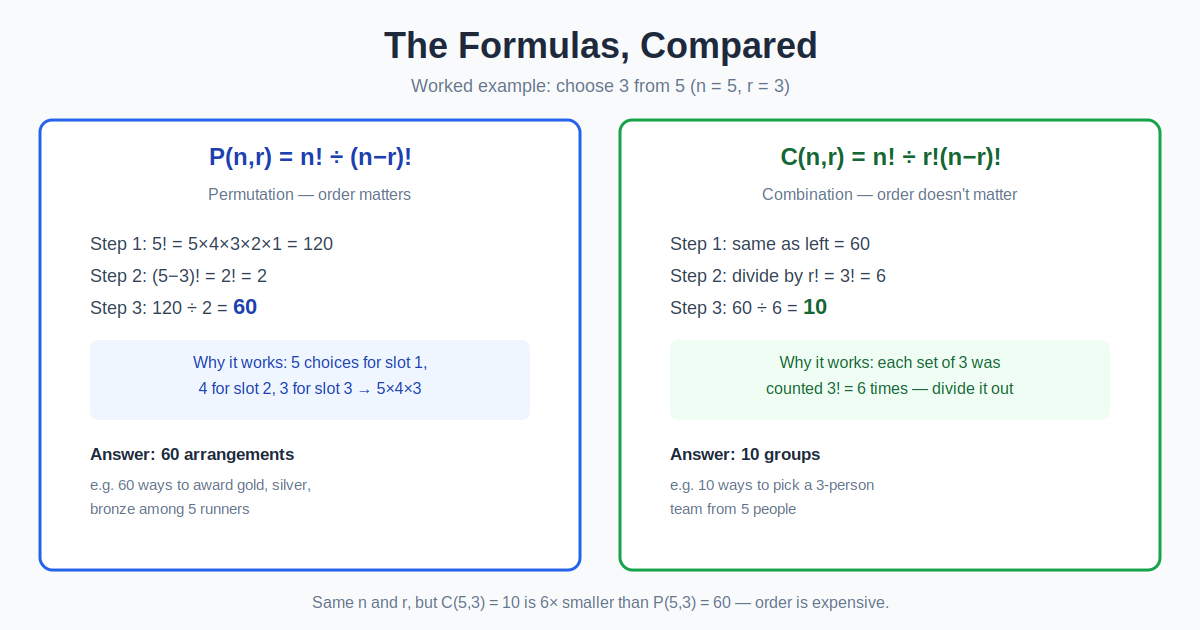
Permutations count ordered arrangements: pick r items from n, and every ordering counts separately. Combinations count unordered groups: the same items in a different order count only once, so you divide by the arrangements of r.
P(n,r) = n! divided by (n-r)!. C(n,r) = n! divided by (r! x (n-r)!).
Example Calculation
Ten runners compete for gold, silver, and bronze. Order matters, so use permutations: P(10,3) = 10! divided by 7! = 10 x 9 x 8 = 720 possible medal outcomes.
A lottery draws 6 numbers from 49, where order does not matter. Use combinations: C(49,6) = 49! divided by (6! x 43!) = 13,983,816 possible tickets. That huge number is why jackpots are so hard to win.
Permutations and Combinations with Repetition
For ordered picks with repetition, like a 4-digit PIN where digits may repeat, the count is n to the power r: 10 to the power 4 = 10,000 possible PINs. For unordered picks with repetition, like choosing 3 scoops from 10 ice cream flavors, use the multiset formula C(n + r – 1, r): C(12, 3) = 220 combinations. The standard formulas above assume no repetition.
Frequently Asked Questions
What is the difference between permutation and combination?
Order matters in permutations but not in combinations. A safe combination of 1-2-3 is really a permutation, since 3-2-1 will not open it. A poker hand is a combination, since the same five cards win regardless of the order dealt.
How do I know whether to use permutation or combination?
Ask whether rearranging the chosen items creates a different outcome. If yes, like race positions or passwords, use permutation. If no, like committee members or pizza toppings, use combination.
What does nCr mean on a calculator?
nCr is the combination function: the number of ways to choose r items from n without regard to order. nPr is its permutation sibling, where order counts.
What is zero factorial?
Zero factorial equals 1 by definition. This keeps the formulas consistent: C(n,0) = 1, which makes sense because there is exactly one way to choose nothing.
Where are permutations used in real life?
Password strength estimates, sports tournament brackets, seating arrangements, and card game odds all rely on permutations and combinations. Any time you ask “how many ways,” you are doing combinatorics.
Can items repeat in permutations and combinations?
Yes. A PIN code reuses digits, so its count is n to the power r, and choosing repeated ice cream flavors uses C(n + r – 1, r). Check whether your situation allows repeats before picking a formula.
Related Calculators
Dive deeper into statistics with our Standard Deviation Calculator, and handle everyday math with our Percentage Calculator.