Calculate yield, price, and total return on US Treasury bonds and bills.

How to Use the Treasury Bond Calculator
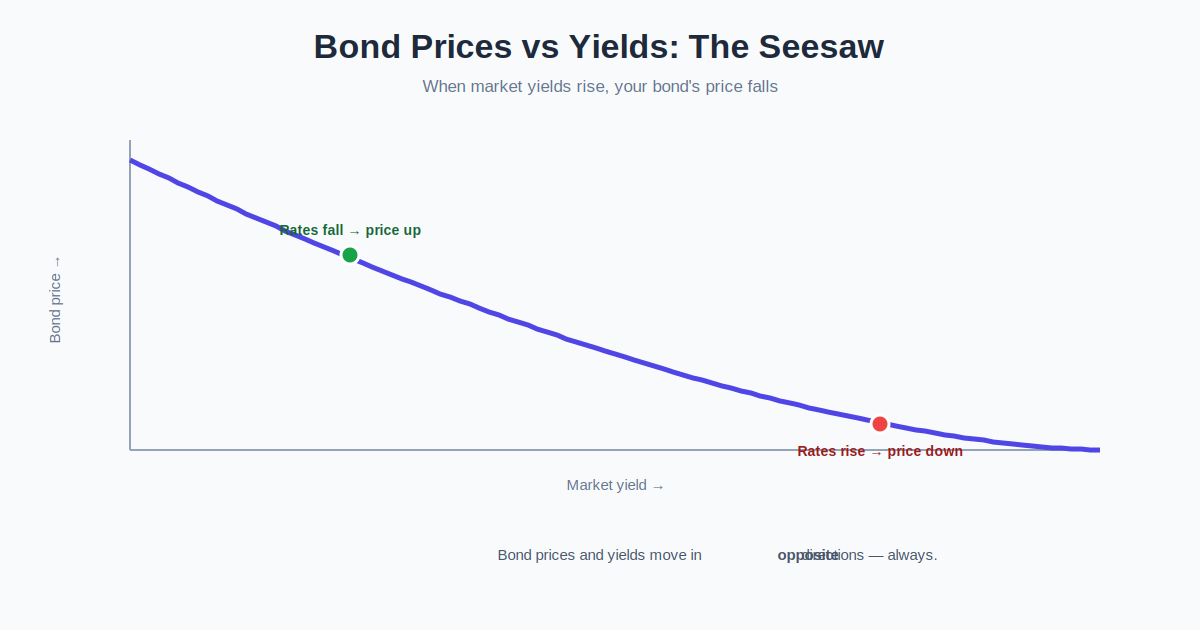
Treasury bonds are the safest investment on earth — backed by the US government — but price and yield move in opposite directions, which confuses beginners. This calculator translates between price, coupon, and yield to maturity.
- Enter the bond’s face value, annual coupon rate, and years to maturity.
- Enter the market yield — the return investors currently demand on similar bonds — and the calculator works out the bond’s fair price at that yield.
- See the fair price, the annual coupon payments, and the total interest you would collect by holding the bond to maturity.
- Compare buying at par, at a discount, or at a premium to understand price-yield mechanics.
Treasury Bond Formula
A bond’s yield to maturity (YTM) is the discount rate that equates the present value of all future payments to the current price. For a bond with face value F, annual coupon C, n years left, and price P: P = C/(1+y) + C/(1+y)² + … + (C+F)/(1+y)ⁿ, solved for y. You do not need to solve this by hand — the calculator iterates to find y — but the relationship it encodes is the key insight: when market prices fall, yields rise, and vice versa.
Coupon payments are fixed: a $10,000 bond with a 4% coupon pays $400 a year ($200 every six months) no matter what happens to market prices. Buy below face value (at a discount) and your yield exceeds the coupon rate, because you also pocket the difference at maturity. Buy above face (at a premium) and yield falls below the coupon. Treasury interest is exempt from state and local income tax — a meaningful edge over CDs and corporate bonds for residents of high-tax states.
Example Calculation
A 10-year Treasury with $10,000 face value and a 4% coupon pays $400 annually. If you buy it at 95 (paying $9,500), your yield to maturity is about 4.65% — higher than the 4% coupon because you will also collect the $500 discount at maturity. If instead you pay 105 ($10,500, a premium), yield drops to roughly 3.4%. Same bond, same coupon, three different yields depending on price. A California resident in the 9.3% state bracket effectively earns about 0.4 percentage points more on Treasuries than on a CD with the identical headline yield, thanks to the state tax exemption.
Treasury Bills and Current Yield: Two Related Calculations
This calculator works with coupon-paying bonds, but two nearby calculations come up constantly in Treasury investing.
Treasury bills pay no coupon. You buy them below face value and receive full face at maturity, so price comes from a discount formula: Price = Face × (1 − (days × rate) / 360). A $1,000 bill with 180 days at 1.5% costs $992.50 — the $7.50 difference is your interest.
Current yield is the quick, incomplete cousin of YTM: annual coupon divided by price paid. A bond paying $50 a year bought for $950 has a current yield of 50 / 950 = 5.26%. Handy for comparing income today, it ignores the gain or loss waiting at maturity.
Yield to maturity stays the complete measure: coupon, price, and maturity payoff folded into one honest rate.
Frequently Asked Questions
What is the difference between a Treasury bill, note, and bond?
Bills mature in under a year and pay no coupon (sold at a discount). Notes run 2–10 years and bonds 20–30 years, both paying semiannual coupons. All three carry the same US government backing.
Why do bond prices fall when interest rates rise?
Existing bonds pay fixed coupons, so when new bonds offer higher rates, old ones must drop in price until their yield matches. A bond is just future cash flows — higher discount rates mean lower present value.
Are Treasury bonds really risk-free?
They carry no default risk in nominal dollars — the government can always print more. But they do carry inflation risk (fixed payments lose purchasing power) and interest-rate risk (sell before maturity and the price may be down).
How are Treasury bonds taxed?
Federal income tax applies to the interest, but it is exempt from all state and local income tax. Capital gains from selling above your purchase price are taxed like any investment gain.
Should I buy individual bonds or a bond fund?
Individual bonds held to maturity guarantee your principal back; funds never mature and their price fluctuates forever. Funds win on diversification and simplicity, individual bonds win on certainty of outcome.
What is the difference between current yield and yield to maturity?
Current yield is the annual coupon divided by the price — a snapshot of income today. Yield to maturity is the total annualized return from holding to redemption, including the difference between price paid and face value received. For a discount bond YTM is higher than current yield; for a premium bond, lower; at face value, the two are equal.
Why do longer-term bonds swing more in price than short-term ones?
Their payments stretch further into the future, and distant payments lose the most value when rates rise — an effect called duration. A 30-year bond’s price can move 15 to 20 percent when yields change by one point, while a 3-month bill barely budges.
Related Calculators
Try our Compound Interest Calculator and Income Tax Calculator for more calculations.