The 30-Second Check Before You Buy Rims
You found the perfect wheels — right style, right diameter — but the listing says “8.5″ wide, ET30” and your current wheels are 7″ ET45. Will the new ones stick out past the fender? Will they clear the strut? That single unknown is what stops most people from ordering, and it is exactly what this wheel offset calculator answers.
Enter the new wheel’s width and offset and you get its backspacing and front spacing instantly. Add your current wheel’s specs and you get a direct comparison: exactly how many millimeters further out (or in) the new wheel sits, how inner clearance changes, and plain-English guidance on whether the fitment looks safe. No signup, no app, no guesswork.
Wheel Offset Calculator
New wheel specs
Current wheel specs optional — for comparison
Please enter a new wheel width (3–20 in) and offset (−60 to +80 mm).
Backspacing
–
How to Use This Calculator
- Enter the new wheel’s width in inches — the number stamped on the wheel or listed by the seller (e.g. 8).
- Enter the new wheel’s offset (ET) in millimeters — usually stamped as “ET35” on the barrel. Negative values are allowed.
- Optional: add your current wheel’s width and offset for a head-to-head comparison showing poke and clearance changes in millimeters.
- Click “Calculate Fitment” — the tool shows backspacing, front spacing, a step-by-step breakdown, and fitment guidance.
- Read the guidance box — it says in plain words whether the new wheel pokes out or tucks in, with warnings when a number looks risky.
What Is Wheel Offset, Really?
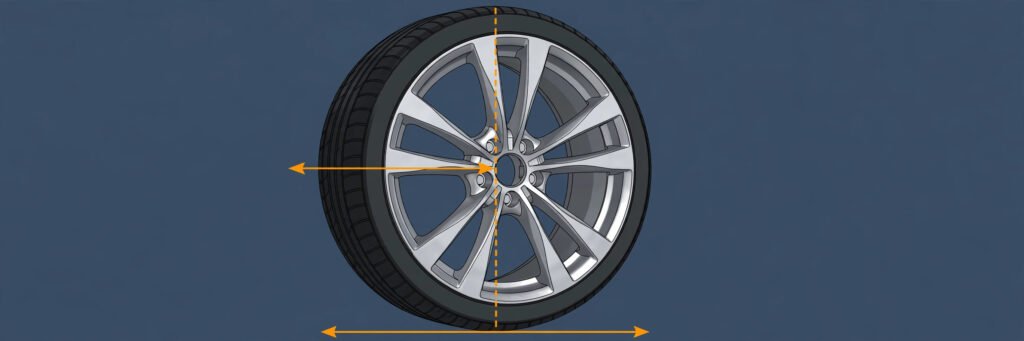
Wheel offset — stamped as ET (from the German Einpresstiefe, “insertion depth”) — is the distance in millimeters between the wheel’s mounting face (the surface that bolts to your hub) and the wheel’s true centerline. It answers one question: where does the wheel sit relative to where it bolts on?
- Positive offset (ET+35): the mounting face sits outboard of the centerline — the wheel tucks deeper under the fender, like most factory wheels.
- Zero offset (ET0): the mounting face is exactly on the centerline — the wheel is perfectly centered.
- Negative offset (ET−12): the mounting face sits inboard of the centerline — the wheel pushes outward for a deep-lip stance.
Offset is the counterpart to backspacing: backspacing measures in inches from the wheel’s inner lip to the mounting face. They describe the same mounting position from opposite directions, so they convert directly into each other.
The Formulas
Front spacing (in) = wheel width − backspacing
Poke change (mm) = (new front spacing − current front spacing) × 25.4
The 0.5″ in the backspacing formula is the standard lip allowance: width is measured bead-to-bead, backspacing from the outer lip. It is the convention wheel shops use, so our numbers match manufacturer specs.
Worked example — my own numbers
Take a common aftermarket wheel: 8 inches wide, ET+35.
- Offset in inches: 35 ÷ 25.4 = 1.378″
- Backspacing: 4″ (half of 8) + 0.5″ (lip) + 1.378″ = 5.878″
- Front spacing: 8″ − 5.878″ = 2.122″
Now compare it with a stock wheel — 7 inches wide, ET+45: backspacing = 3.5 + 0.5 + (45 ÷ 25.4) = 5.772″, front spacing = 7 − 5.772 = 1.228″. Poke change = (2.122 − 1.228) × 25.4 = +22.7 mm — the new wheel sticks out about 23 mm further. Backspacing also grows, from 5.772″ to 5.878″, so the inner edge sits about 2.7 mm closer to the suspension. That is well past the measure-first zone: check fender clearance before buying.
Poke vs inset: two words for the same geometry
Poke is how far the wheel sits outward, toward or past the fender edge. Inset is the opposite: how far it tucks inward, toward the suspension. Every fitment change mixes both, which is why this calculator reports the outer and inner positions together.
Offset Ranges at a Glance
| Offset (ET) | Typical stance | Common use |
|---|---|---|
| +50 to +65 | Deeply tucked in | Stock wheels on most front-wheel-drive cars |
| +35 to +50 | Tucked in | Common aftermarket street fitment |
| +20 to +35 | Moderate | Sporty, near-flush setups |
| 0 to +20 | Near flush | Wide wheels, mild poke |
| Negative | Pokes out | Stance, drift, and show builds — rubbing possible |
Staying within about ±5 mm of your factory offset keeps steering geometry and bearing loads close to stock. Beyond ±10 mm, measure your fender and suspension clearance properly.
Who This Calculator Is For
- Car enthusiasts upgrading wheels — see exactly how new rims change stance before spending money.
- Buyers shopping used wheels — decode an ET stamp and check it against your current setup.
- Track and stance builders — dial in flush fitment or safe poke with real numbers, not forum guesses.
- Anyone considering spacers — a 20 mm spacer behaves like 20 mm less offset, so you can preview its effect with the same math.
Tips for a safe fitment
- Measure twice, order once. Run your numbers here, then physically measure the gaps at the fender and the strut.
- Offset is only part of fitment. Bolt pattern (PCD), center bore and load rating must match your vehicle too.
- Wider wheels change two things at once. Going wider moves the outer edge out and the inner edge in — check fender and suspension clearance.
- Tires matter too. A wider tire extends further in both directions than the wheel numbers alone suggest.
How to Measure Offset on a Wheel You Already Own
- Lay the wheel face down on a flat surface, tire removed if possible.
- Measure the total width from the outer lip to the inner lip, in inches.
- Measure the backspacing: lay a straight edge across the inner lip and measure down to the mounting face.
- Convert to offset: ET in millimeters = (backspacing − total width ÷ 2 − 0.5) × 25.4, using the same lip allowance as the formula above.
Enter the result in the calculator above before buying a matching set or spacers.
Frequently Asked Questions
What is the difference between offset and backspacing?
Both describe where the wheel’s mounting face sits, just from different reference points. Offset (ET) is measured in millimeters from the wheel’s centerline; backspacing is measured in inches from the inner lip. They are directly convertible — this calculator shows both.
Does a negative offset mean the wheel sticks out more?
Yes. Negative offset places the mounting face inboard of the centerline, pushing the wheel outward for a deep-lip look. Positive offset tucks the wheel further under the fender.
How much poke is safe?
That depends on your car’s fender clearance, but as a rough guide: under ~10 mm of extra poke is usually fine, 10–15 mm deserves a check, and beyond ~15 mm you should measure for rubbing.
What does the 0.5 inch in the backspacing formula mean?
Wheel width is measured bead-to-bead, but backspacing is measured from the outer lip. The 0.5″ lip allowance bridges that gap — it is the industry-standard convention wheel shops use, which is why our results match manufacturer specs.
How do wheel spacers affect offset?
A spacer moves the wheel outward, which lowers the effective offset: a 20 mm spacer on an ET35 wheel behaves like ET15. Run ET15 through the calculator to preview the effect.
Will changing offset affect my car’s handling?
It can: large offset changes alter scrub radius and steering feel and push more load onto the wheel bearings. Keeping changes modest and verifying clearances minimizes the risk.
Is this calculator free?
Yes — completely free, no signup, works in your browser on phones and desktops.
How can I measure wheel offset at home?
Lay the wheel face down, measure its total width lip to lip, then measure from a straight edge across the inner lip down to the mounting face for the backspacing. Convert with ET = (backspacing − width ÷ 2 − 0.5) × 25.4.
What does the ET number stamped on my wheel mean?
It is the offset in millimeters, usually cast into the back of a spoke or stamped on the barrel, such as ET35 or ET45. A higher ET tucks the wheel further in; a lower or negative ET pushes it out.
Final Thoughts
Offset is the least visible and most consequential number on a wheel listing. Two wheels that look identical in a photo can sit 30 millimeters apart on your car — the difference between a perfect flush fit and a fender that eats your tire on the first bump. Run the numbers here, measure your real clearances, and order with confidence instead of hope.
Working on More Than Wheels?
Estimate material needs with our asphalt calculator or figure your freight class before you ship.