Convert angles between degrees, radians, gradians, and turns instantly. Perfect for math homework, engineering, and navigation.
Enter an angle and convert it to every unit.
How to Use the Angle Converter
- Type the angle value you want to convert. Decimals and negatives are accepted.
- Select the unit it is currently in: degrees, radians, gradians, or turns.
- Click Convert. The calculator shows the equivalent in all four units plus a normalized 0 to 360 degree value.
- Use the normalized row when you need a compass-style heading from a possibly large or negative angle.
- For trigonometry homework, copy the radian value directly into your calculator in radian mode.
Angle Unit Formulas
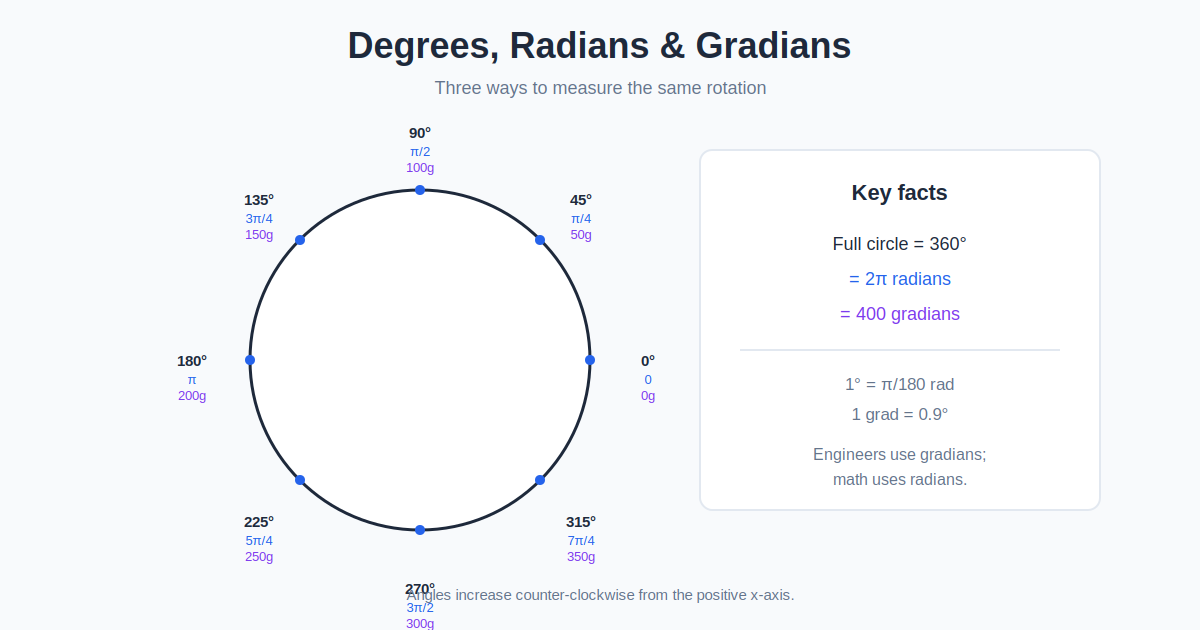
A full circle can be divided many ways, and each field picked its favorite. Degrees split it into 360, a legacy of Babylonian base-60 math, and remain the everyday standard. Radians are the mathematician’s choice: one radian is the angle that subtends an arc equal to the radius, and a full circle is exactly 2π radians, about 6.283. Gradians divide the circle into 400, so a right angle is a tidy 100 gradians; they appear in surveying and some European engineering. Turns, or revolutions, count whole circles, natural for motors and frequencies. Conversions all pivot through degrees: radians = degrees × π/180, gradians = degrees × 10/9 (equivalently degrees ÷ 0.9), turns = degrees ÷ 360. Going the other way: degrees = radians × 180/π, degrees = gradians × 0.9, degrees = turns × 360. The converter normalizes with modulo 360 so that 720 degrees reads as 0 and −90 degrees reads as 270, matching compass conventions. Remember that most programming languages and scientific calculators default trig functions to radians, a classic source of homework errors.
Worked Example
Convert 180 degrees. Radians: 180 × π/180 = π ≈ 3.14159. Gradians: 180 ÷ 0.9 = 200 gon. Turns: 180 ÷ 360 = 0.5 turns. Normalized: 180°. Now convert 1 radian back: degrees = 1 × 180/π ≈ 57.2958°, gradians ≈ 63.662 gon, turns ≈ 0.15915. A surveyor’s right angle of 100 gradians becomes 90 degrees (100 × 0.9), π/2 ≈ 1.5708 radians, and 0.25 turns. For a negative case, −45 degrees: radians −π/4 ≈ −0.7854, normalized 315°, which is the compass bearing pointing northwest. Motor example: 3.5 turns = 1260°, or 7π ≈ 21.99 radians, normalized to 180°. These conversions show up constantly: physics uses radians for angular velocity (a wheel spinning at 2 turns per second is 4π rad/s ≈ 12.57 rad/s), while construction and navigation live in degrees.
Landmark Angles in All Four Units
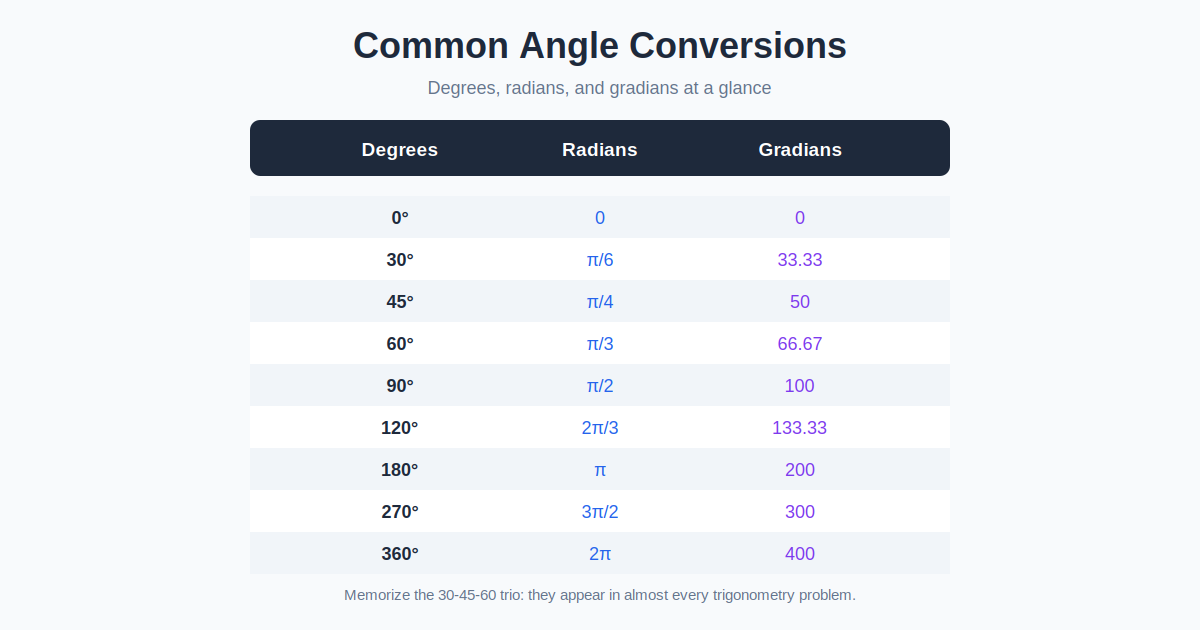
Certain angles appear so often that it helps to recognize them in every unit. The values below are exact:
| Degrees | Radians | Gradians | Turns |
|---|---|---|---|
| 0° | 0 | 0 | 0 |
| 30° | π/6 ≈ 0.5236 | 33.33 | 1/12 ≈ 0.0833 |
| 45° | π/4 ≈ 0.7854 | 50 | 1/8 = 0.125 |
| 60° | π/3 ≈ 1.0472 | 66.67 | 1/6 ≈ 0.1667 |
| 90° | π/2 ≈ 1.5708 | 100 | 1/4 = 0.25 |
| 180° | π ≈ 3.1416 | 200 | 1/2 = 0.5 |
| 270° | 3π/2 ≈ 4.7124 | 300 | 3/4 = 0.75 |
| 360° | 2π ≈ 6.2832 | 400 | 1 |
A handy mental shortcut: 1 radian ≈ 57.3°, so 2 radians is about 114.6° and 0.5 radians is about 28.6°.
Degrees, Minutes, and Seconds
Older navigation charts and some survey instruments split each degree into 60 minutes (′) and each minute into 60 seconds (″) — the same structure as hours, which is no coincidence. To convert a decimal degree to DMS, multiply the decimal part by 60 for minutes, then multiply the remaining decimal by 60 for seconds. For example, 12.5° = 12° + 0.5 × 60′ = 12°30′00″. The calculator above works with decimal values; if you meet an angle written like 45°17′22″, convert it to decimal first (45 + 17/60 + 22/3600 ≈ 45.2894°) and then convert freely.
Where You Will Meet Each Unit
Radians are the language of physics, calculus, and programming — almost every programming language’s trig functions expect radians, which is the most common source of wrong answers (see the FAQ below). They also make the arc-length formula beautifully simple: arc length s = rθ, so a 0.5-radian slice of a circle with radius 10 has an arc length of exactly 5. Gradians are still used in some European surveying and artillery work, where a right angle is a clean 100 gon. Turns are natural for describing rotations in engineering and animation: 2.5 turns means exactly what it says, with no conversion needed.
Frequently Asked Questions
Why do mathematicians prefer radians?
Radians make calculus clean: the derivative of sin(x) is cos(x) only in radians, and arc length is simply radius times angle. Degrees need constant conversion factors.
What are gradians used for?
Mainly surveying and some military artillery work. A right angle is exactly 100 gradians, which simplifies grading calculations in the field.
How many radians are in a full circle?
Exactly 2π, about 6.28319. Half a circle is π, a quarter is π/2. Memorizing these landmarks makes mental conversion much easier.
What is the difference between turns and degrees?
Turns count whole rotations (1 turn = 360°). They are natural for spinning objects: a car engine at 3000 RPM makes 50 turns per second, or 100π radians per second.
Why did my trig answer come out wrong?
The most common cause is radian/degree mode mismatch. If your calculator is in radian mode and you type sin(30), you get sin(30 radians), not sin(30°). Always check the mode first.
How do I convert degrees to radians quickly?
Multiply degrees by π/180 (about 0.01745), or just remember that 1 radian is about 57.3°. A rough check: 90° should come out to about 1.57 rad.
What is a milliradian?
A milliradian is a thousandth of a radian, about 0.0573°. It is used in military optics, surveying instruments, and rifle scopes, where tiny angular adjustments at long range are measured in ‘mils.’
Why are there 360 degrees in a circle?
The most common explanation is historical: the Babylonians used a base-60 number system, and 360 has many divisors (2, 3, 4, 5, 6, 8, 9, 10, 12, …), which makes dividing a circle convenient. It is a convention, not a law of nature — hence gradians and turns.
Related Calculators
Apply angles in triangles with our Pythagorean Theorem Calculator and handle trig functions with our Scientific Calculator.