How to Use the Present Value Calculator
A dollar today is worth more than a dollar in ten years, because today's dollar can be invested. This calculator discounts a future amount back to its equivalent value right now, using your chosen interest rate.
- Enter the future value, the amount you expect to receive later.
- Enter the discount rate as a percentage. This is often your expected investment return.
- Enter the number of periods, usually years, until you receive the money.
- Read the present value result instantly.
Present Value Calculator Formula
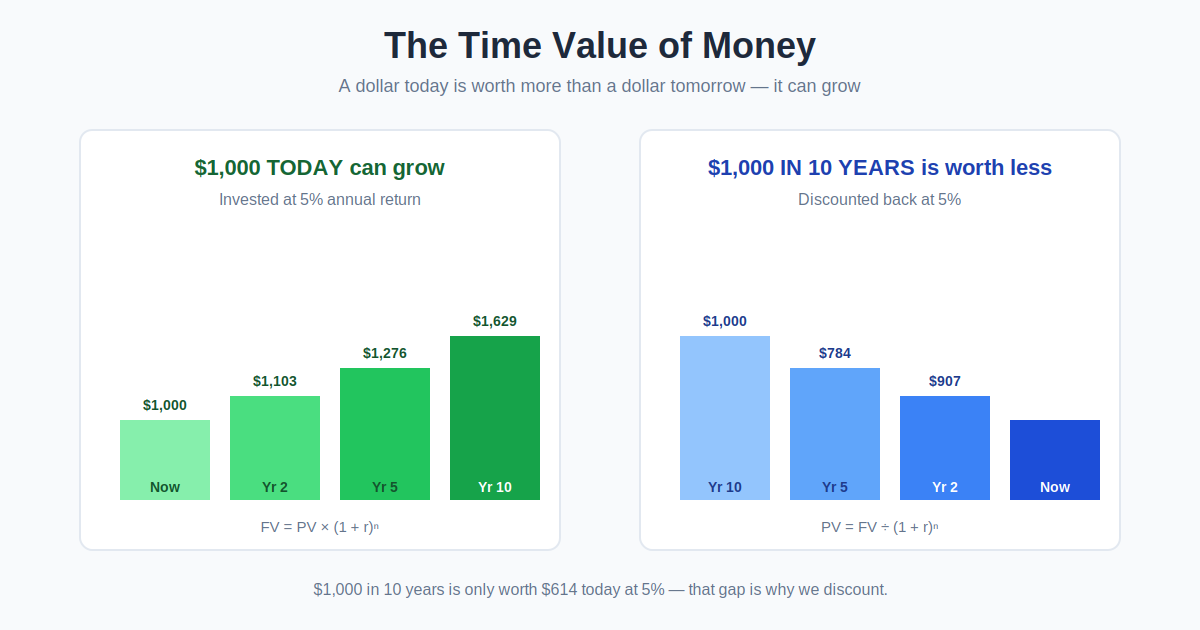
Present value reverses compound growth. While compound interest grows money forward by multiplying by (1 + rate) each period, present value shrinks a future sum by dividing by the same factor. A higher discount rate or longer wait both push present value lower.
PV = FV divided by (1 + r) to the power n, where FV is future value, r is the discount rate per period, and n is the number of periods.
Example Calculation
You are promised 10,000 dollars ten years from now, and you use a 5 percent discount rate. Plugging into the formula: PV = 10,000 divided by (1.05) to the power 10.
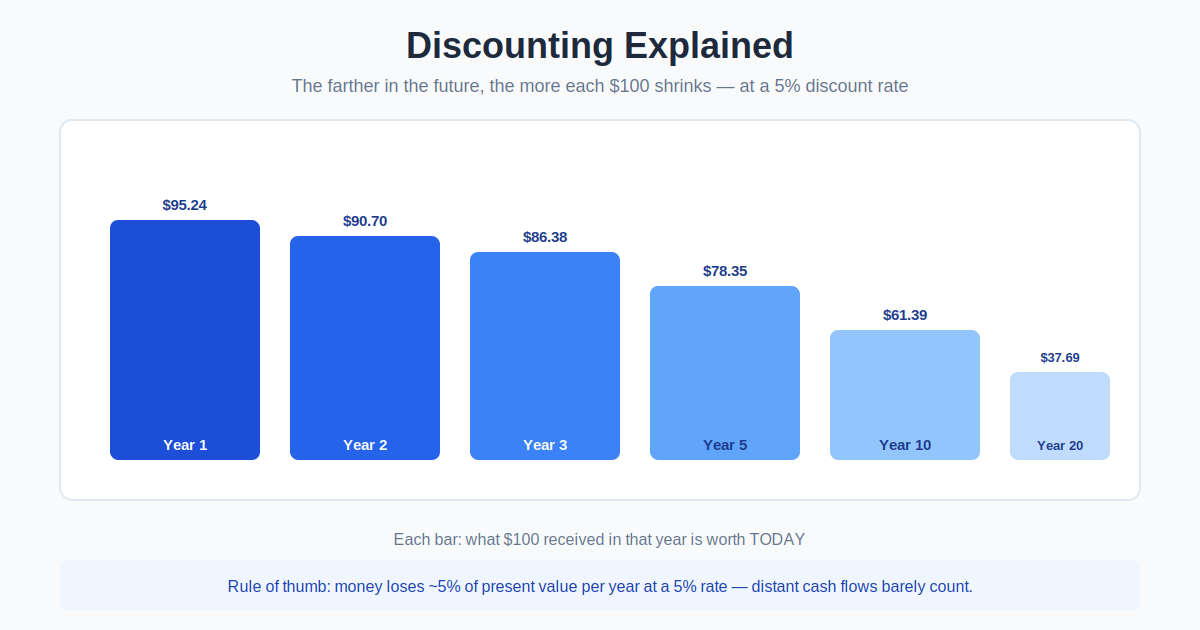
First compute (1.05) to the power 10 = 1.6289. Then 10,000 divided by 1.6289 = 6,139.13 dollars. That future 10,000 is worth about 6,139 dollars in today's money at a 5 percent return.
Choosing the Right Discount Rate
The discount rate represents the return you give up by waiting. For personal decisions, use the return you could earn on money with similar risk — a savings account rate for near-certain payments, or 5 to 7 percent for riskier ones. Businesses use their cost of capital. A higher rate or longer wait shrinks present value, so try a couple of rates to see how sensitive your answer is.
Frequently Asked Questions
What is present value in simple terms?
Present value is what a future payment is worth right now. It answers questions like "how much would I need to invest today to have 10,000 dollars in ten years?"
What is the difference between present value and net present value?
Present value discounts a single future amount. Net present value discounts a whole series of future cash flows and subtracts the initial investment, which is how businesses judge projects.
What discount rate should I use?
Use the return you could earn elsewhere with similar risk. For personal decisions, 5 to 7 percent is common. For business projects, use the company's cost of capital.
Why is money today worth more than money tomorrow?
Three reasons: you can invest today's money and earn returns, inflation erodes future purchasing power, and there is always some risk you never receive the future payment.
How do you calculate the present value of an annuity?
An annuity is a series of equal payments. Its present value is the payment times (1 minus (1 + r) to the power -n) divided by r. Our calculator handles single sums, and the annuity formula extends the same discounting idea across many periods.
What is the present value interest factor (PVIF)?
The present value interest factor is the discount multiplier itself: 1 divided by (1 + r) to the power n. For 10 years at 5 percent, the PVIF is 0.6139, which is why 10,000 dollars of future money is worth about 6,139 dollars today.
Related Calculators
Run the math in reverse with our Compound Interest Calculator, and plan borrowing costs with our Loan Calculator.