Calculate engine horsepower from torque and RPM, or estimate from 0-60 times.

What Does a Horsepower Calculator Do?
Horsepower is the number everyone quotes when they talk about how fast or powerful a car is, yet few drivers know where their own car’s number comes from. A horsepower calculator removes the guesswork: enter your engine’s torque and RPM and it instantly shows how much power the engine makes at that point in the rev range. Whether you are comparing cars before a purchase, checking the effect of a tune or modification, or settling a debate, this tool gives a fast, math-based answer instead of a brochure figure.
Our horsepower calculator works in two modes. The direct engineering mode computes horsepower from torque and RPM using the same formula dynamometers rely on. The estimation mode works backwards from real-world performance — the car’s weight plus its 0 to 60 mph time or quarter-mile trap speed — to approximate the power it must be making.
How to Use the Horsepower Calculator
- Choose your calculation mode. If you know the engine’s torque figure (from a dyno sheet or the manufacturer’s specs) and the RPM where it occurs, pick the torque and RPM mode. If you only know how the car performs, pick the 0 to 60 or trap-speed estimation mode.
- Enter torque in pound-feet and RPM. Type the torque value and the engine speed it was measured at. For the most meaningful result, use the RPM of peak torque or peak power rather than redline, since horsepower differs at every point in the rev range.
- For estimation mode, enter weight and performance data. Provide the car’s weight in pounds including driver and fuel, plus the 0 to 60 mph time in seconds or the quarter-mile trap speed in mph. A real scale weight and a GPS-verified time produce a far more believable estimate than guesses.
- Select the drivetrain type to see wheel horsepower. Engines are rated at the crank, but the transmission and differential consume some power. Choose rear-wheel, front-wheel, or all-wheel drive and the calculator estimates wheel horsepower using typical losses of about 15 percent for rear-wheel drive and 20 percent for all-wheel drive.
- Click calculate and read your results. The calculator shows engine horsepower, plus estimated wheel horsepower when a drivetrain is selected. Compare against typical benchmarks: a family sedan makes 180 to 250 horsepower, a sports car 300 to 500, and a supercar 600 or more.
- Experiment with different RPM points. Try torque values at several RPM points from a dyno curve to see exactly why engines make peak power near the top of the rev range even though peak torque arrives much earlier.
- Use the results to plan upgrades or diagnose problems. If the estimate from your 0 to 60 time sits well below the manufacturer’s rating, the gap is drivetrain loss — or a sign the car is underperforming. If a tune claims an extra 40 horsepower, plug the new torque number in and check whether the claim holds up mathematically.
The Horsepower Formula Explained
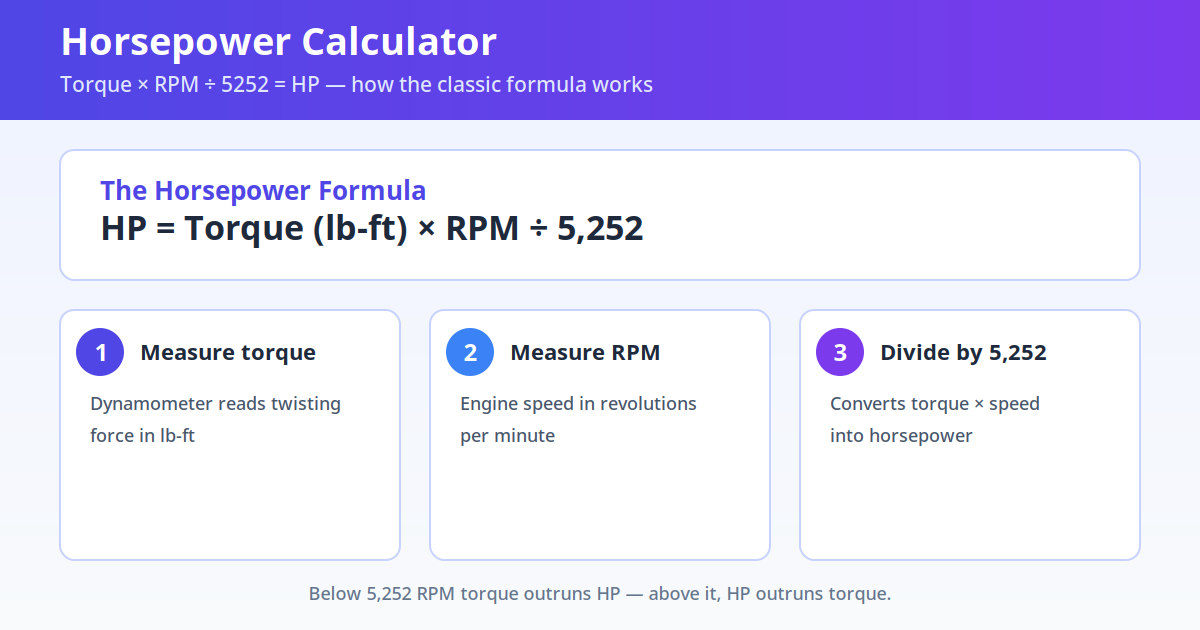
At the heart of every horsepower calculation sits one simple equation: horsepower equals torque multiplied by RPM, divided by 5,252. In symbols, HP = (Torque x RPM) / 5252, with torque in pound-feet. This is not a rule of thumb — it is the exact mathematical relationship between twisting force, rotational speed, and power, and the same formula dynamometer software uses to print your power curve.
The constant 5,252 comes from James Watt’s original definition. In the 1700s Watt marketed steam engines to buyers who understood horses, not physics, so he defined one horsepower as 33,000 foot-pounds of work per minute. One shaft revolution sweeps a one-foot lever through a circle of 2 x pi feet, so horsepower equals (torque x RPM x 2 x pi) / 33,000 — and 33,000 / (2 x pi) simplifies to 5,252. That is also why torque and horsepower curves always cross at exactly 5,252 RPM on a dyno chart.
Metric conversions: watts, kilowatts, and PS
One mechanical horsepower equals 745.7 watts, so a 400-horsepower engine produces about 298 kilowatts. European spec sheets often use PS (Pferdestarke), where one metric PS equals 735.5 watts — about 1.4 percent less than an imperial horsepower. That small gap explains why the same car can be rated 300 hp in the US and 304 PS in Germany.
Brake horsepower vs wheel horsepower
Manufacturers advertise brake horsepower (bhp), measured at the crankshaft with no drivetrain attached. Wheel horsepower (whp) is measured at the wheels on a chassis dyno, after the transmission and differential take their share — typically around 15 percent for rear-wheel drive and 20 percent for all-wheel drive. A car rated at 400 bhp might therefore put down roughly 340 whp, which is why comparing a bhp figure directly against a whp figure is one of the most common mistakes in car discussions.
0 to 60 and trap-speed estimation formulas
Without torque figures, physics still lets you work backwards from performance. The elapsed-time method estimates horsepower as weight in pounds divided by the cube of (quarter-mile elapsed time / 5.825). The trap-speed method, often more reliable, is HP = weight x (trap speed in mph / 234)^3. Both derive from the relationship between kinetic energy, mass, and the power needed to accelerate that mass.
Limitations to keep in mind
The torque-RPM equation is exact but only as accurate as the torque number you feed it. The 0 to 60 and trap-speed estimates assume average traction, gearing, and aerodynamics, so drag-race tires or a very slippery shape will skew results. Altitude, temperature, fuel quality, and tire pressure all move real-world numbers. Treat estimation-mode results as a solid ballpark — usually within about 10 percent — rather than a certified dyno figure.
Worked Example: From Torque to Horsepower
Take a V8 making 400 lb-ft of torque at 5,000 RPM. Plugging into the formula: HP = (400 x 5,000) / 5,252 = 2,000,000 / 5,252, or approximately 380.8 horsepower at exactly 5,000 RPM. If the same engine still makes 350 lb-ft at 6,500 RPM, the result is (350 x 6,500) / 5,252, about 433.1 horsepower — higher, even though torque fell, because RPM rose faster than torque dropped. This is why peak power always lives near the top of the rev range.
Now the estimation mode. Suppose your sports sedan weighs 3,800 pounds with driver and fuel, and traps 110 mph in the quarter mile. Using HP = 3,800 x (110 / 234)^3: 110 / 234 is about 0.4701, cubed it is about 0.1039, and multiplied by 3,800 gives roughly 394.7 crank horsepower. With 15 percent rear-wheel-drive drivetrain loss, expect around 335 horsepower at the wheels — verifiable on a chassis dyno.
| Input | Torque and RPM mode | Trap-speed mode |
|---|---|---|
| Torque | 400 lb-ft | Not needed |
| Engine speed | 5,000 RPM | Not needed |
| Vehicle weight | Not needed | 3,800 lb |
| Trap speed | Not needed | 110 mph |
| Crank horsepower | 380.8 hp | 394.7 hp |
| Wheel horsepower (RWD) | 323.7 whp | 335.5 whp |
The two independent methods land within about 4 percent of each other — a reassuring sanity check that the number is trustworthy.
Power-to-Weight Ratio: Why the Same Horsepower Feels Different
Horsepower alone does not tell you how fast a vehicle feels — the weight it has to move matters just as much. The power-to-weight ratio, usually written as pounds per horsepower (weight ÷ horsepower), captures this in one number. Lower is faster:
- 18–22 lb/hp — economy cars: adequate, relaxed acceleration
- 14–18 lb/hp — typical family sedans and crossovers
- 10–14 lb/hp — sporty cars that feel genuinely quick
- Under 10 lb/hp — sports-car territory
- Under 6 lb/hp — supercars and superbikes
A modern V8 muscle car making 486 hp at 3,850 lb works out to 7.9 lb/hp. A 150 hp sport motorcycle weighing 450 lb — 630 lb with rider and fuel — reaches about 4.2 lb/hp, which is why bikes accelerate so violently despite modest horsepower figures. When you estimate horsepower with this calculator’s trap-speed mode, divide the car’s as-raced weight (driver and fuel included) by the result to see where it lands on this scale.
Frequently Asked Questions
What is the difference between torque and horsepower?
Torque is twisting force, measured in pound-feet — the shove you feel at low RPM. Horsepower measures how quickly that force is applied over time, which determines top speed and sustained high-speed acceleration. A diesel truck motor has huge torque but a low redline, so it pulls hard yet makes modest horsepower. You need both: torque gets the car moving, horsepower keeps it moving fast.
Why do torque and horsepower curves always cross at 5,252 RPM?
It falls straight out of the formula HP = (Torque x RPM) / 5252: when RPM equals 5,252, the equation becomes HP = Torque, so the two numbers are identical there. Below 5,252 RPM the torque figure is numerically higher; above it, horsepower is higher. This is also why low-revving diesels with enormous torque still post modest horsepower numbers.
What is the difference between brake horsepower (bhp) and wheel horsepower (whp)?
Brake horsepower is measured at the crankshaft with no drivetrain attached — the number manufacturers advertise. Wheel horsepower is measured at the wheels, after the drivetrain absorbs roughly 15 percent for rear-wheel drive or 20 percent for all-wheel drive. To estimate whp from a bhp rating, multiply by about 0.85 for a rear-wheel-drive car.
Can I really estimate horsepower from my 0 to 60 time?
Yes, within about 10 percent if your inputs are honest: use a real scale weight with driver and fuel, and a GPS-verified time rather than a guess. The trap-speed method is more reliable than elapsed time because launch technique affects ET far more than trap speed. Altitude, tires, and weather all influence the result, so treat it as a strong estimate, not a dyno certificate.
How much horsepower do I actually need?
For relaxed daily driving, 150 to 200 horsepower is plenty; a family sedan in the 180 to 250 range feels effortless on the highway, while 300-plus is genuinely entertaining. If you tow heavy trailers, prioritize torque over peak horsepower. Above 500 you are mostly buying bragging rights — and power-to-weight ratio matters far more than the raw number.
Is metric horsepower (PS) the same as horsepower (hp)?
Almost: one metric PS equals 735.5 watts versus 745.7 watts for one imperial horsepower, making PS about 1.4 percent smaller. That is why a car rated 300 hp in the US shows 304 PS on a German spec sheet. To convert horsepower to kilowatts, multiply by 0.7457.
Why does my car feel slower than its horsepower rating suggests?
First, the advertised figure is crank horsepower, and 15 to 20 percent disappears through the drivetrain. Second, weight matters enormously: 300 horsepower feels very different in a 4,500-pound SUV versus a 3,000-pound coupe. Third, naturally aspirated engines lose roughly 3 percent per 1,000 feet of altitude, and heat or low-octane fuel costs more. A wide, flat torque curve usually feels faster daily than a bigger peak number near redline.
How do you calculate horsepower from torque and RPM?
The standard formula is HP = (Torque x RPM) / 5252, where torque is in pound-feet. An engine making 400 lb-ft at 5,000 RPM produces about 381 horsepower. Enter your numbers in the horsepower calculator above to get an instant result with the full formula shown.
How do you convert torque to horsepower?
Multiply torque (lb-ft) by engine speed (RPM) and divide by 5,252. The constant 5,252 comes from James Watt’s definition: 33,000 ft-lb per minute divided by 2pi. Note that torque and horsepower are always equal at exactly 5,252 RPM on any dyno chart.
Can you estimate horsepower from engine size (cc)?
Roughly, yes: most modern car engines make about 0.08 to 0.12 HP per cc, so a 2,000 cc engine typically produces 160 to 240 HP. This varies hugely with turbocharging, so a turbo 2.0L can exceed 300 HP. For accuracy, always use measured torque and RPM in an engine power calculator instead of displacement alone.
What is a good power-to-weight ratio?
As a rough guide in pounds per horsepower: 18–22 is economy-car pace, 14–18 covers most family cars, 10–14 feels sporty, under 10 is sports-car territory, and under 6 is supercar or superbike territory. Divide the vehicle’s weight (with driver and fuel) by its horsepower to find where it sits.
How much horsepower is lost in the drivetrain?
Typically 10–25% of crank horsepower never reaches the wheels. Front-wheel-drive cars lose the least (about 10–15%), rear-wheel-drive cars lose about 15–18%, and all-wheel-drive cars can lose 20–25% because of the extra shafts and differentials. That is why a 400 hp engine often shows roughly 330–350 hp on a chassis dyno.
Related Calculators
Try our Unit Converter, Cooking Measurement Converter, and Fuel Cost Calculator.
Related: Engine Horsepower Calculator, BTU Calculator.