Find how many wallpaper rolls you need: enter wall size, roll dimensions, and pattern repeat. Accounts for pattern waste so you never run short. Free.
Results are estimates for planning purposes and are not financial, medical, or professional advice.
How to Use the Wallpaper Calculator
Running out of wallpaper mid-project is every decorator’s nightmare. This calculator works out exactly how many rolls to buy. Enter your wall dimensions, the roll size from the label, and the pattern repeat, and it accounts for the waste that pattern matching creates.
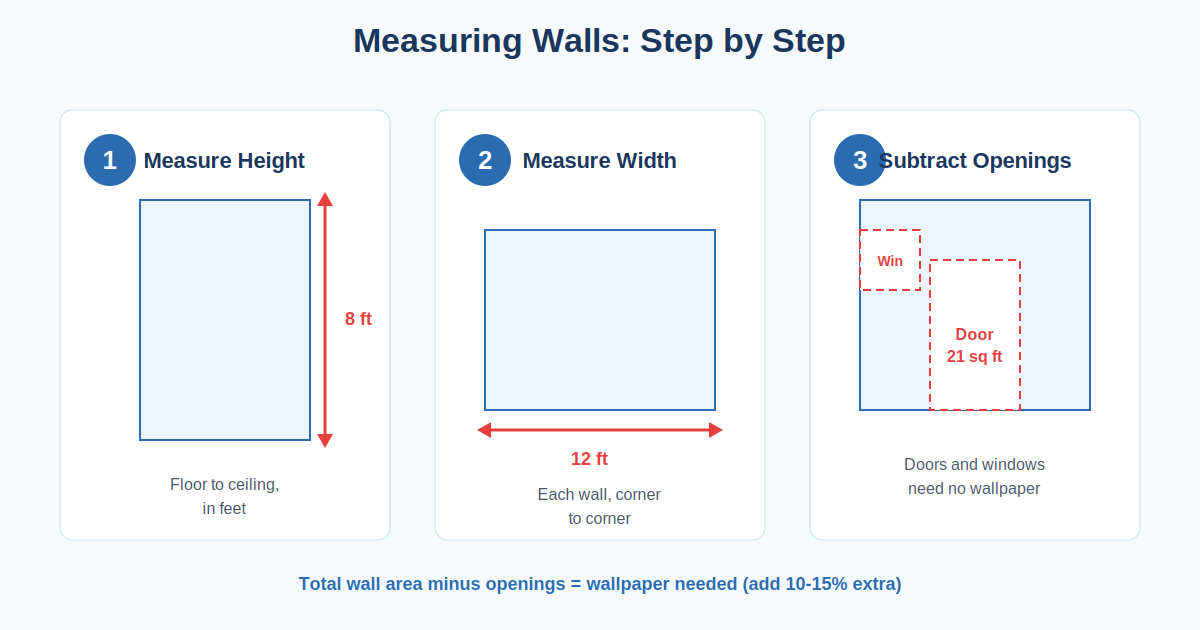
- Measure one wall length and the wall height in feet, then enter how many walls you are covering. If your walls have different lengths, add the lengths together and enter the total as one “wall”.
- Enter the roll width in inches and roll length in feet from the wallpaper label. Standard American double rolls are 20.5 inches wide and 33 feet long.
- Enter the pattern repeat in inches from the label, or 0 for solid and textured papers with no pattern to match.
- Buy the number of rolls shown. For patterned paper, consider one extra roll for mistakes and future repairs.
Wallpaper Formula
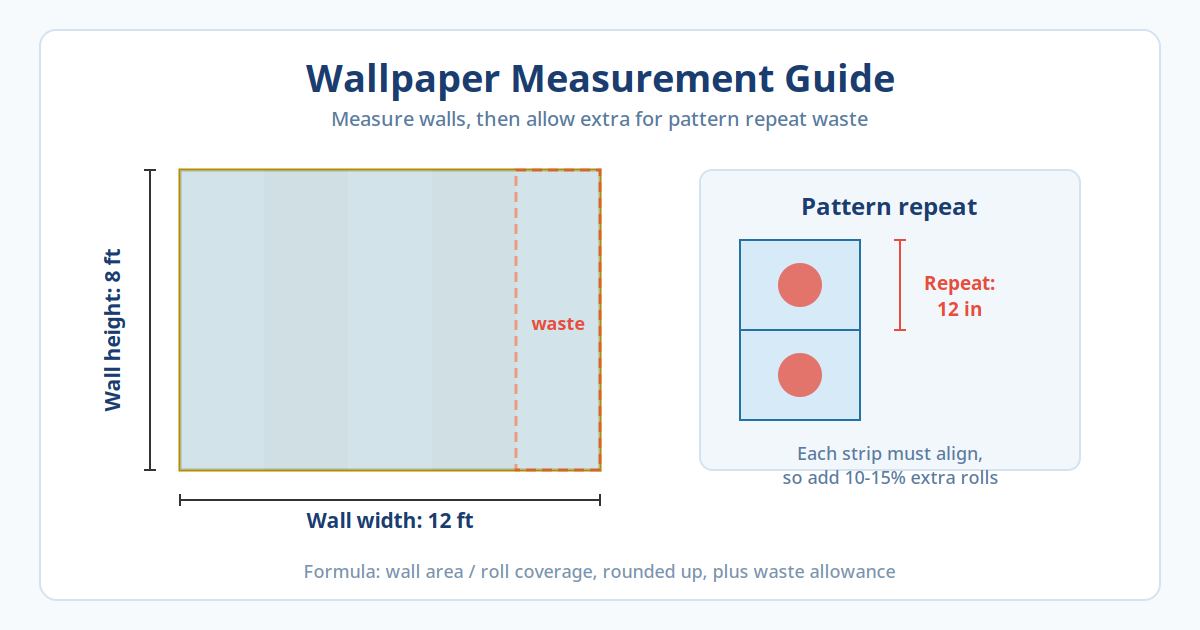
Wallpaper is hung in vertical strips (drops), not painted by area, so the calculator works in strips. The strip length equals the wall height plus one pattern repeat, because every strip after the first must shift so the pattern lines up across the seam, wasting up to one full repeat per strip. Usable strips per roll equal the roll length divided by the strip length, rounded down. Each strip covers one roll width of wall, so one roll covers the strip count times the roll width (in feet) of wall length. Total rolls equal the total wall length divided by the coverage per roll, rounded up. Solid papers with zero repeat waste nothing between strips, which is why they need fewer rolls. Note this method makes no deduction for doors and windows — the strips around openings still come off the roll, and the offcuts rarely carry a usable pattern.
Example Calculation
Four walls, each 12 feet long and 8 feet high, with standard 20.5 inch by 33 foot rolls and no pattern: total wall area is 384 square feet. Each roll yields 33 divided by 8, rounded down, which is 4 strips. One roll covers 4 times 20.5 divided by 12, or 6.83 feet of wall. Total wall length is 48 feet, so rolls needed equal 48 divided by 6.83, rounded up, which is 8 rolls.
Now give that room a pattern with a 24-inch repeat. The strip length becomes 8 feet plus 2 feet, or 10 feet, so each roll yields only 3 strips and covers 5.13 feet of wall. The same room now needs 48 divided by 5.13, rounded up: 10 rolls. Two extra rolls is the real price of a big, bold pattern — budget for it before you fall in love with the design.
Pattern Match Types and What They Cost
| Match type | How it works | Waste to expect |
|---|---|---|
| Random / free match | Solids, textures, and stripes with no alignment needed | Lowest — set repeat to 0 in the calculator |
| Straight match | The pattern lines up horizontally at the same height on every strip | Moderate — up to one repeat lost per strip |
| Half-drop match | Each alternate strip drops by half a repeat to align the design | Higher — awkward offcuts that rarely get reused |
| Large repeat (24 in +) | Big statement designs repeat every two feet or more | Highest — plan an extra roll beyond the estimate |
Roll Sizes at a Glance
| Roll type | Width | Length | Covers roughly |
|---|---|---|---|
| US single roll | 20.5 in | 16.5 ft | 28 sq ft |
| US double roll | 20.5 in | 33 ft | 56 sq ft |
| European roll | 21 in (53 cm) | 33 ft (10.05 m) | 57 sq ft |
US wallpaper is priced by the single roll but usually shipped and sold as doubles — check whether the price you are comparing is for a single or a double before deciding a roll is “cheap”.
Before You Order
Buy the whole job at once, same batch. Every roll carries a batch (dye lot) number. Shades shift slightly between print runs, so rolls from different batches can mismatch visibly on the wall. Check the batch numbers match before the first strip is cut.
Keep one roll back. A leftover roll from the same batch is the only guaranteed match for patching damage years later. That is cheap insurance for hallways, kids’ rooms, and anywhere furniture scrapes.
Measure tricky rooms wall by wall. Sloped ceilings, bay windows, and walls of different heights break the “number of walls” shortcut. Run the calculator once per distinct wall height and add the roll counts.
Frequently Asked Questions
What is pattern repeat in wallpaper?
The pattern repeat is the vertical distance before the design starts over, printed on the roll label. Larger repeats waste more paper because each strip must shift to align the pattern.
Should I subtract windows and doors?
For small windows and doors, most decorators skip the subtraction because the offcuts around openings get wasted anyway. For very large openings, subtract roughly half the opening area.
How many rolls do I need for one accent wall?
Enter 1 for the number of walls with your wall length and height. A single 12 by 8 foot wall with standard rolls needs 2 rolls.
What is the difference between single and double rolls?
A double roll is simply twice the length of a single roll. This calculator uses the actual roll length you enter, so it works with either.
Why buy an extra roll?
Matching patterns, trimming mistakes, and future repairs all consume paper. Wallpaper dye lots also vary, so leftover paper from the same lot is the only guaranteed match.
How many rolls do I need for a 12 by 10 foot room?
A 12 by 10 foot room has 44 feet of wall. With 8-foot walls and standard 20.5 by 33 foot double rolls and no pattern, that is 7 rolls. With a 24-inch pattern repeat, each roll yields only 3 strips and the room needs 9 rolls. Run your own dimensions above for the exact count.
What is a half-drop match?
A match type where alternate strips are shifted down by half the pattern repeat so the design lines up across the seams. It wastes more than a straight match, because the offset cuts leave awkward offcuts, so expect to buy an extra roll on large-repeat papers.
Related Calculators
Decorating the whole room? Try our Paint Calculator, Square Footage Calculator, and Flooring Calculator.