What Is a VAT Calculator?
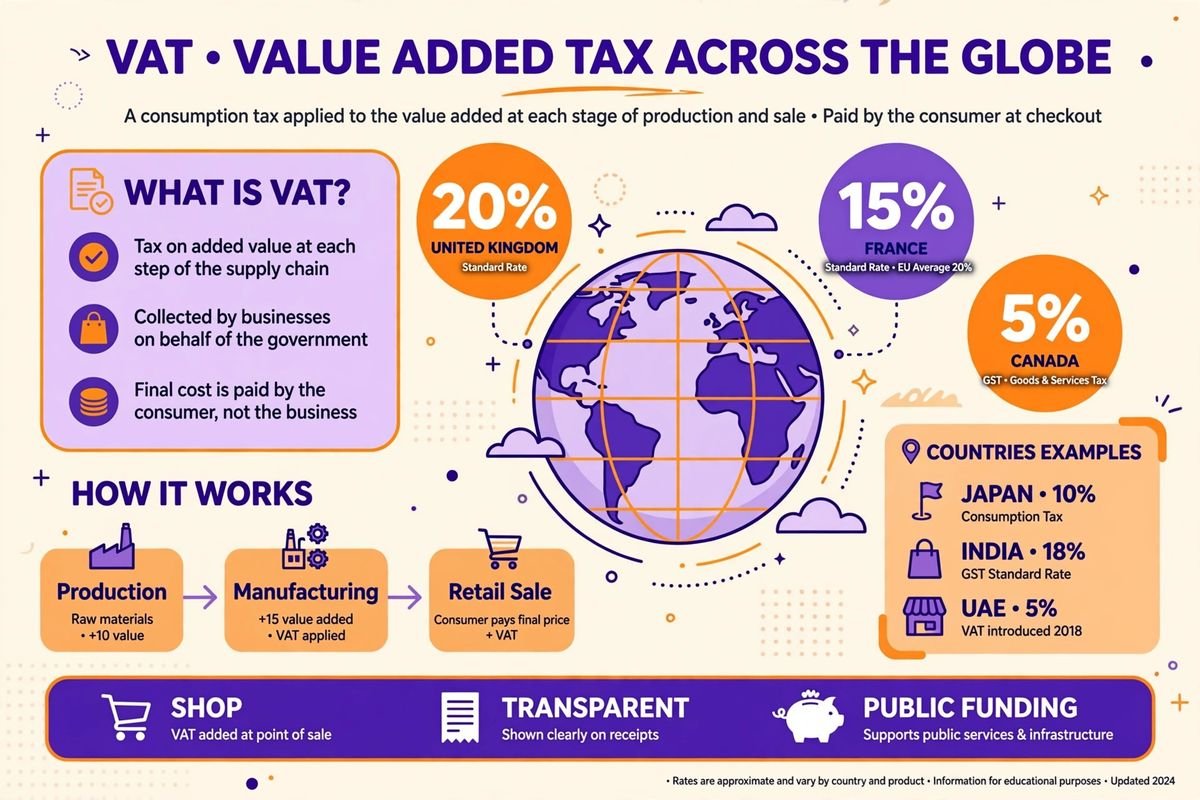
Value Added Tax (VAT) is a consumption tax charged on goods and services at each stage of production and distribution. Unlike a simple sales tax added once at checkout, VAT is collected incrementally — but for most shoppers and small businesses, what matters is the final number on the invoice. A VAT calculator instantly converts between net prices (before tax) and gross prices (including tax), so you always know exactly how much tax you are paying or charging.
If you run a business in the UK, EU, UAE, or any of the 170+ countries with a VAT or GST system, you quote prices, file returns, and issue invoices with VAT every day. Doing the math by hand is slow and error-prone — especially when you need to strip VAT back out of a gross figure. This value added tax calculator handles both directions in one click: add VAT to a net amount, or remove VAT from a gross amount.

How to Use the VAT Calculator
- Choose a mode. Select “Add VAT” if you have a net (pre-tax) price and want the gross total, or “Remove VAT” if you have a gross (tax-inclusive) price and want to find the net amount underneath.
- Enter the amount. Type the price you are starting from — net for adding, gross for removing.
- Set the VAT rate. Type any rate, or tap a preset: 5%, 10%, 15%, 20%, or 25% cover the most common standard rates worldwide.
- Click Calculate. You will see the VAT amount and the converted total, plus the exact formula used so you can verify the result.
VAT Formulas
The calculator uses two simple formulas. Let r be the VAT rate as a decimal (so 20% becomes 0.20):
- Adding VAT: Gross = Net × (1 + r). The VAT itself is Net × r.
- Removing VAT: Net = Gross ÷ (1 + r). The VAT itself is Gross − Net.
The removal formula surprises many people: to strip 20% VAT from a $120 gross price, you do not subtract 20% of $120 ($24). The correct net is $120 ÷ 1.20 = $100, and the VAT is $20. That is because the 20% was calculated on the net $100, not on the gross $120. This is the single most common VAT mistake, and the calculator exists precisely to prevent it.
Worked Examples
Example 1 — Adding UK VAT to a service invoice
A freelancer in London quotes £850 net for a project. UK standard VAT is 20%. Gross = £850 × 1.20 = £1,020, and the VAT amount is £170. The invoice shows all three figures, matching the illustration above.
Example 2 — Removing VAT from a Dubai restaurant bill
A dinner bill in Dubai totals AED 210 including 5% VAT. Net = 210 ÷ 1.05 = AED 200, so the VAT portion is AED 10. Useful when a business traveller needs the pre-tax figure for expense reports.
Example 3 — Checking a French quote at 20%
A Paris supplier quotes €1,200 gross with 20% VAT included. Net = 1,200 ÷ 1.20 = €1,000, VAT = €200. If you are VAT-registered and can reclaim input VAT, your real cost is the €1,000 net figure.
The VAT Fraction: How Much of a Gross Price Is VAT?
There is a shortcut for extracting just the VAT amount from a VAT-inclusive price. The VAT inside a gross price is the gross amount multiplied by the VAT fraction: rate ÷ (100 + rate).
- At 20% VAT the fraction is 20/120 = 1/6 of the gross price
- At 5% VAT the fraction is 5/105 = 1/21 of the gross price
- At 25% VAT the fraction is 25/125 = 1/5 of the gross price
Example: a €600 invoice total at 20% VAT contains 600 × 1/6 = €100 of VAT, leaving a €500 net amount. Accountants use the fraction to check receipts and invoices quickly, because it avoids the two-step divide-then-subtract process.
Standard VAT Rates Around the World
Rates change, so treat these as a starting point and confirm with your local tax authority before invoicing:
| Country / Region | Standard rate | Notes |
|---|---|---|
| United Kingdom | 20% | Reduced 5% for energy, zero rate for most food |
| Germany | 19% | Reduced 7% for food, books, transport |
| France | 20% | Reduced 5.5% and 10% for essentials |
| UAE | 5% | Introduced 2018; zero-rated exports |
| Saudi Arabia | 15% | Raised from 5% in 2020 |
| India (GST) | 18% | Slabs of 5%, 12%, 18%, 28% by category |
| Japan (Consumption Tax) | 10% | Reduced 8% for food and drink |
| United States | — | No federal VAT; states levy sales tax instead — try our sales tax calculator |
VAT vs GST: Are They the Same Thing?
You will often see “VAT” and “GST” (Goods and Services Tax) used almost interchangeably, and for calculation purposes they are: both are percentage taxes applied to the value of goods and services, and the add/remove math is identical. The difference is mostly terminological and administrative. The UK and most of Europe say VAT; Canada, Australia, New Zealand, Singapore, and India say GST. India runs a dual GST where tax is split between central and state governments, which complicates filings but not the basic arithmetic — an 18% GST on a ₹1,000 item works exactly like 18% VAT.
Japan calls its version a consumption tax (10%, reduced 8% for food). The economic effect is the same: a broad-based tax on spending. So if you understand VAT, you understand GST — and this calculator works for all of them. Just enter the correct local rate.
Practical Uses for Businesses
- Quoting: convert your net prices to the gross figures customers actually see, for any VAT rate.
- Invoicing: show net, VAT, and gross as separate lines — required on VAT invoices in most countries.
- Reclaiming input VAT: strip VAT out of supplier bills to find your true deductible cost.
- Cross-border trade: compare quotes from countries with different rates on a like-for-like net basis.
- Quick checks: verify a supplier’s invoice math before you pay it — data entry errors on tax lines are common.
Tips and Common Mistakes
- Never subtract the rate from the gross. Removing 20% VAT from $120 gives $100 (divide by 1.20), not $96 (subtract 20%).
- Confirm which rate applies. Many countries have reduced rates for food, medicine, books, or children’s goods — using the standard rate everywhere overcharges customers.
- Round only at the end. Calculate with full precision, then round the final VAT and total to cents — rounding mid-calculation creates penny differences across invoice lines.
- Keep the rate current. Governments change VAT rates (Saudi Arabia tripled its rate in 2020). Bookmark your tax authority’s page.
- Know when you must register. Most countries have a turnover threshold — below it you cannot charge VAT at all; above it you must.
Related Calculators
For US-style checkout taxes, use our sales tax calculator. To reverse-engineer a tax-inclusive price step by step, try the reverse sales tax calculator. For general percentage problems, the percentage calculator covers increases, decreases, and “what percent of” questions.
Frequently Asked Questions
What is the difference between VAT and sales tax?
VAT is collected at every stage of production and distribution, with businesses reclaiming the tax they paid on inputs — only the end consumer bears the full cost. Sales tax (used in the US) is charged once, at the final retail sale. Economically they are similar for consumers, but the paperwork differs greatly.
How do I add 20% VAT to a price?
Multiply the net price by 1.20. A $100 net price becomes $120 gross, and the VAT amount is $20. Our calculator does this instantly — enter 100, select 20%, choose “Add VAT”.
How do I remove VAT from a gross price?
Divide the gross price by 1 plus the rate as a decimal. For 20% VAT: $120 ÷ 1.20 = $100 net. Do not simply subtract 20% of the gross — that gives the wrong answer ($96) because the tax was computed on the net, not the gross.
Which countries have no VAT?
The United States has no federal VAT (states use sales tax instead). A few others, like some Gulf states before 2018 and certain small jurisdictions, also have no VAT — but the list shrinks as governments adopt it for revenue.
Can VAT rates change?
Yes, and they do. Governments raise, lower, or restructure rates in budgets — sometimes temporarily (as several EU countries did during COVID). Always verify the current rate with your national tax authority before issuing invoices.
Is the VAT I charge the same as the VAT I pay?
Not exactly. You charge output VAT on your sales and pay input VAT on your purchases; you remit the difference to the tax authority. The calculator helps with both sides — adding VAT to quotes and stripping it from supplier bills.
What fraction of a VAT-inclusive price is VAT?
It depends on the rate: the VAT fraction is rate ÷ (100 + rate). At 20% VAT it is one sixth (1/6) of the gross price, at 5% it is 1/21, and at 25% it is 1/5. So a €600 gross price at 20% contains €100 of VAT.
What is the difference between zero-rated and exempt supplies?
Zero-rated supplies are taxable at a 0% rate: the business charges no VAT to customers but can still register for VAT and reclaim VAT on its related costs. Exempt supplies sit outside the VAT system: no VAT is charged, but VAT on related costs cannot be reclaimed either. Most food, children’s clothing and books are zero-rated in the UK, while insurance, finance, health and education are typically exempt.