
This fractal generator online draws the real Mandelbrot and Julia sets in your browser, computed pixel by pixel from the actual mathematics — not an AI impression of one. Click anywhere to zoom into that exact spot, drag to pan, switch between five color palettes, raise the iteration count to reveal deeper detail, and jump sideways into the Julia set hiding behind any point of the Mandelbrot image. Download any view as a PNG. Everything runs locally on your device: no sign-up, no credits, no watermark, nothing uploaded.
Cursor: move over the image to read its coordinates.
Every pixel is one complex number on the complex plane, colored by how quickly its orbit escapes under repeated squaring — the escape-time method explained below. Points that never escape belong to the set and are drawn dark.
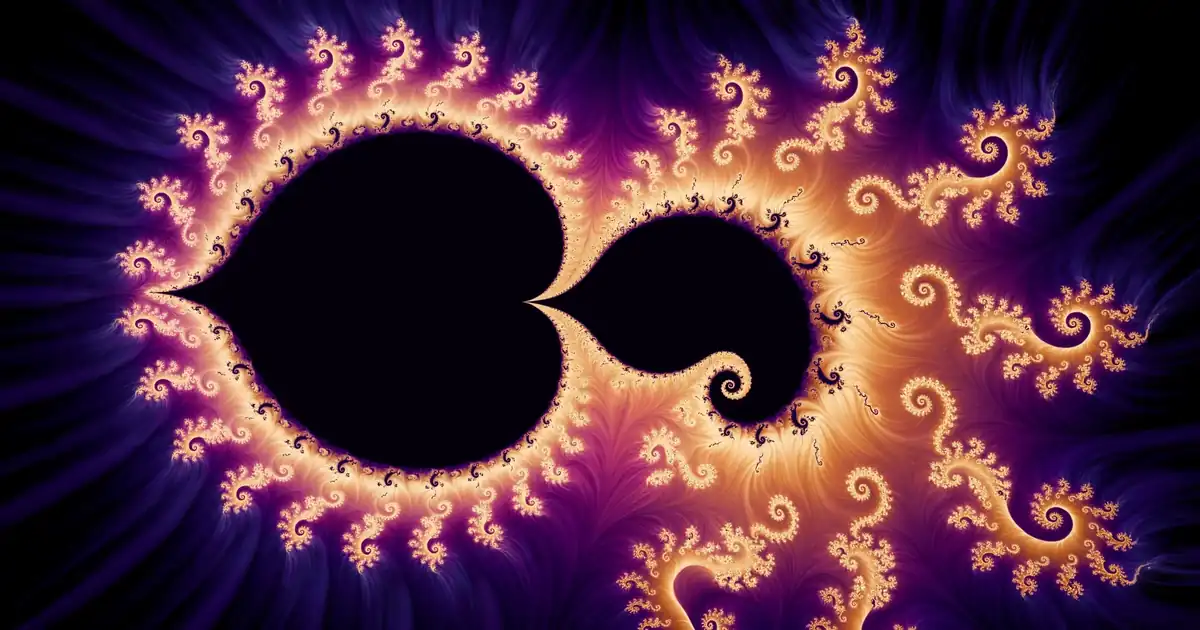
What a Fractal Is
A fractal is a shape that contains smaller copies of itself, at every scale, without end. Zoom into the edge of a snowflake, a fern or a coastline and the same kind of jagged, branching structure keeps appearing instead of smoothing out. Most fractals are not drawn by hand; they are grown by a very simple rule repeated an enormous number of times. The Mandelbrot set, the most famous fractal of all, comes from a rule a child can write down — take a number, square it, add the same starting constant, repeat — yet the picture that rule produces has more detail than anyone could explore in a lifetime. This page computes that genuine set live, so the detail you zoom into is really there, not painted on.
Fractals matter outside mathematics because nature keeps using the same trick: a tree branches into limbs that branch into twigs, rivers split into tributaries, and lungs, lightning and blood vessels all repeat a pattern across scales. Measuring that repetition leads to the idea of a fractal dimension — a number between whole dimensions that says how thoroughly a pattern fills space.
The Mandelbrot Set, Explained Simply
Take the complex plane: every point on it is a number c with a real part (left–right) and an imaginary part (up–down). For each point, start with z at zero and apply one rule over and over: replace z with z squared plus c. Two things can happen. For some points the values stay small forever — those points are in the Mandelbrot set. For others the values grow, pass the point of no return, and race off to infinity. Escape is guaranteed once the size of z passes 2 — a provable fact that makes the set computable, since a program only has to watch for that moment.
The generator colors each pixel by how long its point survived before escaping — the escape-time method. Points that escape immediately get the start of the palette; points that struggle for hundreds of rounds get colors from deep in the palette; points that never escape within the iteration limit are treated as members of the set and drawn dark. The glowing bands around the black shape are therefore a kind of contour map of almost-escaping, and the filigree at the boundary is real structure: miniature copies of the whole set and spiral seahorse tails at smaller and smaller scales. The big round regions have names — the central cardioid and the period-2 bulb on its left — and every round bulb corresponds to points whose orbits settle into a repeating cycle of that period.
Julia Sets: A Whole Family Behind Every Point
The Julia sets use the identical rule with the roles swapped. Here the constant c is fixed once, and the starting value z is the pixel itself. Change c and the whole picture changes: one seed gives a branching dendrite like frost on a window, another fat spirals, another disconnected dust. There is one Mandelbrot set, but a different Julia set for every possible c.
The two sets are joined by the most useful fact on this page: a Julia set is one connected piece exactly when its seed c lies inside the Mandelbrot set, and scattered dust when c lies outside. The Mandelbrot image is therefore a catalogue of all Julia sets: it tells you, for every point you can click, whether the Julia set behind it will be whole or shattered. That is why this generator includes a "Julia from a point" button: click a filament on the Mandelbrot boundary and the tool builds the Julia set for precisely that seed.
How to Use This Fractal Generator
- Start with the full Mandelbrot set. The page opens on the whole shape. Dark means in the set; the colored halo is the region where points escape slowly.
- Click to zoom. Clicking any point re-centres there and doubles the magnification. The scroll wheel zooms at the cursor, the buttons zoom about the centre, and dragging pans. The readout shows the current centre, view width and zoom factor, and the cursor line shows exact coordinates.
- Raise the iterations when a zoom goes plain. Deep in the boundary, points need many more rounds before they escape. If a zoomed view turns dark or featureless, it usually means the survivors have not escaped yet within the budget — push Max iterations up (toward 500 or 1000) and the structure returns.
- Recolor freely. The five palettes — Twilight, Ocean, Ember, Rainbow and Mono — only change how escape times are painted, never the mathematics, so recoloring is instant in effect and safe to experiment with.
- Switch to a Julia set. Choose Julia set, then either pick a named preset (Dendrite, Spirals, Galaxy, Frost, Basilica), type your own seed into the two seed fields, or use "Julia from a point" and click the Mandelbrot image to harvest a seed from it.
- Save your view. Download PNG saves the canvas exactly as rendered, ready for a wallpaper, a classroom slide or a project background.
Places Worth Visiting
Random clicking works, but the set has famous neighbourhoods. Use the coordinate readout to navigate: zoom in stages, clicking toward the target each time.
| Place | Coordinates to aim for | What you will find |
|---|---|---|
| Seahorse Valley | About −0.745 + 0.113i, view width near 0.05 | Rows of spiral "seahorse tails" along the top of the main bulb — the classic first deep zoom |
| The period-2 bulb | About −1.0 + 0.0i, view width near 0.6 | The large round bulb left of the cardioid; its Julia seed (Basilica preset) gives chained oval islands |
| Elephant Valley | About 0.29 + 0.52i, view width near 0.1 | Trunk-like filaments curling off the right edge of the cardioid |
| A miniature Mandelbrot | About −1.768 + 0.001i, view width near 0.01 | A complete tiny copy of the whole set on the antenna to the left, proof of the self-similarity |
| The dendrite seed | Julia mode, seed −0.7 + 0.27015i (Dendrite preset) | A Julia set of pure branching lightning — its seed sits just outside the set, so the fractal is a single connected thread |
Try the same target under two palettes: Ember makes Seahorse Valley look carved from copper, while Mono shows the pure contour structure. In Julia mode, Frost (0.285 + 0.01i) gives a lacy web and Galaxy (−0.4 + 0.6i) broad spiral arms — and shifting a seed by a hundredth can flip a Julia set from connected web to falling dust.
Making Fractal Art With It
Because every image here is genuine mathematics, the art you export is original to your exact coordinates, and zooming truly reveals more detail rather than stretching pixels. For wallpapers, hunt for a high-contrast boundary region, raise iterations until the filaments are crisp, choose a palette, and download the PNG. For teaching, students can watch a seed cross the Mandelbrot boundary and see its Julia set break apart — the connectedness rule made visible. Designers use the exports as backgrounds, book covers and texture references; the images are yours to use, since no artist and no AI model stands behind them, only arithmetic.
Limitations, Honestly
- Zoom depth is finite. The explorer uses ordinary double-precision numbers, so below a view width of about a trillionth, neighbouring pixels can no longer be told apart and the image breaks into blocks. Research tools with arbitrary-precision arithmetic go deeper; a trillion-fold magnification is the honest limit here, and the controls stop there.
- "Inside" means "had not escaped yet". A pixel is drawn dark when its orbit survives the iteration cap. A handful of boundary points would escape given a bigger budget, which is exactly why raising iterations sharpens deep zooms.
- The PNG is the canvas size. Downloads are 720 by 540 pixels, as rendered. That suits web use, slides and phone wallpapers in a pinch; it is not a print-shop file, and no higher-resolution export is promised.
- Rendering takes a moment at high iterations. A full frame at 1000 iterations over a detailed region can take a few seconds on a slow phone — the status line tells you while it works.
More Tools on This Site
Fractals sit at the meeting point of mathematics and image-making. The Minecraft Circle Generator solves the opposite problem — forcing a smooth curve onto a coarse grid of blocks — while the Random Image Generator is the place for photographic inspiration rather than computed art. For the other classic of algorithmic text art, the ASCII Art Generator turns words into pictures built from characters.
Frequently Asked Questions
What is a fractal generator?
A fractal generator is a tool that draws fractals — shapes with detail that repeats at every scale — by repeating a simple mathematical rule millions of times. This one computes the real Mandelbrot and Julia sets in your browser: every pixel is tested by the escape-time method and colored by how quickly its orbit escapes, so you can zoom, pan and recolor the genuine mathematics and download the result as a PNG.
What is the difference between the Mandelbrot set and a Julia set?
Both iterate the same rule, z becomes z squared plus c, but the roles differ. In the Mandelbrot set, z starts at zero and c is the pixel being tested, so there is exactly one Mandelbrot set. In a Julia set, c is one fixed seed and z starts at the pixel, so there is a different Julia set for every seed. A Julia set is connected exactly when its seed lies inside the Mandelbrot set, which makes the Mandelbrot image a catalogue of all Julia sets.
Why does the image go dark or plain when I zoom in?
Because of the iteration budget. Points deep in the boundary take far longer to escape, and any point that has not escaped within the Max iterations setting is drawn dark as if it were inside the set. Raise Max iterations — toward 500 or 1000 on deep zooms — and the hidden filaments and spirals appear. Lowering iterations again makes rendering faster on broad views.
Can I create a fractal from an image, or from a point I found?
Yes, in the explorer sense: press "Julia from a point on the image", then click any point of the Mandelbrot picture. The tool reads that point's coordinates and builds the Julia set for exactly that seed, so the new fractal is generated from the image in front of you. This tool does not turn photographs into fractals — the AI image tools that do that produce an impression of a fractal rather than the real set, and they cannot be zoomed or explored.
Can I use the downloaded fractal as a wallpaper or in my projects?
Yes. The PNG you download is rendered on your own device from pure mathematics, at coordinates you chose, so you can use it as a wallpaper, in slides, in videos or in design projects. The file is 720 by 540 pixels, which suits screens and web use; it is not large enough for high-quality poster printing.
Is this fractal generator free, and do I need to install anything?
Yes, it is completely free, with no sign-up, no credits and no watermark. Nothing needs installing and nothing is uploaded: the generator is a single web page and all the computing happens in your browser, on your own device, so it works the same on a phone, a tablet or a computer.