Calculate HSA contributions, tax savings, and growth potential for your Health Savings Account.
How to Use the HSA Calculator
A Health Savings Account is one of the most powerful savings tools available to American workers, yet it remains widely misunderstood. This calculator helps you see exactly how much you can save in taxes today and how much your account could grow over time. Start by selecting your coverage type. Self-only coverage has a lower annual contribution limit than family coverage, and the calculator uses the 2026 IRS limits automatically.
- Choose your coverage type. Select self-only if your high-deductible health plan covers just you, or family if it covers a spouse or dependents. The IRS sets different contribution limits for each.
- Enter your planned annual contribution. This is the amount you will put in from your own paycheck or bank account during the year. Many employers let you contribute through payroll deduction, which also saves you Social Security and Medicare taxes.
- Add any employer contribution. Some employers seed your HSA with a few hundred or even a thousand dollars per year. This counts toward your IRS limit, so include it to avoid overcontributing.
- Enter your federal tax bracket. Your HSA contributions reduce your taxable income dollar for dollar. If you are in the 22 percent bracket, every 1,000 dollars you contribute saves you 220 dollars in federal income tax.
- Set your time horizon and expected return. HSAs can be invested in mutual funds just like a 401(k). Enter how many years until you expect to need the money and a realistic annual return.
- Add catch-up contributions if you are 55 or older. The IRS allows an extra 1,000 dollars per year once you turn 55.
- Click Calculate. You will see your tax savings, projected account value, and a warning if you exceed the IRS limit.
HSA Tax Benefits and Growth Formula
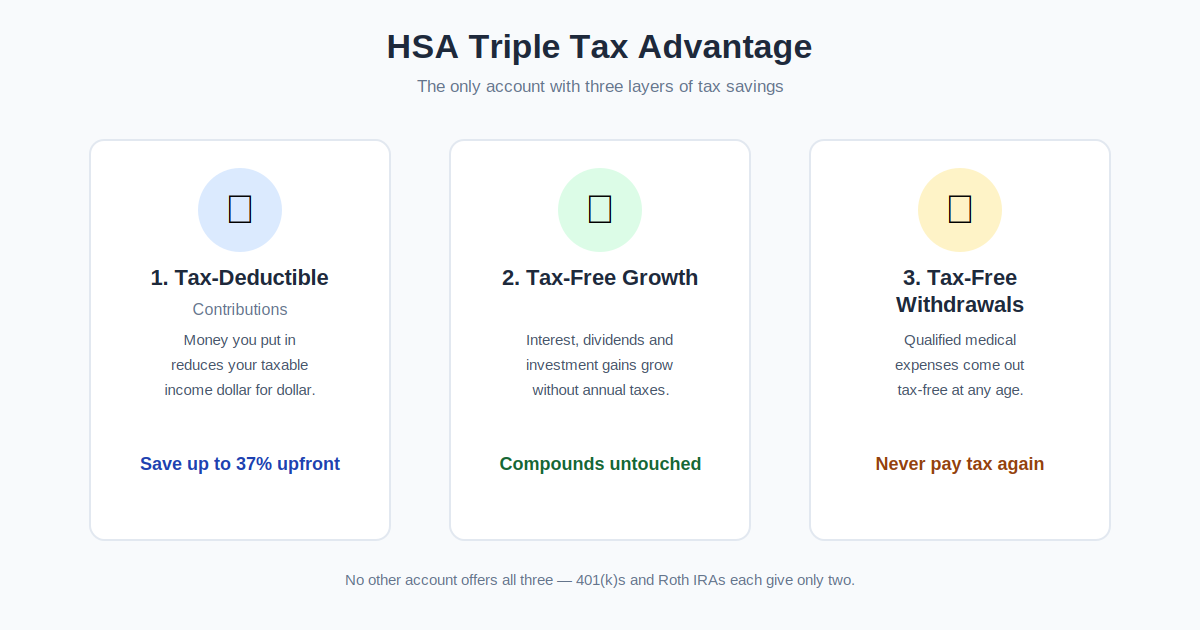
The HSA is famous for its triple tax advantage, a combination no other account offers. First, contributions are tax-deductible, which lowers your taxable income in the year you contribute. Second, the money grows tax-free while it sits in the account, so dividends, interest, and capital gains are never taxed. Third, withdrawals are tax-free as long as you spend the money on qualified medical expenses. No other retirement or savings account gives you all three benefits at once.
The tax savings calculation is straightforward. Multiply your annual contribution by your marginal federal tax rate. A 4,400 dollar contribution in the 22 percent bracket saves 968 dollars in federal tax. If you contribute through payroll deduction, you also avoid the 7.65 percent FICA tax, which adds another 329 dollars of savings on that same contribution. State tax savings can push the total even higher in states with income tax.
Growth follows the future value of an annuity formula. If you contribute the same amount P each year for n years at annual return r, the future value equals P times ((1 + r) raised to the power n, minus 1) divided by r. With a 4,400 dollar annual contribution growing at 7 percent for 20 years, the account reaches roughly 180,000 dollars, of which about 92,000 dollars is pure investment growth that was never taxed.
One important rule: you must be enrolled in a qualifying high-deductible health plan to contribute. For 2026, that means a plan with a deductible of at least 1,700 dollars for self-only coverage or 3,400 dollars for family coverage. If you switch to a non-qualifying plan mid-year, your contribution limit is prorated.
Worked Example
Consider Maya, age 35, who has family coverage through a high-deductible plan. She contributes 6,000 dollars per year and her employer adds 1,500 dollars, for a total of 7,500 dollars. The 2026 family limit is 8,750 dollars, so she is safely under the cap. Maya is in the 22 percent federal bracket.
Her annual federal tax savings equal 7,500 times 0.22, which is 1,650 dollars. Because she contributes through payroll deduction, she also saves 7.65 percent in FICA taxes, another 574 dollars. Her total first-year tax benefit is about 2,224 dollars, meaning her 7,500 dollar contribution really costs her only about 5,276 dollars out of pocket.
If Maya invests the full 7,500 dollars each year at a 7 percent average return for 25 years until age 60, the future value formula gives roughly 474,000 dollars. She will have contributed 187,500 dollars over that time, so more than half of the final balance is tax-free investment growth. She can then use that money tax-free for Medicare premiums, dental work, vision care, and other medical costs in retirement.
2026 HSA Contribution Limits and HDHP Rules
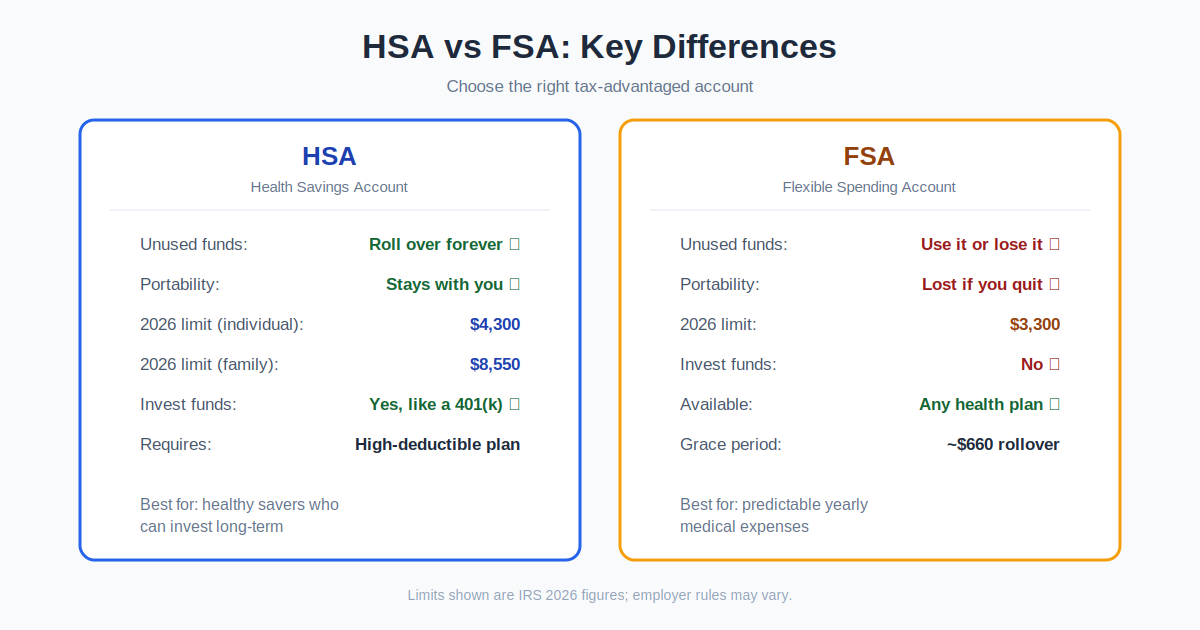
For 2026 you can contribute up to 4,400 dollars with self-only coverage or 8,750 dollars with family coverage, plus a 1,000 dollar catch-up contribution if you are 55 or older. Contributions from you or your employer count toward the same limit.
To qualify, your health plan must be a high-deductible plan: a minimum deductible of 1,700 dollars self-only or 3,400 dollars family, with out-of-pocket maximums of 8,500 and 17,000 dollars respectively. You also cannot contribute while enrolled in Medicare or if someone claims you as a dependent.
The growth math is where the HSA shines. Start with a 2,000 dollar balance, add 3,000 dollars a year for 20 years at 6 percent, and you end with about 116,771 dollars — 54,771 dollars of it pure growth. At a 22 percent tax rate those contributions also save about 660 dollars a year in taxes. Invest the balance beyond one year’s deductible and let compounding do the heavy lifting.
Related Calculators
Planning your broader finances? Try our Roth IRA Calculator to compare retirement account options, or our 401(k) Calculator to project employer-plan growth alongside your HSA.
Frequently Asked Questions
What is an HSA and who qualifies?
A Health Savings Account is a tax-advantaged account for people enrolled in a qualifying high-deductible health plan. For 2026 the plan must have a deductible of at least $1,700 self-only or $3,400 family. You cannot contribute if you are on Medicare or claimed as a dependent.
What is the HSA triple tax advantage?
Contributions are tax-deductible, growth is tax-free, and withdrawals for qualified medical expenses are tax-free. No other account combines all three benefits, which is why financial planners often rank the HSA above even the 401(k) for medical savings.
What happens to my HSA if I change jobs?
The HSA is yours forever. Unlike a flexible spending account, the money does not expire and stays with you when you switch employers or retire. You can keep investing it and using it for medical costs for life.
Can I use HSA money for non-medical expenses?
Yes, but withdrawals for non-medical costs before age 65 face income tax plus a 20 percent penalty. After 65, non-medical withdrawals are taxed like a traditional IRA with no penalty.
Should I invest my HSA or keep it in cash?
Many experts suggest keeping one year of deductible in cash and investing the rest for long-term growth. Paying current medical bills out of pocket while letting the HSA compound can turn it into a powerful retirement account.
What is the HSA contribution limit for 2026?
4,400 dollars for self-only coverage and 8,750 dollars for family coverage, plus a 1,000 dollar catch-up if you are 55 or older. Employer contributions count toward the same limits.
What happens if I overcontribute to my HSA?
Excess contributions face a 6 percent excise tax each year they remain in the account. Remove the excess (plus any earnings on it) before your tax filing deadline to stop the penalty.