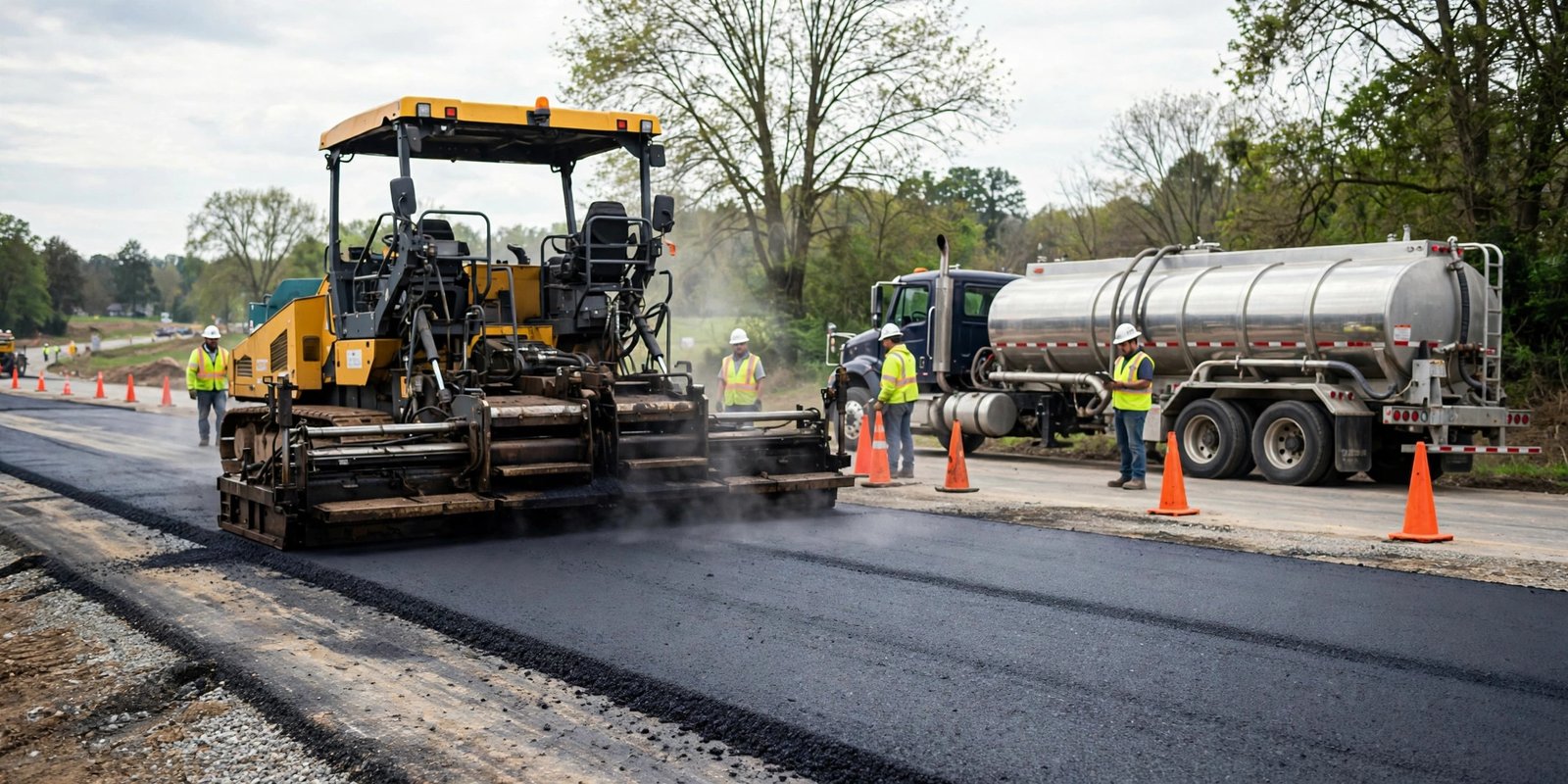
Order the Right Binder Quantity — Not a Tonne Too Much, Not a Drum Too Little
Bitumen is the sticky black binder that glues aggregates together in asphalt pavement — and it is usually the most expensive ingredient in the mix. Order too much and you waste money on material that sits in drums; order too little and the paver stops mid-shift while you wait for a tanker. A bitumen calculator turns your road dimensions, layer thickness, and mix design into an exact binder quantity in tonnes and kilograms, so the order matches the job.
Enter the values below and get your bitumen weight, total mix weight, and mix volume instantly — in both metric and imperial units.
Road & paving · binder quantity · mix estimate
Please enter a length, width, thickness, density, and bitumen content % — all above 0 (content no more than 100%).
Bitumen required
Binder quantity for your paved section
Estimates assume a uniform compacted layer with the mix design values you enter. Contractors usually add 3–5% extra for waste and trimming. Always follow your lab’s job-mix formula for final orders — this is a planning estimate, not engineering advice.
How to Use This Calculator
- Enter the road length and width — pick metres or feet for each.
- Enter the layer thickness — the compacted depth of the asphalt layer (millimetres, centimetres, metres, or inches).
- Enter the bitumen content % — the binder percentage from your mix design. Typical range is 4–7% (default 5%).
- Enter the mix density — default 2.4 t/m³ for compacted hot-mix asphalt (or 149.8 lb/ft³).
- Click Calculate Bitumen — get binder weight in tonnes and kg, plus total mix weight, mix volume, and aggregate weight.
What Is Bitumen in Road Paving?
Bitumen — also called asphalt binder or asphalt cement — is a dark, highly viscous petroleum product refined from crude oil. In road construction it plays one role: glue. Aggregates (crushed stone, sand, and mineral filler) make up roughly 93–96% of the mix by weight; bitumen coats every particle and binds them into a waterproof, flexible pavement layer.
The binder content is deliberately small but critical. Too little bitumen leaves the mix dry and brittle, leading to cracking and raveling; too much makes the surface soft, causing rutting and bleeding in hot weather. That is why the exact percentage comes from laboratory mix design (Marshall or Superpave testing) rather than guesswork — this calculator takes your specified percentage and turns it into an order quantity.
The Bitumen Calculation Formula
Total mix weight = Volume × Mix density
Bitumen weight = Total mix weight × (Bitumen content % ÷ 100)
Worked example
A road section 100 m long and 10 m wide, with a 50 mm (0.05 m) wearing course, 5% binder, and 2.4 t/m³ mix density:
- Volume: 100 × 10 × 0.05 = 50 m³
- Total mix: 50 × 2.4 = 120 tonnes
- Bitumen: 120 × (5 ÷ 100) = 6 tonnes (6,000 kg)
- Aggregate: 120 − 6 = 114 tonnes
Bitumen Content % Guide by Mix Type
Binder content varies with the mix design and the job the layer has to do. Use the table as a starting point — your laboratory job-mix formula always has the final word.
| Mix type | Typical bitumen % | Common use |
|---|---|---|
| Dense-graded hot mix | 5.0 – 6.0% | General road paving |
| Stone mastic asphalt (SMA) | 6.0 – 7.0% | High-traffic highways |
| Open-graded friction course | 4.5 – 5.5% | Drainage / surface layer |
| Porous asphalt | 5.5 – 6.5% | Permeable pavements |
| Polymer-modified mix | 5.5 – 7.0% | Airports, heavy-duty roads |
| Surface dressing / spray seal | n/a (coverage rate) | Tack coat, prime coat |
Bitumen Grades at a Glance
The quantity math is the same for every binder, but the grade you order matters. Viscosity grades dominate modern specs: VG-10 is the softest, used in cold climates and for spraying work; VG-30 is the standard paving grade for most highways; VG-40 is the stiffest, chosen for heavy traffic, junctions and hot regions. Older penetration grades — 60/70 for general paving, 80/100 for cooler areas — cover roughly the same jobs. Polymer-modified (PMB) and crumb-rubber (CRMB) binders step in where loads or temperatures are extreme.
Surface treatments are ordered by coverage, not mix percentage: prime coat typically needs 0.8–1.2 kg/m², tack coat 0.2–0.4 kg/m², and a seal coat about 1.0–1.5 kg/m² — multiply by the treated area to get the binder quantity.
Practical Tips for Accurate Estimates
- Use compacted thickness. The calculator works with the final, rolled-down depth — if you only know the loose (uncompacted) depth, reduce it by your compaction factor first.
- Add a wastage allowance. Most contractors add 3–5% on top of the calculated quantity for trimming, spills, and edge losses.
- Check density per mix. Dense mixes sit around 2.3–2.4 t/m³; SMA and gap-graded mixes can run slightly higher. Your plant’s ticket often lists the actual value.
- Match the spec, not the habit. Binder content changes with aggregate gradation and climate — always enter the percentage from the approved mix design.
- Convert drums to tonnes. A standard 200-litre drum holds roughly 200 kg of bitumen (density ≈ 1.0–1.04 kg/L), so 5 drums ≈ 1 tonne.
Frequently Asked Questions
How do you calculate bitumen quantity for a road?
Multiply length × width × layer thickness to get the mix volume, multiply by the mix density for total mix weight, then multiply by the bitumen content percentage. For example, 50 m³ × 2.4 t/m³ × 5% = 6 tonnes of bitumen.
What is a typical bitumen content percentage?
Most hot-mix asphalt designs use 4.5% to 7% bitumen by total mix weight. Dense-graded mixes sit around 5–6%, SMA runs 6–7%, and open-graded friction courses around 4.5–5.5%. The exact value comes from laboratory mix design.
What is the density of asphalt mix?
Compacted hot-mix asphalt typically weighs 2.2 to 2.45 t/m³ (about 137 to 153 lb/ft³). Dense-graded mixes are usually near 2.4 t/m³, which is this calculator’s default.
How many tonnes of bitumen are in one tonne of asphalt?
At 5% binder content, one tonne of asphalt contains 50 kg of bitumen; at 5.5% it is 55 kg; at 6% it is 60 kg. The rest is aggregate.
Should I add wastage to my bitumen order?
Yes — add 3–5% to the calculated quantity for site waste, trimming, and compaction loss. Many estimators use 5% for irregular sections and 3% for straight highway runs.
Is bitumen the same as asphalt?
Not exactly. Bitumen is the black binder (the “glue”); asphalt (hot-mix asphalt) is the finished mixture of bitumen plus aggregates. In everyday speech the words are often swapped, but in specifications they mean different things.
How do I convert bitumen tonnes to litres or drums?
Paving-grade bitumen has a density of roughly 1.0–1.04 kg per litre, so 1 tonne ≈ 960–1,000 litres ≈ 5 drums of 200 litres. This tool gives weight; multiply tonnes by 1,000 to get kilograms, then divide by ~1.02 for litres.
What affects how much bitumen a road needs?
Paved area, layer thickness, the mix’s density, and the binder percentage from the mix design. Finer, denser gradations and surface courses usually need slightly more binder than coarse base mixes.
Which bitumen grade is best for highway paving?
VG-30 is the standard choice for most highway work. Step up to VG-40 or a polymer-modified binder for very heavy traffic, junctions and hot climates; VG-10 suits cold regions and spraying applications.
How do I calculate bitumen for a tack coat?
Tack and prime coats are specified as a spray rate per square metre — typically 0.2–0.4 kg/m² for tack and 0.8–1.2 kg/m² for prime. Multiply the rate by the treated area to get kilograms of binder.
Final Thoughts
Bitumen is a small slice of every asphalt mix but a large slice of its cost — getting the quantity right protects both your budget and your schedule. Run your dimensions through the calculator above, add your wastage allowance, and always confirm against the approved job-mix formula before placing the order.
Estimating a Full Paving Job?
Combine this with our asphalt calculator for total mix quantities and our gravel calculator for base layers.