Percent change between old and new values — increase or decrease.
How to Use the Percentage Increase Calculator
Comparing two numbers is one of the most common tasks in everyday math, from tracking a raise at work to measuring how much a stock gained. This calculator takes an original value and a new value, then tells you exactly how much changed in percentage terms — and whether that change was an increase or a decrease.
- Enter the original (old) value. This is your starting point — last year’s salary, the old price, or the earlier measurement.
- Enter the new value. This is the updated number you want to compare against the original.
- Click Calculate. The tool instantly shows the percentage change, clearly labeled as an increase or decrease.
- Read the breakdown. You will also see the absolute difference (in plain units) alongside the percentage, so you get the full picture.
What Is Percentage Increase?
A percentage increase tells you how much a value grew relative to where it started, expressed out of 100. Absolute change alone can mislead: a $5 price rise means something very different on a $20 item (+25%) than on a $500 item (+1%). By anchoring the change to the original value, percentage increase puts growth on a fair, comparable scale — which is why it is the standard language of raises, inflation, investment returns, and price changes. The same formula handles decreases too: a negative percentage increase is simply a percentage decrease.
Percentage Increase Calculator Formula
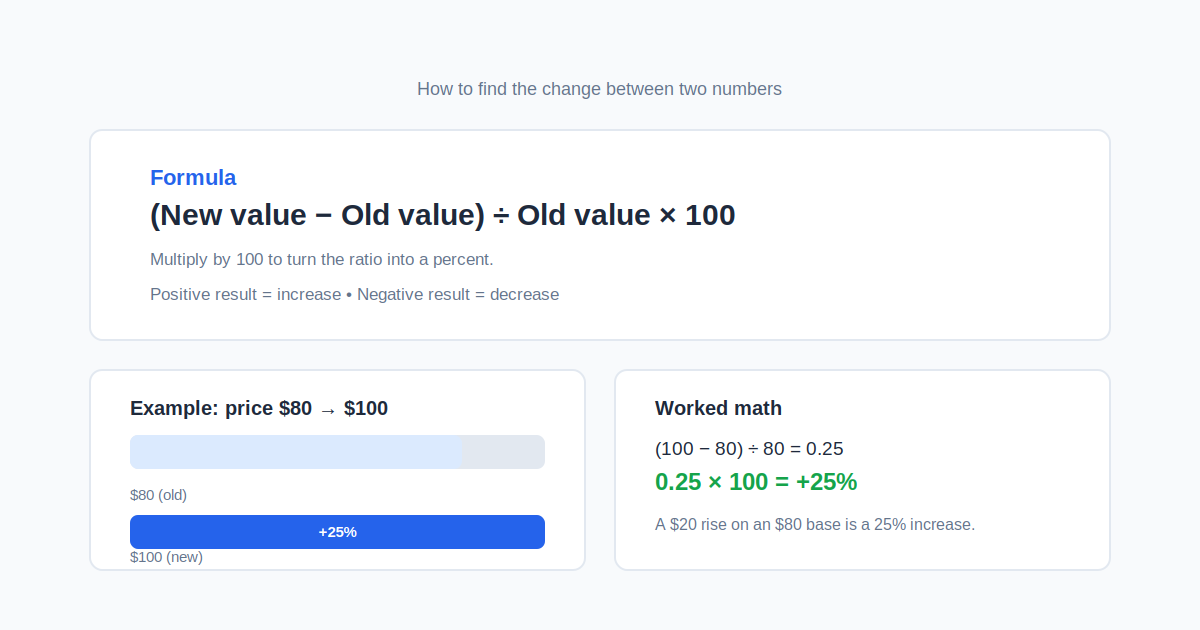
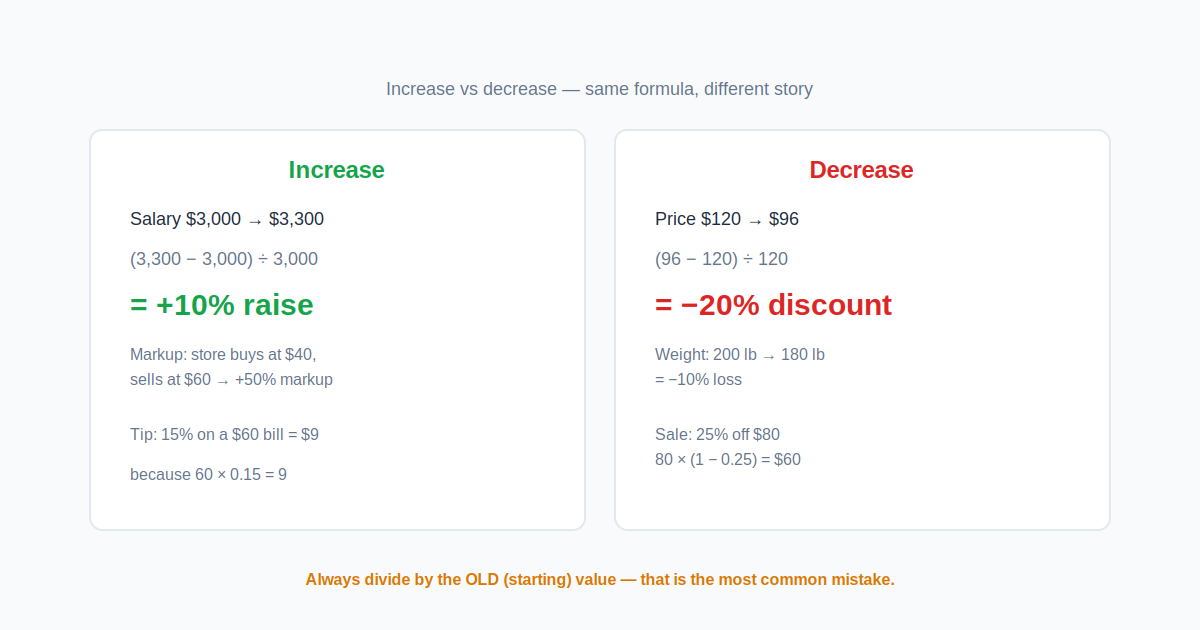
The percentage change between two values is computed with a single, elegant formula: percentage change = (new value − old value) ÷ old value × 100. Subtracting the old value from the new value gives the absolute change; dividing by the old value expresses that change relative to where you started; multiplying by 100 converts the ratio into a percentage. A positive result means the value increased, while a negative result means it decreased.
It is important to distinguish percentage change from percentage points, a confusion that trips up even experienced analysts. If an interest rate rises from 4% to 6%, that is a 2-percentage-point increase — but a 50% increase relative to the original 4%. Percentage points describe the raw difference between two percentages, while percentage change describes that difference relative to the starting value. Our calculator reports true percentage change.
One more subtlety: percentage changes are not symmetric. A 50% increase followed by a 50% decrease does not return you to the starting point. Growing $100 by 50% gives $150, but shrinking $150 by 50% gives $75 — because the second change is computed against a larger base. This asymmetry matters in investing, where a 50% loss requires a 100% gain just to break even.
The Multiplier Method
When you already know the percentage and want the new value — or want to work backwards — multipliers are faster than the full formula. Every percentage change has a multiplier: add the percentage (as a decimal) to 1 for an increase, or subtract it from 1 for a decrease.
New value = old value × (1 + p/100). A price of $120 rising 15% becomes $120 × 1.15 = $138. A salary of $850 rising 12% becomes $850 × 1.12 = $952.
Original value = new value ÷ (1 + p/100). If a bill of $150 already includes a 25% increase, the original was $150 ÷ 1.25 = $120. The same trick reverses decreases: a sale price of $96 after 20% off came from $96 ÷ 0.80 = $120 — and note that dividing by 0.80 is the mirror of multiplying by 1.25.
Multipliers also chain cleanly. Two successive 10% rises are 1.1 × 1.1 = 1.21 — a 21% total rise, not 20% — because the second rise applies to the already-grown value.
Example Calculation
Suppose your hourly wage rises from $22.00 to $24.75. To find the percentage increase, subtract the old value from the new: $24.75 − $22.00 = $2.75. Divide by the old value: $2.75 ÷ $22.00 = 0.125. Multiply by 100 to get 12.5%. Your raise is a 12.5% increase.
Now consider a decrease. A jacket priced at $120 goes on sale for $84. The change is $84 − $120 = −$36. Dividing by the original: −$36 ÷ $120 = −0.30, or −30% — a 30% decrease. Notice that the store could truthfully advertise this as “30% off,” and the math confirms it.
Quick Reference: Common Percentage Changes
| From | To | Percentage change |
|---|---|---|
| 80 | 100 | +25% |
| 22 | 24.75 | +12.5% |
| 200 | 150 | −25% |
| 45 | 36 | −20% |
| 120 | 84 | −30% |
Why Losses Hurt More: The Recovery Table
Because an increase and a decrease are computed from different bases, recovering from a loss always takes a larger gain than the loss itself:
| If you lose | You must gain to break even |
|---|---|
| −10% | +11.1% |
| −20% | +25% |
| −25% | +33.3% |
| −50% | +100% |
| −75% | +300% |
| −90% | +900% |
This asymmetry is the single most important intuition percentage change teaches: protect against deep losses, because the climb back is always steeper than the fall.
Common Mistakes to Avoid
Dividing by the new value. Percentage change is always measured against the old value. Going from 80 to 100 is +25% (20 ÷ 80), not +20% (20 ÷ 100).
Adding successive percentages. A 10% rise followed by another 10% rise is +21%, not +20%, because the second rise builds on the first. Chain multipliers instead of adding rates.
Confusing percentage points with percent. A rate moving from 4% to 6% rose 2 percentage points but 50 percent. Headlines exploit this confusion constantly.
Starting from zero. Percentage increase from 0 is undefined — division by zero has no answer. Describe growth from zero in absolute terms instead.
Mixing units or periods. Compare like with like: same currency, same time window, same measurement method. A monthly change and an annual change are not interchangeable.
Frequently Asked Questions
What is the difference between percentage increase and percentage points?
Percentage increase measures change relative to the starting value: (new − old) ÷ old × 100. Percentage points measure the simple arithmetic difference between two percentages. If unemployment rises from 5% to 7%, that is a 2-percentage-point rise but a 40% increase relative to the original 5%.
Can percentage change be negative?
Yes. A negative result simply means the new value is smaller than the old one — a decrease. For example, going from 200 to 150 is a −25% change, i.e., a 25% decrease. The calculator labels negative results as decreases automatically.
Can a percentage increase be more than 100%?
Absolutely. A 100% increase means the value doubled. A 200% increase means it tripled (original plus twice more). Going from 50 to 175 is a 250% increase. There is no upper limit on percentage increases.
Why do we divide by the old value and not the new one?
Percentage change is always measured against the starting point, because the question being answered is ‘how much did it change relative to where it began?’ Dividing by the new value would answer a different question. This convention is universal in finance, science, and statistics.
How is this used in real life?
Investors track portfolio gains, employers compute raises, retailers set discounts, economists measure inflation and GDP growth, and students compare test scores. Any time you compare a before and after, percentage change is the standard language.
How do I find the original value if I only know the increased price?
Divide the new value by the multiplier (1 + p/100). If a price of $150 is the result of a 25% increase, the original was $150 ÷ 1.25 = $120. For a decrease, divide by (1 − p/100): $96 after 20% off means $96 ÷ 0.80 = $120 originally.
Is there a quick mental shortcut for percentage increase?
Anchor on 10%. Ten percent of any number is just the decimal point moved one place left. From there: 20% is double that, 5% is half, and 15% is 10% plus 5%. To check our example, 10% of $22 is $2.20 and 2.5% is $0.55, totaling $2.75 — matching the exact 12.5% raise.
Related Calculators
Try our Percentage Calculator for all percentage problems, or the Percentage Change Calculator for change between any two values.