What Is Military Time?
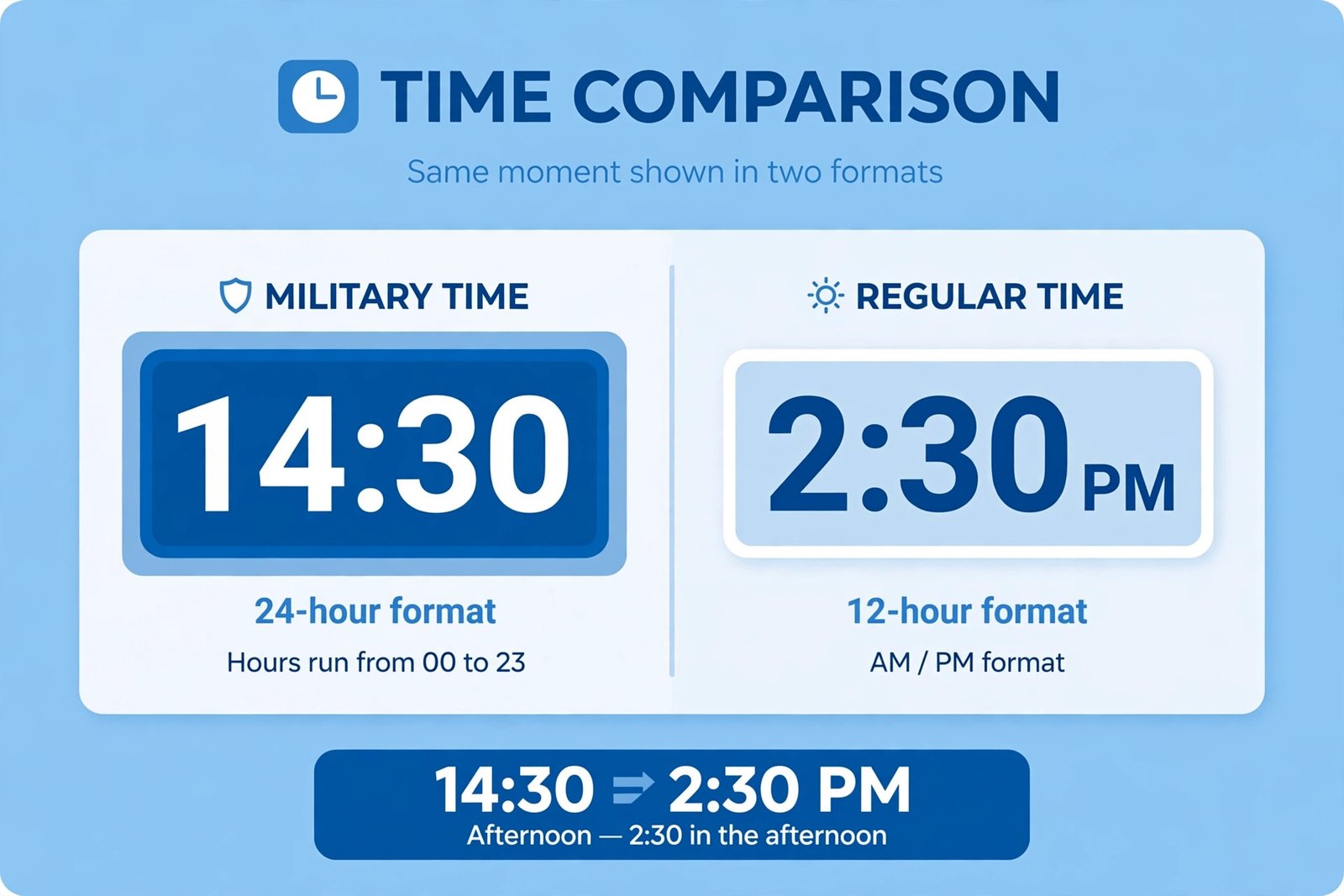
Military time is a 24-hour clock system used by armed forces, hospitals, airlines, emergency services, and transportation schedules around the world. Instead of repeating the numbers 1 through 12 twice a day with AM and PM labels, military time counts each hour of the day once, from 0000 (midnight) to 2359 (one minute before the next midnight).
The word "military" comes from its origins: the system was adopted by navies and armies to eliminate the deadly confusion of mixing up morning and afternoon times in orders and schedules. Today you will also hear it called the 24-hour clock. When someone says "seventeen thirty hours," they mean 5:30 PM. Our military time converter above translates instantly between the two systems so you never have to do the mental math.
Military time is always written as four digits with no colon: the first two digits are the hour, the last two are the minutes. So 1:05 AM becomes 0105, and 1:05 PM becomes 1305. Notice the leading zero — in military time, 0900 is pronounced "oh nine hundred," not "nine hundred." That leading zero matters because it keeps every time stamp exactly four digits long, which is why spreadsheets, databases, and flight schedules prefer it.
How to Convert Standard Time to Military Time
Converting is simple once you know the rule. The military time converter above does it automatically, but here is the manual method so you understand what is happening.
AM times
For hours from 1:00 AM through 11:59 AM, keep the hour as it is and add a leading zero to single-digit hours. So 5:30 AM becomes 0530, and 11:15 AM becomes 1115. Midnight is the one exception: 12:00 AM (midnight) becomes 0000, not 1200.
PM times
For hours from 1:00 PM through 11:59 PM, add 12 to the hour. So 5:30 PM becomes 1730, and 11:45 PM becomes 2345. Noon is the exception here: 12:00 PM (noon) stays 1200 rather than becoming 2400.
The two exceptions to memorize
Midnight (12:00 AM) is 0000. Noon (12:00 PM) is 1200. Every other time follows the plain rules above. A quick sanity check: any military time of 1200 or higher is a PM time, and anything below 1200 is an AM time.
How to Convert Military Time to Standard Time
Reading military time back into the 12-hour clock is just as easy. If the hour part is 00, it is midnight: 0030 is 12:30 AM. If the hour is between 01 and 11, it is the same number with AM: 0930 is 9:30 AM. If the hour is 12, it is noon: 1245 is 12:45 PM. If the hour is 13 or higher, subtract 12 and add PM: 1730 minus 12 is 5, so it is 5:30 PM. And 2359 minus 12 is 11, giving 11:59 PM.
Minutes never change during conversion — only the hour and the AM/PM label change. That is why the process is so fast once you practice it a few times.
Military Time Conversion Chart
Bookmark this quick reference chart for the most common times of day.
| Standard | Military | Pronounced |
|---|---|---|
| 12:00 AM (midnight) | 0000 | Zero hundred |
| 1:00 AM | 0100 | Oh one hundred |
| 6:00 AM | 0600 | Oh six hundred |
| 9:30 AM | 0930 | Oh nine thirty |
| 12:00 PM (noon) | 1200 | Twelve hundred |
| 1:00 PM | 1300 | Thirteen hundred |
| 3:45 PM | 1545 | Fifteen forty-five |
| 5:30 PM | 1730 | Seventeen thirty |
| 8:00 PM | 2000 | Twenty hundred |
| 11:59 PM | 2359 | Twenty-three fifty-nine |
Where Is Military Time Used?
Beyond the armed forces, the 24-hour clock is the standard in hospitals (medication schedules must never confuse 8 AM with 8 PM), aviation (flight plans, air traffic control, and boarding passes), emergency dispatch, railways and public transit in most countries, meteorology, and scientific research. Most of the world outside the United States uses the 24-hour clock in everyday life — train tickets in Europe, shop hours in Asia, and TV listings in Latin America all read 20:00 instead of 8 PM.
Technology uses it heavily too. Computer logs, server timestamps, database records, and scheduling software almost always store times in 24-hour format because it sorts correctly and never needs an AM/PM field. If you work with data, you will meet military time constantly.
Pronouncing Military Time
Spoken military time follows a simple pattern. For times on the hour, say the hour followed by "hundred": 0800 is "oh eight hundred," 1500 is "fifteen hundred." For times with minutes, just say the digits: 1430 is "fourteen thirty," 0715 is "oh seven fifteen." Midnight, 0000, is "zero hundred" (some units say "midnight" to be extra clear). In formal radio communication you may hear "hours" added at the end: "seventeen thirty hours."
Common Mistakes to Avoid
The most frequent error is writing military time with a colon, like 17:30. True military notation has no colon — it is 1730. Another common slip is dropping the leading zero and writing 930 instead of 0930; that breaks the four-digit standard and can confuse automated systems. People also sometimes convert noon and midnight backwards: remember, 0000 is midnight and 1200 is noon, not the reverse. Finally, do not say "2400" for midnight — the day ends at 2359 and the new day begins at 0000.
Worked Examples
Example 1: Convert 7:45 PM to military time. PM means add 12: 7 plus 12 is 19. Minutes stay 45. Answer: 1945.
Example 2: Convert 0845 to standard time. The hour 08 is below 12, so it is AM: 8:45 AM.
Example 3: Convert 12:20 AM to military time. Midnight-hour exception: 12 AM becomes 00. Answer: 0020.
Example 4: A flight departs at 2210. Subtract 12: 22 minus 12 is 10, so the departure is 10:10 PM.
Tips for Learning Military Time Quickly
The fastest way to get comfortable with military time is the "minus 12" trick for afternoon and evening hours. Whenever you see a military time of 1300 or higher, subtract 12 in your head: 1400 becomes 2 PM, 1900 becomes 7 PM, 2200 becomes 10 PM. After a few days of practice, the common ones become automatic — you will read 1700 as "5 PM" without thinking.
Another useful habit is setting one of your devices to the 24-hour clock for a week. Your phone, computer, or watch will constantly show you both systems side by side, and the conversion becomes second nature. Pilots, nurses, and dispatchers all learn it this way — through exposure, not memorization.
For the reverse direction, remember that PM hours are just the military hour minus 12. And for morning times, nothing changes except dropping the leading zero: 0930 is simply 9:30 AM. The only two values that need real memorization are 0000 (midnight) and 1200 (noon).
Military Time Around the World
While Americans call it "military time," most of the world just calls it "the time." In Europe, Asia, Africa, and Latin America, the 24-hour clock is the default for public life: train schedules, business hours, television guides, and official documents all use it. A restaurant in Paris opens at 19h00, a train in Tokyo departs at 21:15, and a shop in Berlin closes at 20:00.
The United States, Canada (partially), Australia, and the Philippines are among the few places where the 12-hour clock dominates everyday conversation. Even there, hospitals, airlines, the military, and emergency services run on 24-hour time internally. If you travel internationally or work with global teams, fluency in military time is practically a requirement.
One regional quirk: some countries write the 24-hour time with a colon (17:30) or even a period (17.30), while strict military notation always omits separators (1730). The meaning is identical — only the punctuation differs.
Zulu Time: One Clock for Every Time Zone
Military operations and aviation add one more idea to the 24-hour clock: a single reference time zone so that a timestamp means the same thing everywhere. That reference is called Zulu time, written with a Z after the time — 1500Z, for example. Zulu is simply Coordinated Universal Time (UTC), the world's primary time standard, and the letter Z is the phonetic-alphabet name for the UTC zone.
Why it matters: if a flight plan, weather report, or military order just said "1500", nobody would know whose 1500 it meant. In Zulu, 1500Z is 15:00 UTC everywhere on Earth — the same moment as 10:00 AM in New York on standard time (UTC−5) or 8:00 PM in Karachi (UTC+5). Pilots, air traffic controllers, and military units worldwide work in Zulu for exactly this reason.
Frequently Asked Questions
What is 1730 in regular time?
1730 in military time is 5:30 PM in regular 12-hour time. Subtract 12 from 17 to get 5, and keep the 30 minutes.
What is 0000 in military time?
0000 is midnight — the very start of the day, equivalent to 12:00 AM. It is pronounced "zero hundred."
Is 12 PM 1200 or 0000 in military time?
12 PM (noon) is 1200 in military time. 0000 is midnight (12 AM). Mixing these two up is one of the most common conversion mistakes.
Do you say "oh" before single-digit hours in military time?
Yes. 0930 is pronounced "oh nine thirty" and 0800 is "oh eight hundred." The spoken "oh" mirrors the written leading zero.
Why is it called military time?
It was standardized by military organizations to prevent dangerous AM/PM mix-ups in orders and schedules. The 24-hour clock itself is much older, but the military made its use systematic.
What is the difference between military time and the 24-hour clock?
They are the same system. "Military time" is the common American name; "24-hour clock" is the international term. The only formatting difference is that civilian 24-hour clocks often use a colon (17:30) while strict military notation omits it (1730).
What is Zulu time?
Zulu time is military and aviation shorthand for Coordinated Universal Time (UTC), marked with a Z after the time, as in 1500Z. Because every unit and airport uses the same reference, a Zulu timestamp means the same moment everywhere — 1500Z is 15:00 UTC, which is 10:00 AM in New York on standard time.