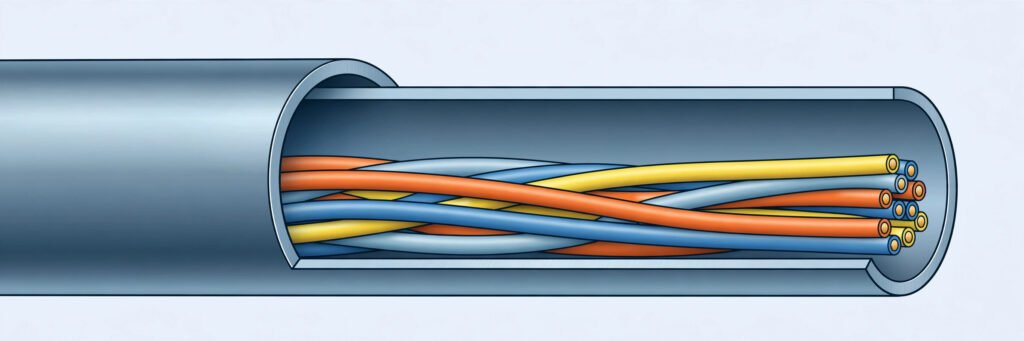
The Inspection Question You Answer Before the Inspector Asks It
You’ve got a bundle of wires, a length of conduit, and a nagging doubt: is that run legal, or are you stuffing too much copper into too little pipe? Guessing is how people end up re-pulling a run — or failing an inspection. Conduit fill is the number that settles it: the percentage of the conduit’s interior cross-section taken up by conductors.
This free conduit fill calculator applies the National Electrical Code (NEC) Chapter 9 fill percentages to your exact setup — EMT, rigid metal, or PVC, mixed wire gauges welcome — and tells you instantly whether the run passes or needs a bigger pipe.
Conduit fill · NEC Chapter 9 · EMT / Rigid / PVC
Please enter at least one wire with a quantity of 1 or more.
Conduit fill
Planning aid only: this calculator estimates fill per NEC Chapter 9 fill percentages for planning. Wire and conduit dimensions are approximate table values — verify against your product’s spec sheet. Electrical work must follow your local electrical code and be done by a licensed electrician. It cannot replace professional design or inspection.

How to Use This Calculator
- Pick the conduit type — EMT, rigid metal, or PVC Schedule 40 (interior areas differ slightly).
- Choose the trade size — from 1/2″ up to 2″.
- Add your wires — one row per wire gauge (14 AWG up to 4/0), with the quantity of each. Include grounding and neutral conductors.
- Click “Calculate Fill” — you get the fill percentage, a PASS/FAIL verdict against the NEC limit, and a step-by-step breakdown.
- If it fails, the tool tells you the minimum interior area you need and suggests the next standard size up.
What Is Conduit Fill?
Conduit fill is simply how full a conduit is, measured as the total cross-sectional area of all conductors inside it divided by the conduit’s interior cross-sectional area — expressed as a percentage. The NEC caps it with three different limits depending on how many conductors share the pipe:
| Conductors in the conduit | Maximum fill (NEC Ch. 9, Table 1) |
|---|---|
| 1 conductor | 53% |
| 2 conductors | 31% |
| 3 or more conductors | 40% |
The limits exist for physical reasons, not bureaucratic ones. An overstuffed conduit traps heat around the conductors (which can derate their ampacity), makes the pull itself brutally hard, and risks nicking insulation as wires jam against each other and the conduit walls. That’s also why two wires get the harshest limit — 31% — since a pair jams across the pipe diameter more easily than a round bundle of three or more.
The Conduit Fill Formula
Total conductor area = sum of (wire area × quantity) for each gauge
Worked example
Say you’re pulling 6 wires of 12 AWG THHN through 3/4″ EMT:
- Wire area: 12 AWG THHN ≈ 0.0133 in² each → 6 × 0.0133 = 0.0798 in²
- Conduit interior area: 3/4″ EMT ≈ 0.533 in² (NEC Ch. 9, Table 4)
- Fill %: 0.0798 ÷ 0.533 × 100 = 15.0%
- NEC limit: 6 wires → 40% — PASS, with about 25 percentage points of headroom
That headroom is the interesting part: you could still add a few more conductors later without upsizing the pipe — but you’d re-run the calculator first, because fill is about all the conductors in the run, not just the ones you’re pulling today.
THHN wire areas used by the calculator
Approximate overall cross-sectional areas for copper THHN/THWN conductors (NEC Chapter 9, Table 5):
| Wire gauge | Area (in²) | Wire gauge | Area (in²) |
|---|---|---|---|
| 14 AWG | 0.0097 | 3 AWG | 0.0973 |
| 12 AWG | 0.0133 | 2 AWG | 0.1158 |
| 10 AWG | 0.0211 | 1 AWG | 0.1562 |
| 8 AWG | 0.0366 | 1/0 AWG | 0.1855 |
| 6 AWG | 0.0507 | 2/0 AWG | 0.2223 |
| 4 AWG | 0.0824 | 3/0 AWG | 0.2679 |
| 4/0 AWG | 0.3237 |
Who This Is For — Tips From the Field
- Apprentices and DIYers: run the numbers before buying conduit — upsizing at the supply house costs pennies compared to re-pulling.
- Contractors bidding work: fill determines your conduit schedule, so an accurate number keeps your bid tight and your inspector happy.
- Count every conductor: equipment grounding conductors and neutrals count toward fill. Forgetting the ground is the single most common mistake.
- Leave room for the future: if there’s any chance of adding circuits later, size up one trade size now while the walls are open.
- Watch the 4+ conductor rule: fill limits aren’t the only rule — with more than 3 current-carrying conductors, NEC ampacity derating kicks in too. Ask your electrician.
Frequently Asked Questions
What is conduit fill?
It’s the percentage of a conduit’s interior cross-section occupied by conductors, calculated as total conductor area divided by conduit interior area, times 100. The NEC limits it to 53% for one wire, 31% for two wires, and 40% for three or more.
What are the NEC conduit fill limits?
Per NEC Chapter 9, Table 1: one conductor may fill up to 53% of the conduit, two conductors up to 31%, and three or more conductors up to 40%. The calculator applies the right limit automatically based on your wire count.
Do ground wires count toward conduit fill?
Yes. Equipment grounding conductors and neutral conductors both count toward the fill total. This is the most common thing people forget, and it can flip a passing run into a failing one.
Does the conduit type change the fill calculation?
Slightly. EMT, rigid metal conduit, and PVC Schedule 40 have slightly different interior areas at the same trade size (NEC Chapter 9, Table 4), so the calculator uses type-specific values for accuracy.
Why can’t I fill a conduit past 40%?
Two reasons: heat and friction. Packed conductors can’t dissipate heat, which can force you to derate their current-carrying capacity — and a tight pull risks damaging insulation as wires scrape against each other and the conduit walls.
What wire areas does this calculator use?
Approximate overall areas for THHN/THWN copper conductors from NEC Chapter 9, Table 5, in square inches. If you’re using a different insulation type (XHHW, THW, etc.), check your wire’s spec sheet, since thicker insulation means a larger area.
Can I use this for cables or metric conduit sizes?
This calculator is built for individual conductors in inch trade sizes (1/2″ to 2″). Multi-conductor cables follow different NEC rules, and metric sizes aren’t included — a licensed electrician can advise on those cases.
What is the 60% fill rule for conduit nipples?
NEC Chapter 9, Table 1 has one exception: a nipple — a short conduit stub of 24 inches or less between boxes or enclosures — may be filled to 60% of its interior area instead of the usual 53/31/40%. The exception exists because a short, straight stub has no long pull to damage insulation. All conductors, including grounds, still count.
How many 12 AWG THHN wires fit in 3/4-inch EMT?
Sixteen. The math: 3/4-inch EMT has about 0.533 in² of interior area, the 40% limit for 3+ conductors allows 0.213 in², and each 12 AWG THHN takes about 0.0133 in² — 0.213 ÷ 0.0133 = 16.0 wires. In 1/2-inch EMT (0.304 in²) the same math gives 9 wires. Always re-check with your actual wire count, grounds included.
Final Thoughts
Conduit fill is one of those numbers that’s cheap to check and expensive to ignore. Thirty seconds with the calculator above — before the wire goes in the cart — is the difference between a clean pull and a run you have to do twice. Keep your grounds counted, leave yourself headroom, and size the pipe for the wires you might add, not just the ones you have.
Estimating Materials for the Job?
Figure out lumber with our board foot calculator and stone coverage with our stone calculator.