See the true lifetime cost of smoking — daily packs add up to shocking totals.

How to Use the Smoking Cost Calculator
Most smokers think in terms of a few dollars a day and never add it up. This calculator does the uncomfortable math: what you spend daily, what you have already spent, what you will spend if you continue, and what that money could have become if invested. The numbers surprise almost everyone.
- Enter cigarettes per day. Be honest. A pack-a-day smoker enters 20. If you smoke socially or irregularly, estimate your weekly total and divide by 7.
- Enter the cost per pack in your area. Prices range from about 6 dollars in low-tax states to over 12 dollars in places like New York. Use what you actually pay.
- Enter years smoked so far. This shows the sunk cost, money already gone. It is not meant to guilt you, but to make the scale concrete.
- Enter how many more years you expect to continue. This drives the future cost and the investment comparison. Try different values to see the impact of quitting sooner.
- Set an investment return. Seven percent is the long-run stock market average after inflation. This shows the opportunity cost, what the cigarette money could have earned.
- Click Calculate. You will see costs by day, week, month, and year, lifetime totals, the invested alternative, and your total cigarette count.
The Real Cost of Smoking
The daily cost seems small because it is dripped out a few dollars at a time. Twenty cigarettes a day at 8.50 dollars a pack is 8.50 dollars daily, which sounds manageable until you multiply: about 60 dollars a week, 259 dollars a month, and 3,103 dollars a year. Over 30 years that is more than 93,000 dollars literally burned, and that ignores price increases, which have historically outpaced inflation as taxes rise.
The opportunity cost is the starker number. Money spent on cigarettes cannot compound. The future value formula shows what annual cigarette spending would become if invested: yearly cost times ((1 + r) to the power n minus 1) divided by r. At 3,103 dollars per year and 7 percent for 30 years, that is roughly 293,000 dollars. A pack-a-day habit over a working lifetime can easily cost the equivalent of a house down payment, or a comfortable retirement supplement.
Then there are the costs no calculator captures. Smokers pay more for life insurance, sometimes double or triple the premiums of non-smokers, and often more for health insurance. They face higher out-of-pocket medical costs over their lifetimes. Productivity losses from smoking breaks and smoking-related illness are real though harder to quantify. And the health costs, measured in years of life and quality of life, dwarf every dollar figure.
The encouraging flip side: quitting pays immediately. Within 20 minutes blood pressure drops. Within a year, heart disease risk is cut in half. Within 10 years, lung cancer risk falls dramatically. Financially, the savings start the first day you do not buy a pack, and former smokers often describe the extra money as one of the most motivating parts of staying quit.
Worked Example
Take Marcus, who smokes a pack a day (20 cigarettes) at 8.50 dollars per pack. He has smoked for 10 years and, at age 35, expects to continue 20 more years without quitting. His daily cost is 8.50 dollars, yearly cost 3,102.50 dollars.
He has already spent about 31,025 dollars over the past decade. Continuing 20 more years adds 62,050 dollars, for a lifetime total above 93,000 dollars. His total cigarette count over 30 years is 20 times 365 times 30, or 219,000 cigarettes.
If instead Marcus quit today and invested the 3,102.50 dollars each year at 7 percent for 20 years, the future value would be about 127,000 dollars. If he had never started and invested for the full 30 years, it would be about 293,000 dollars. Seeing that his habit will cost him a quarter-million dollars in lost wealth is, for many people, the motivation that finally sticks.
If That Money Had Been Invested Instead
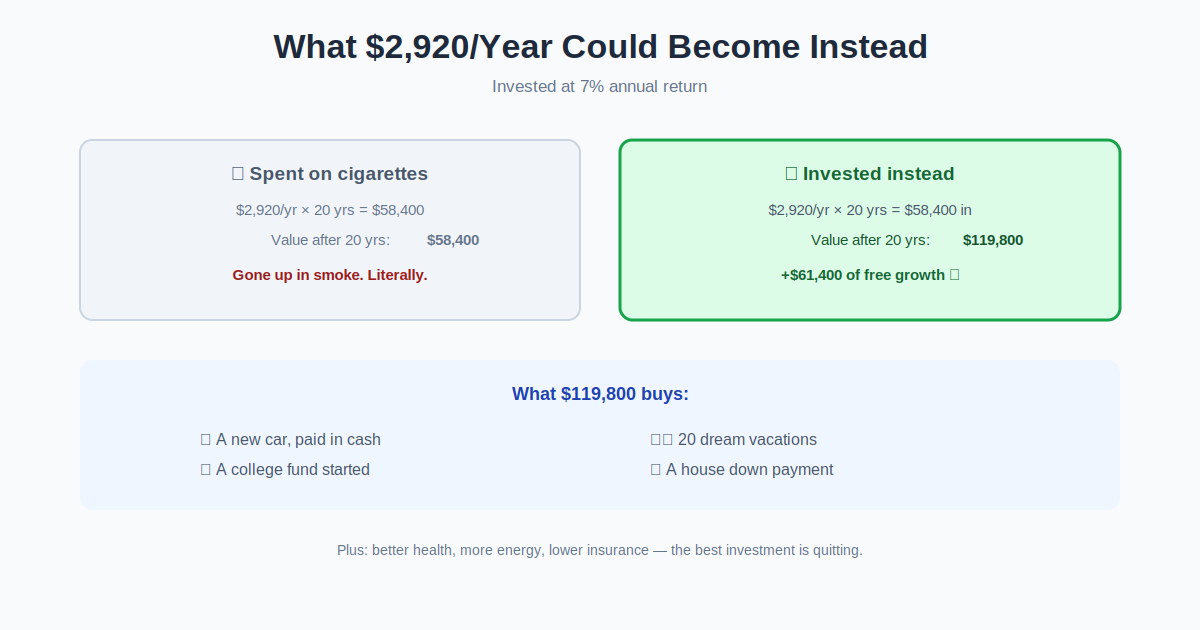
The table below uses the worked-example smoker: one pack a day at $8.50, spending $3,102.50 a year. The right-hand column shows what those yearly contributions would grow to if invested instead, assuming a 7% average annual return (the calculator above lets you use your own return assumption):
| Period | Spent on cigarettes | If invested at 7% |
|---|---|---|
| 1 year | $3,102.50 | ≈ $3,100 |
| 10 years | $31,025 | ≈ $42,900 |
| 20 years | $62,050 | ≈ $127,200 |
| 30 years | $93,075 | ≈ $293,100 |
| 50 years | $155,125 | ≈ $1,261,000 |
The gap between the two columns is the opportunity cost: money spent on cigarettes is not just gone, it also never gets the chance to compound.
The Hidden Costs Beyond the Pack Price
Cigarettes are only the visible spend. Smokers typically pay 50–100% more for life insurance than non-smokers of the same age, and health-insurance loadings and out-of-pocket medical and dental costs run higher too. Smoke exposure lowers the resale value of cars and homes (buyers discount for smell and staining), and smoking breaks quietly erode paid working time. None of this appears in the calculator — deliberately, because those costs vary too much by person to estimate honestly — but for many smokers they add up to thousands more per decade on top of the figures above.
Your Body After Your Last Cigarette
The financial recovery starts the same day you quit, and so does the physical one. Within about 20 minutes, heart rate and blood pressure begin settling toward normal. By 12 hours, carbon monoxide in the blood drops back to normal levels, improving oxygen delivery. Over the next 2–12 weeks circulation improves and lung function increases, and coughing and shortness of breath typically ease over 1–9 months. At one year, the risk of coronary heart disease is roughly half that of a continuing smoker; at 5–15 years, stroke risk can fall to a non-smoker’s level; and by 10–15 years, lung cancer risk drops to about half. Quitting later still pays: even people who stop after 60 live longer, on average, than those who continue — and every one of them keeps the money in the table above instead.
Frequently Asked Questions
How much does smoking cost per year?
A pack-a-day smoker at $8.50 per pack spends about $3,100 per year. Heavier smokers or those in high-tax states can exceed $5,000-$6,000 annually. This calculator personalizes it to your habit.
What is the lifetime cost of smoking?
A pack a day for 30 years costs roughly $93,000 out of pocket at current prices. Invested at 7% instead, that money could grow to nearly $300,000. Price increases make the real figure higher.
Do smokers pay more for insurance?
Yes. Life insurance premiums for smokers are often 2-3 times higher than for non-smokers. Health insurance and disability premiums can also be higher, adding thousands per year beyond cigarette costs.
How quickly do the savings add up after quitting?
Immediately. A pack-a-day quitter saves about $260 per month from day one. Within a year that is over $3,100, enough for a vacation or a solid emergency fund starter.
What are free resources to help quit smoking?
In the US, call 1-800-QUIT-NOW for free coaching and often free nicotine replacement. Smokefree.gov offers tools and text programs. Many employers and insurers cover cessation programs at no cost.
How much does a pack-a-day smoker spend in a lifetime?
At $8.50 a pack, one pack a day costs $3,102.50 a year, so 50 years comes to about $155,125 — before any price rises, which in practice push it higher. Add the invested-at-7% figure from the table above and the lifetime opportunity cost passes a million dollars.
Does cutting down save much money?
It saves exactly in proportion: halving from a pack a day to half a pack a day saves about $1,551 a year at $8.50 a pack. But remember that smoking-related health risks do not fall in a straight line — cutting down helps your wallet more reliably than it helps your health.
How much will I save in the first month after quitting?
A pack-a-day smoker at $8.50 keeps roughly $259 in the first month ($8.50 × 30.44 days). Put that monthly amount somewhere visible — many quitters move it into a savings account to watch it grow.
Related Calculators
Thinking about health costs? Our Life Expectancy Calculator shows how habits affect longevity, and our Emergency Fund Calculator helps redirect savings productively.