Compare consolidating debts into one loan vs current payments — savings and payoff time.
Your Current Debts
Consolidation Loan Offer
How to Use the Debt Consolidation Calculator
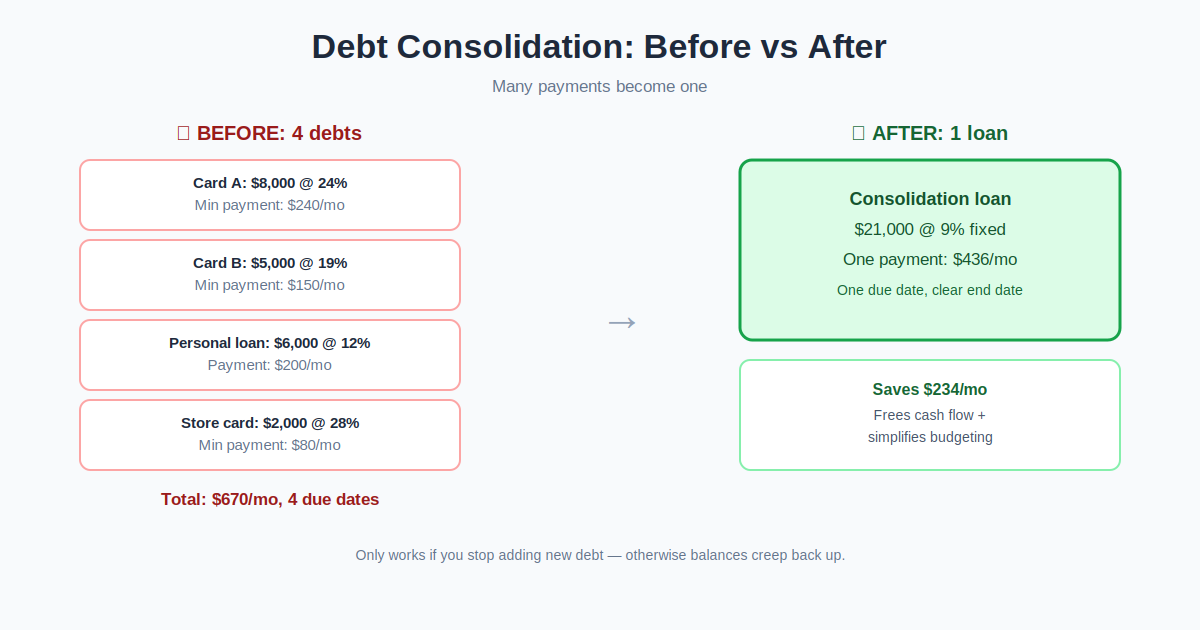
Juggling several debts with different rates and due dates is stressful and expensive. A consolidation loan rolls them into one payment, ideally at a lower rate. This calculator compares your current payoff path against a consolidation offer so you can see the true savings, including the origination fee many borrowers forget.
- Enter up to three current debts. For each, enter the balance and APR. List your highest-rate debts first for the most accurate avalanche simulation.
- Enter the total monthly payment you can afford. This is the combined amount you will put toward debt each month. The calculator applies it optimally across your debts.
- Enter the consolidation loan APR. Use the actual rate you were offered or prequalified for, not the advertised starting rate.
- Enter the origination fee. Most personal loans charge 1 to 8 percent upfront, added to your balance. A low rate with a big fee can be worse than it looks.
- Click Calculate. Compare months to payoff, total interest, and total paid under each scenario, plus a plain-English verdict.
How Debt Consolidation Works
Consolidation replaces multiple debts with a single fixed-rate loan. The appeal is obvious: one payment, one due date, and usually a lower average interest rate than credit cards. Personal loans, home equity loans, and balance-transfer cards are the most common tools. Each has trade-offs. Personal loans are unsecured but carry origination fees. Home equity loans offer the lowest rates but put your house at risk. Balance transfers offer 0 percent introductory periods but charge transfer fees and the rate spikes when the promo ends.
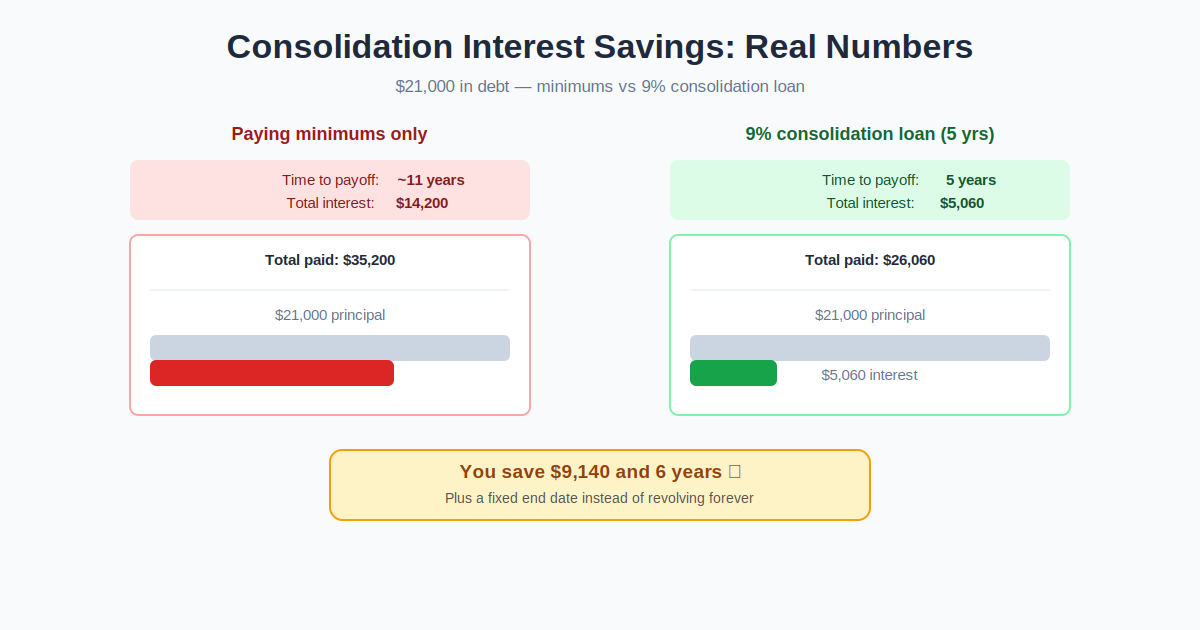
The math that matters is total cost, not just the monthly payment. Lenders sometimes stretch the term to make the payment look small, which can actually increase total interest even at a lower rate. A 5-year consolidation loan at 10 percent can cost more total interest than grinding through cards at 22 percent in 2 years with aggressive payments. This calculator keeps the monthly payment identical in both scenarios so you compare apples to apples.
The origination fee is the hidden trap. A 3 percent fee on 16,000 dollars adds 480 dollars to your balance on day one. At a modest rate improvement, that fee can take a year or more to earn back. Always ask whether the fee is deducted from the loan proceeds or added to the balance, and factor it into your comparison.
Consolidation only works if you stop the bleeding. Studies consistently show that many borrowers run their cards back up after consolidating, ending deeper in debt than before. The winning move is to consolidate, then cut up the cards or freeze them, and automate the single payment.
Worked Example
Take Sofia, who owes 8,000 dollars at 22 percent, 5,000 at 18 percent, and 3,000 at 12 percent, a total of 16,000 dollars. She can afford 600 dollars per month. Paying optimally (avalanche method, highest rate first), she becomes debt-free in about 32 months and pays roughly 4,100 dollars in interest.
A lender offers her a consolidation loan at 10 percent with a 3 percent origination fee. The fee adds 480 dollars, so she borrows 16,480 dollars. At 600 dollars per month, she pays it off in about 31 months with roughly 2,300 dollars in interest. Total paid drops from about 20,100 dollars to about 18,780 dollars, a savings of roughly 1,320 dollars, and she finishes a month sooner with a single payment.
But change the offer to 14 percent with a 6 percent fee and the picture flips. The fee adds 960 dollars, the higher rate slows progress, and total interest barely beats the original plan. Sofia would save almost nothing while giving up the flexibility of separate accounts. The calculator exposes exactly these trade-offs before you sign.
Keep Paying the Old Amount
The cheapest consolidation strategy is rarely the lower payment — it is keeping your payment exactly where it was. Dropping your interest rate while holding the payment steady attacks principal far faster. The math behind payoff time is the formula n = -ln(1 – rP/M) / ln(1 + r), where r is your monthly rate, P is the balance, and M is the payment.
Run it on 20,000 dollars of debt at 22 percent with a 600 dollar payment: payoff takes about 52 months and costs about 11,192 dollars in interest. Consolidate to 10 percent and keep paying the same 600 dollars: payoff drops to about 40 months and interest falls to about 3,530 dollars. Same payment, roughly one year sooner, and about 7,660 dollars saved.
Compare that to the common mistake — stretching the new loan to 7 years for a smaller payment. You would pay comfortably each month and hand the lender far more interest than the original debt ever demanded. Use the calculator above to test both paths: a lower rate with the same payment almost always beats a lower payment with the same rate.
Related Calculators
Explore payoff strategies with our Debt Payoff Calculator, or check whether refinancing makes sense using our Refinance Break-Even Calculator.
Frequently Asked Questions
Is debt consolidation a good idea?
It can be when the new rate is meaningfully lower, the fee is modest, the term is not stretched too long, and you commit to not running balances back up. Run the numbers first — a lower payment alone does not mean savings.
Does consolidation hurt my credit score?
You may see a small temporary dip from the hard inquiry and new account. Over time, lower utilization and on-time payments usually raise your score. Closing old cards can hurt by reducing available credit.
What is a good APR for a consolidation loan?
It depends on credit. Excellent credit can get 7-10%, good credit 10-15%, fair credit 15-20%+. Compare the offer against your weighted average current rate minus the fee drag.
Should I use a balance transfer card instead?
A 0% intro APR for 12-21 months can beat a loan if you can pay the balance within the promo period. Watch the 3-5% transfer fee and have a plan for the rate spike afterward.
What is the biggest mistake people make when consolidating?
Running the paid-off cards back up. Without changed spending habits, consolidation just converts existing debt into more total debt. Automate payments and remove temptation.
Do my credit cards stay open after consolidation?
Usually yes, unless you close them. That is actually helpful: keeping old cards open preserves your available credit and account history, which supports your score. The danger is spending on them again — many people lock the physical cards away until the debt is gone.
Can I consolidate debt with bad credit?
Options are thinner but exist: secured personal loans, credit-union loans, and nonprofit debt management plans that negotiate lower rates without a new loan. Compare any offer against your current weighted-average rate — a consolidation at a higher rate than you already pay helps no one.