Carpet square yards needed including waste for pattern matching.
How to Use the Carpet Calculator
Carpet is priced by the square yard, but rooms are measured in feet — and the waste factor for seams, pattern matching, and odd angles catches many buyers off guard. This calculator converts your room to square yards, adds the right waste allowance, and tells you exactly how much to order.
- Measure length and width. Measure each wall at floor level in feet, using the longest dimensions — carpet must cover wall to wall.
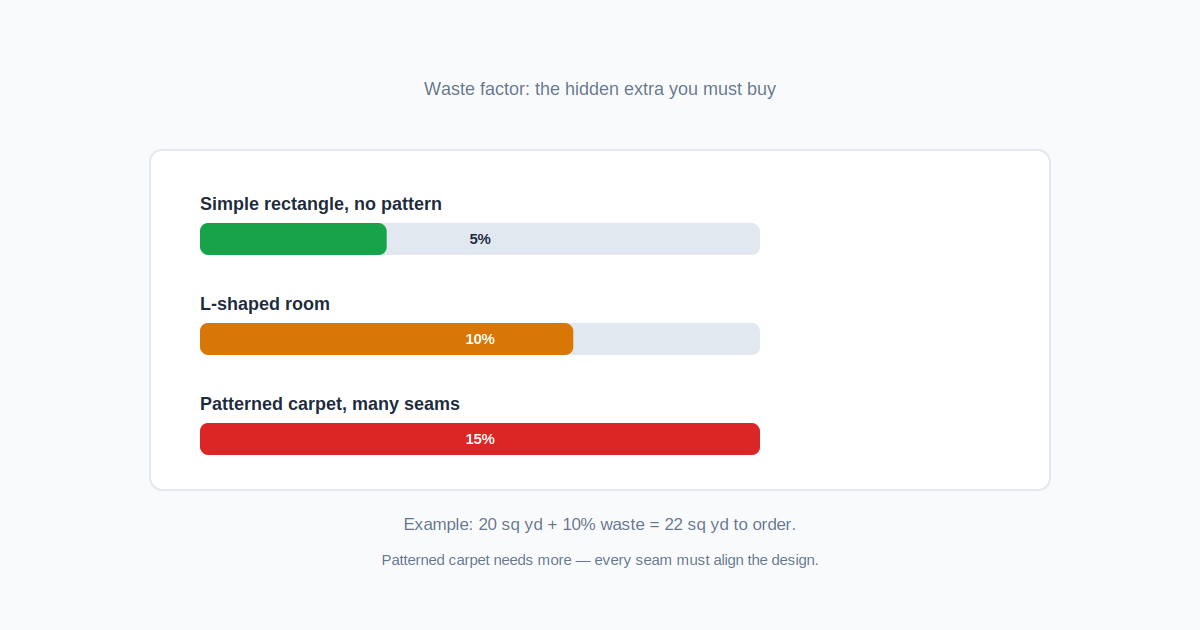
- Enter the waste percentage. Standard rooms need 5–10%; rooms with angles, closets, or patterned carpet need 10–15%.
- Add stairs or hallways separately if needed. These are measured and calculated on their own, then added to the total.
- Calculate. The tool shows the area in square feet, the square yards including your waste allowance, and the total amount to order.
Carpet Calculator Formula
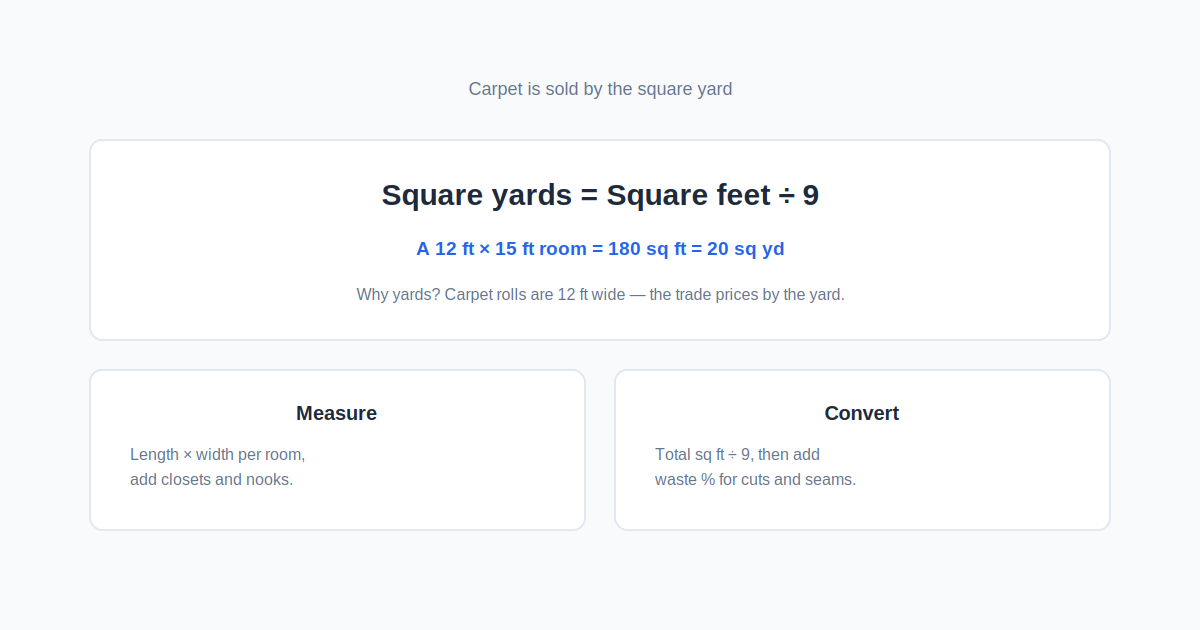
The conversion at the heart of carpet math is square yards = (length in feet × width in feet) ÷ 9, since one square yard equals nine square feet. A 12×15-foot room is 180 sq ft, or exactly 20 sq yd before waste. The order quantity then becomes order = square yards × (1 + waste percentage) — with 10% waste, that 20 sq yd room needs 22 sq yd ordered.
Waste is not padding the retailer’s margin; it is genuinely consumed. Carpet comes in 12-foot-wide rolls, so any room dimension that doesn’t divide evenly into 12 leaves offcuts. Seams must fall in low-traffic areas and run with the pile direction, which constrains layout. Patterned carpets (stripes, geometrics) must be matched at every seam, easily consuming an extra half-repeat per seam — hence the higher waste factor.
One more practical note: carpet is sold in whole and half-yard increments, and installers order slightly over because a shortfall means reordering from a different dye lot — visibly different color. Rounding your 21.3 sq yd calculation up to 22 is cheap insurance against a two-tone floor.
Example Calculation
A 14×16-foot living room with one angled wall, using a subtly patterned carpet. Area = 14 × 16 = 224 sq ft. Convert: 224 ÷ 9 ≈ 24.9 sq yd. The angle plus pattern calls for 12% waste: 24.9 × 1.12 ≈ 27.9 sq yd → order 28 sq yd. At $28 per square yard installed-materials price, the carpet costs about $784 before pad and labor.
Compare a simple 10×12 bedroom in solid-color carpet: 120 sq ft = 13.3 sq yd, 7% waste → 14.3 → order 14.5 sq yd. Small rooms are proportionally efficient because the 12-foot roll width covers them with minimal cutting.
Why You Buy More Carpet Than Your Room Measures
The square-yard figure from the formula is your room’s net area — but carpet is not sold by net area. It is cut from a roll, almost always 12 feet wide, so you buy rectangular cuts (roll width × cut length), not the exact shape of your room. A real three-room example shows the effect: two 10×10-foot bedrooms (100 sq ft each) each need a 12×10-foot cut, which is 120 sq ft of carpet apiece, and a 9×15-foot living room (135 sq ft) needs a 12×15-foot cut of 180 sq ft. The rooms total 335 sq ft — about 37.2 sq yd — yet you purchase 420 sq ft, about 46.7 sq yd, roughly 25 percent more. The leftover strips are called remnants; use them in closets or on stairs rather than treating them as pure loss. Rooms wider than the roll also need a seam, which is the other reason quotes exceed the simple divide-by-9 answer.
How to Measure Tricky Rooms
For an L-shaped or irregular room, do not hunt for one magic formula. Split the floor into rectangles on a quick sketch, measure each rectangle’s length and width, and run each one through the calculator, adding the square yards together. Measure closets and alcoves as their own small rectangles. Take every measurement wall to wall at the longest points, and measure into the middle of each doorway — installers hide seams under doors, and carpet should reach that midpoint. Write measurements down room by room as you go; a sketch with numbers beats a good memory at the carpet store.
Frequently Asked Questions
Why is carpet sold by the square yard instead of square foot?
Historical convention from the textile trade, where fabric is sold by the yard. Since carpet rolls are manufactured in yard-based widths (12 feet = 4 yards), the square yard is the natural unit. Just remember: divide square feet by 9.
How much waste should I add?
5–7% for simple rectangular rooms with solid carpet; 10% for rooms with angles, closets, or hallways; 12–15% for patterned carpet requiring seam matching. When in doubt, round up — a dye-lot mismatch from reordering is far more visible than the cost of an extra yard.
Does pattern matching really use that much extra?
Yes. Every seam in patterned carpet must align the pattern, which can waste half a pattern repeat per seam — often 6–12 inches of full roll width. Large-scale patterns on wide rooms are the hungriest combination.
How do I measure stairs for carpet?
Measure one tread plus riser as a unit (tread depth + riser height + a few inches for wrap), multiply by the stair width and number of steps, then convert to square yards. Most installers prefer to measure stairs themselves — ask before ordering.
Should I include carpet pad in the calculation?
Pad is usually priced separately per square yard and needs the same area as the carpet (without the extra waste factor, since pad seams don’t need matching). Budget $3–$8 per sq yd for decent pad — it dramatically affects how the carpet feels and wears.
How do I calculate carpet for an L-shaped room?
Split the L into two rectangles, calculate each one separately (length × width ÷ 9), and add the square yards together before applying your waste percentage. Run each rectangle through the calculator above and add the results — and keep the waste allowance at 10 percent or higher, because an L-shape needs at least one seam.
Why does the store quote more square yards than my room size?
Because carpet is cut from rolls, usually 12 feet wide. A 10×10-foot room needs a 12×10-foot cut — 120 square feet of carpet for a 100-square-foot room — and the extra strip is called a remnant. Quotes based on cuts rather than net room area are normal; ask whether the remnants are included in the price or charged separately.
Related Calculators
Try our Flooring Calculator, Square Footage Calculator and Tile Calculator for more calculations.