Convert grams to milliliters, or milliliters back to grams, for any substance rather than just water. Pick the substance or type in its density, choose your units, and the answer updates as you type. The converter also handles milligrams, kilograms, ounces, liters, teaspoons, tablespoons and fluid ounces, so it works for a milligram question from a lab or a medicine-style label just as well as for a recipe. Every density in the list is an approximate typical value.
Densities are approximate typical values at room temperature. Liquids are consistent to within a percent or two; powders such as flour and sugar vary with how they are packed, so treat those results as a close guide rather than an exact measure.
How to Use This Grams to Milliliters Converter
- Choose a direction. Mass to volume turns grams, milligrams, kilograms or ounces into milliliters. Volume to mass does the reverse, starting from milliliters, liters, teaspoons, tablespoons or fluid ounces.
- Enter the amount and its unit. The unit list changes with the direction, and the result updates live as you type; there is no Convert button.
- Pick the substance. This step is the whole point of the tool. Each substance carries its own density, and the answer for honey is very different from the answer for flour at the same weight.
- Use Custom density when your substance is not listed. Choosing it reveals a density box. Product data sheets, textbooks and labels often print density in g/mL, and the section below shows how to measure it yourself with a jug and a scale.
- Read the result and the working. The large line gives the answer, with liters or kilograms in parentheses once the result reaches 1,000. The smaller line underneath shows the exact division or multiplication, so you can check it by hand.
Why Grams and Milliliters Measure Different Things
A gram measures mass: how much matter is in something, which your kitchen scale reports as weight. A milliliter measures volume: how much space something takes up, which a measuring jug reports. They answer different questions, so there is no fixed exchange rate between them the way there is between grams and kilograms. The bridge between the two is density, the mass packed into each milliliter, written in grams per milliliter (g/mL).
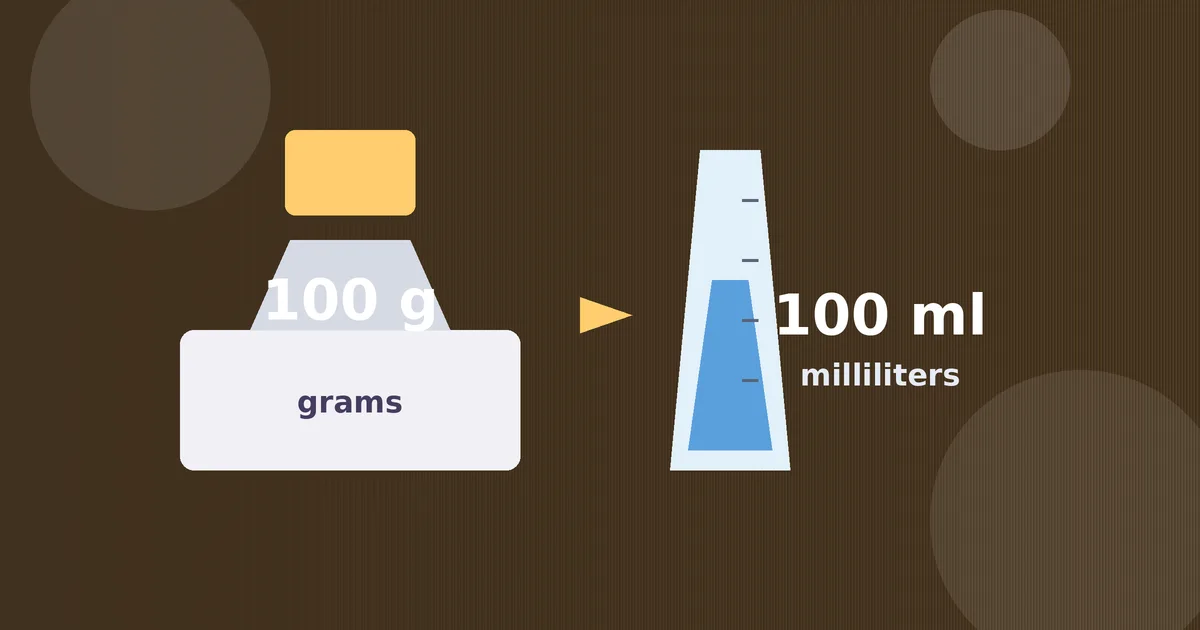
Water is the reason the two units are so often confused. Its density is almost exactly 1 g/mL, so 100 g of water really is 100 mL, and for water alone the numbers can be swapped freely. That happy coincidence ends with nearly everything else. Honey, at about 1.42 g/mL, packs far more mass into each milliliter, so 100 g of honey is only about 70 mL. All-purpose flour sits at the other extreme: spooned flour is full of air at roughly 0.51 g/mL, so 100 g of it fills about 196 mL, nearly twice the space of the same weight of water. Oils fall in between but on the light side, around 0.91 to 0.92 g/mL, which is why oil floats on water and why 100 g of oil is about 109 mL rather than 100 mL.
Density is a typical value, not a law of nature. Liquids shift slightly with temperature, and powders shift a lot with packing: flour that is scooped, spooned or sifted can differ by a fifth from one measure to the next. That is why the presets are labeled approximate.
The Formula for Converting Between Mass and Volume
Both directions come from one definition: density equals mass divided by volume. Rearranging it gives the two working formulas:
Milliliters = grams ÷ density (g/mL)
Grams = milliliters × density (g/mL)
Milliliters = milligrams ÷ (1,000 × density), because milligrams must become grams first
To go from mass to volume you divide, because a denser substance fits the same mass into less space. To go from volume to mass you multiply, because each milliliter contributes that many grams. Milligrams add one small step at the front: there are 1,000 milligrams in a gram, so 5,000 mg is 5 g before the density step even starts. The converter handles all of this by translating every unit into grams or milliliters first, then applying the density once.
Density Reference Table for Common Substances
These are the same approximate densities the converter uses. The last column shows what 100 grams of each substance becomes, which is the fastest way to build an instinct for how far from water a substance sits.
| Substance | Density (g/mL) | 100 g equals |
|---|---|---|
| Water | 1 | 100 mL |
| Milk | 1.03 | 97.09 mL |
| Olive oil | 0.91 | 109.89 mL |
| Vegetable oil | 0.92 | 108.7 mL |
| Honey | 1.42 | 70.42 mL |
| Maple syrup | 1.32 | 75.76 mL |
| Glycerin | 1.26 | 79.37 mL |
| Ethanol | 0.79 | 126.58 mL |
| Granulated sugar | 0.85 | 117.65 mL |
| All-purpose flour | 0.51 | 196.08 mL |
| Table salt | 1.22 | 81.97 mL |
Worked Examples
100 grams of olive oil. Olive oil has a density of about 0.91 g/mL, so the volume is 100 ÷ 0.91 = 109.89 mL. A recipe that lists 100 g of oil and a cook with only a jug should pour a little under 110 mL, not 100 mL.
250 milliliters of honey, weighed. Run the formula the other way: 250 × 1.42 = 355 g. That is why a jug of honey feels so heavy, and why weighing it straight into the bowl is cleaner and more accurate than scraping it out of a jug.
120 grams of flour. At 0.51 g/mL, 120 ÷ 0.51 = 235.29 mL, just under one US cup of 236.59 mL. The same 120 g of water would be only 120 mL, so a cook who treats grams and milliliters as equal would use barely half the flour the recipe wants. Flour is the clearest everyday proof that the substance cannot be ignored.
A milligram example, in the style of a lab or medicine label. Suppose a water-based liquid is listed as 5,000 mg. First divide by 1,000 to get 5 g, then divide by the density of 1 g/mL to get 5 mL. Small masses stay small in volume: 500 mg of glycerin is 0.5 g, and 0.5 ÷ 1.26 = 0.3968 mL, roughly 0.4 mL, which is why doses and lab quantities at this scale are measured with a syringe rather than a spoon. When the milligrams on a real medicine label describe the drug itself, a different rule applies, and the next section explains it.
Milligrams, Medicine and the Laboratory
Milligram questions deserve one careful warning, because two different ideas share the same units. This converter works with density: the mass of a substance and the volume that mass occupies. Medicine labels usually work with concentration instead: the milligrams name the amount of active drug dissolved in the liquid, and the milliliters name the liquid you swallow or inject. A label reading 120 mg per 5 mL is telling you the strength of the mixture, not the density of anything.
For a labeled medicine, the dose volume is the prescribed milligrams divided by the concentration in mg per mL, and the only safe source for both numbers is the pack, the prescription or a clinician. Never estimate a dose from a density table, and always measure it with the oral syringe or dosing spoon supplied with the product, because kitchen spoons vary widely. Where density conversion genuinely helps is nearby work: weighing out a powder, preparing a solution of known density in a lab, or checking a supplement serving.
Common Mistakes to Avoid
- Assuming 1 gram equals 1 milliliter for everything. That shortcut is only true for water. It under-measures flour by nearly half and over-measures honey by more than 40 percent.
- Multiplying when you should divide. Grams to milliliters divides by density; milliliters to grams multiplies. If your answer moves the wrong way (a dense syrup apparently taking up more space than water), the operation is backwards.
- Skipping the milligram step. Milligrams must be divided by 1,000 before the density formula. Feeding 5,000 straight into the formula as if it were grams gives an answer a thousand times too large.
- Using a powder density for a liquid, or the wrong product entirely. Granulated sugar, icing sugar and brown sugar all pack differently. Match the preset to the actual form of the ingredient, or measure your own density.
- Confusing fluid ounces with ounces. An ounce (oz) is mass; a fluid ounce (fl oz) is volume, about 29.57 mL. The converter keeps them in their own direction lists so they cannot be mixed up.
- Treating medicine concentration as density. The mg on a medicine label is the drug dose, not the weight of the liquid. Follow the label dose in milliliters, as explained above.
More Tools on This Site
This converter sits between two families of tools. The Weight Converter moves within mass alone, between grams, kilograms, ounces and pounds, while the Volume Calculator works out the volume of shapes such as boxes, cylinders and spheres. In the kitchen, the Cooking Converter and the Baking Converter translate between cups, spoons and grams for specific ingredients, and the Length Converter covers the other measurement family you meet when scaling a recipe or a project.
Frequently Asked Questions
Is 1 gram always equal to 1 milliliter?
Only for water, and only approximately. One gram of water takes up almost exactly one milliliter because its density is about 1 g/mL. Every other substance has a different density, so the same gram takes up more space (flour, oil) or less space (honey, salt). Always convert with the density of the substance you actually have.
How do I convert milligrams to milliliters?
First turn milligrams into grams by dividing by 1,000, then divide by the density in g/mL. For water that means 1,000 mg is 1 g, which is 1 mL. In the converter, choose Mass to volume, set the unit to milligrams and pick your substance, and it does both steps for you.
How many milliliters is 100 grams of oil?
About 109.89 mL for olive oil at 0.91 g/mL, and about 108.7 mL for a typical vegetable oil at 0.92 g/mL. Oils are lighter than water, so 100 grams of any cooking oil fills noticeably more than 100 mL.
Why does the result change with the substance?
Because grams measure mass and milliliters measure space, and substances pack different amounts of mass into the same space. That packing is density. A dense syrup fits a lot of grams into few milliliters, while a light powder such as flour fits few grams into many milliliters.
Can I enter my own density, and how do I find it?
Yes. Choose Custom density and type any value in g/mL. To find a density yourself, put a measuring jug on a scale, zero the scale, fill the jug to a clear mark such as 250 mL and divide the weight in grams by the volume. If 250 mL weighs 228 g, the density is 228 divided by 250, which is 0.912 g/mL.
Can I use this converter to work out a medicine dose?
Only with care, and never instead of the label. This converter turns the mass of a substance into its volume using density. Medicine labels work differently: the milligrams describe the drug itself and the milliliters describe the liquid, joined by the concentration printed on the pack, such as 120 mg per 5 mL. Always take the milliliter dose on the label or prescription and measure it with the syringe or spoon supplied.