Find how many months until refinancing pays for itself in monthly savings.
How to Use the Refinance Break-Even Calculator
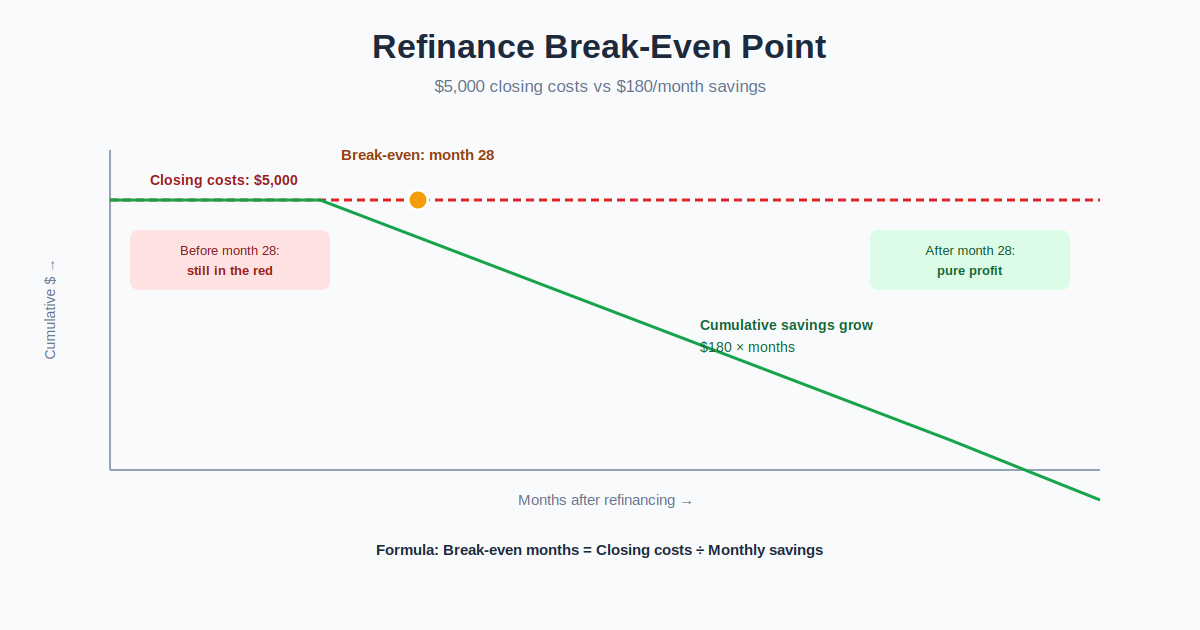
Refinancing can save you tens of thousands, or it can quietly cost you money. The difference comes down to one number: how long it takes for your monthly savings to repay the closing costs. This calculator finds that break-even point and compares it against how long you actually plan to keep the loan.
- Enter your current loan balance. Use the payoff amount, not the original loan amount. Check your latest statement.
- Enter your current interest rate. This is the rate on your existing mortgage, not the rate you hope to get.
- Enter the new rate you were offered. Use a real quote or prequalification, and make sure it is for the same loan type and term you are comparing.
- Set the new loan term. Refinancing into a new 30-year term restarts the clock, which lowers the payment but can increase lifetime interest. Compare equal terms first, then test shorter ones.
- Enter total closing costs. Include origination, appraisal, title, and prepaid items. Lenders must disclose these on the Loan Estimate form.
- Enter how many months you plan to stay. Be honest. If you might move or refinance again in 3 years, a 5-year break-even is a bad deal.
- Click Calculate. You will see both payments, monthly savings, the break-even month, and net savings over your planned stay.
The Break-Even Formula
The math is refreshingly simple. Monthly savings equal your old payment minus your new payment, where each payment comes from the standard amortization formula: payment equals balance times monthly rate times (1 plus monthly rate) to the power of total payments, divided by (1 plus monthly rate) to the power of total payments minus 1. The break-even point in months is closing costs divided by monthly savings, rounded up.
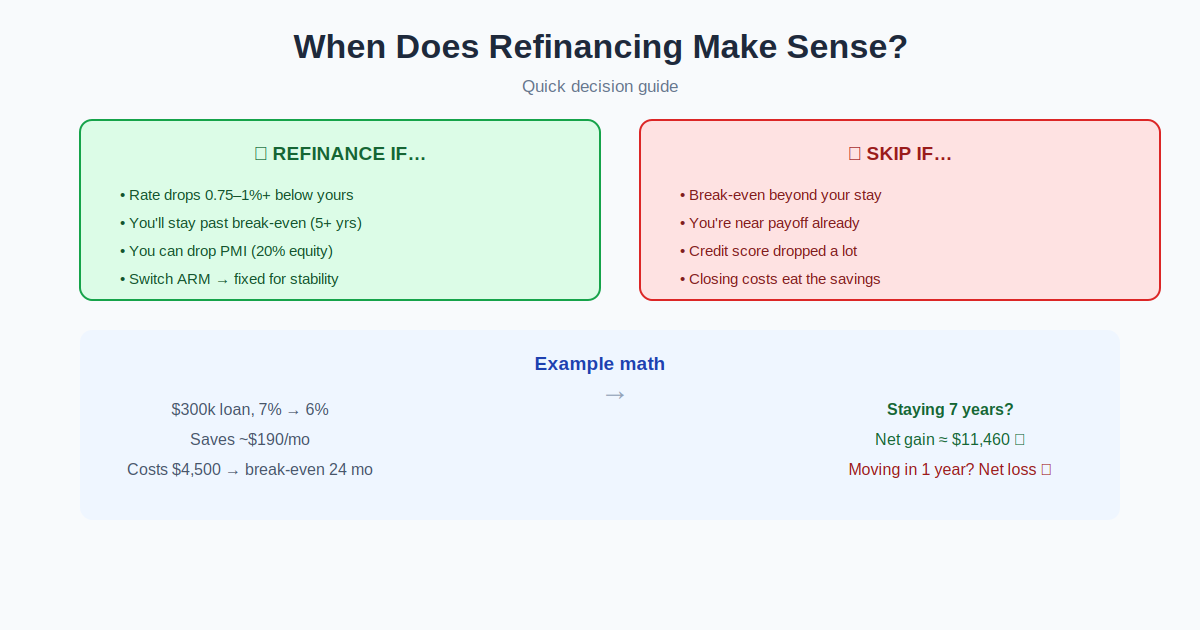
For example, 6,000 dollars in closing costs divided by 250 dollars of monthly savings gives a 24-month break-even. Every month you stay past month 24, you pocket 250 dollars. Sell or refinance again at month 20 and you have lost 1,000 dollars on the deal. The rule of thumb: only refinance if your planned stay comfortably exceeds the break-even point, ideally by years, not months.
Two subtleties deserve attention. First, the term reset trap. Refinancing a loan you have paid for 7 years into a fresh 30-year term lowers your payment partly by stretching repayment, not just by lowering the rate. You could pay more total interest despite the lower rate. Always compare total interest over your actual remaining timeline, not just the monthly payment. Second, the rate-versus-cost trade-off. Lenders let you buy down the rate with discount points or take a higher rate with lender credits that reduce closing costs. Credits shrink the break-even dramatically and often win for anyone who might move within a decade.
Taxes used to sweeten refinancing because mortgage interest was deductible for most borrowers. Since the standard deduction roughly doubled, fewer homeowners itemize, so do not count on a tax benefit unless you already itemize comfortably above the standard deduction.
Worked Example
Consider the Nguyen family with a 300,000 dollar balance at 7.5 percent and 23 years remaining. Their current payment is about 2,143 dollars per month. They are offered 6.25 percent on a new 30-year loan with 6,000 dollars in closing costs. The new payment is about 1,847 dollars, saving 296 dollars per month.
The break-even is 6,000 divided by 296, about 21 months. They plan to stay at least 7 years (84 months), so refinancing clearly wins. Over those 84 months they save 296 times 84 minus 6,000, roughly 18,864 dollars net. Even after accounting for the term reset, the lower rate dominates because they are early enough in the loan for rate differences to compound powerfully.
Now imagine they might relocate for work in 18 months. The break-even of 21 months exceeds their horizon, so they would lose about 672 dollars by refinancing. In that case the smart move is to ask the lender for credits in exchange for a slightly higher rate, say 6.5 percent with 2,000 dollars in lender credits cutting net costs to 4,000 dollars. The payment rises slightly but the break-even falls to about 15 months, turning a losing deal into a winning one.
The Term-Reset Trap
The break-even formula only tells you when the monthly savings recover your closing costs. It says nothing about total interest — and that is where the term-reset trap hides.
Take a 300,000 dollar balance at 7 percent with 25 years remaining. The payment is about 2,120 dollars a month, and roughly 336,100 dollars in interest is left on the loan. Now refinance into a brand-new 30-year loan at 6 percent. The payment drops to about 1,799 dollars — a 322 dollar monthly saving — and 6,000 dollars in closing costs break even in about 19 months. It looks like a clear win.
But the new loan stretches repayment back out to 30 full years. Total interest over the life of the new loan is about 347,500 dollars — roughly 11,400 dollars more than staying with the old loan. You pay less each month and still pay more overall.
The fix is simple: keep making the old payment. Send 2,120 dollars a month toward the new 6 percent loan instead of the required 1,799 dollars, and you will finish years early with a fraction of the interest. The true break-even question is not just months to payback — it is whether your total lifetime cost actually falls.
Related Calculators
See the full payment picture with our Mortgage Calculator, or compare payoff strategies using our Amortization Schedule Calculator.
Frequently Asked Questions
What is the refinance break-even point?
The number of months until your cumulative monthly savings equal what you paid in closing costs. Divide closing costs by monthly savings. Only refinance if you will stay well past that point.
What is a good break-even period?
Under 24 months is excellent, 24 to 36 is reasonable, and beyond 48 months is risky unless you are certain you will stay decades. Shorter is always safer because life plans change.
Should I refinance into a 15-year loan?
If you can afford the higher payment, a 15-year term at a lower rate builds equity dramatically faster and slashes total interest. The break-even math still applies to the costs.
Are no-closing-cost refinances really free?
No. The costs are rolled into a higher rate or larger balance. They can still win if the break-even on a traditional refinance exceeds your horizon, but compare the total cost, not just the upfront cash.
How many times can I refinance?
As often as it makes financial sense, though each round has costs and resets amortization. Serial refinancing every rate dip can erode equity through repeated fees.
Why can refinancing cost more even at a lower rate?
Because refinancing usually resets your amortization to a fresh full term. A lower rate shrinks the payment, but 30 more years of payments can add up to more total interest than the years you had left. Compare lifetime interest, not just the monthly payment.
How much are closing costs typically?
Usually 2 to 5 percent of the loan amount — 6,000 to 15,000 dollars on a 300,000 dollar loan. Lenders can roll them into the balance or cover them with a slightly higher rate, but you pay them either way.