Decode any tire size code into real measurements. Type a metric size such as 225/65R17 or a flotation size such as 31×10.50R15 and this tire size conversion tool works out sidewall height, overall diameter, circumference, width and revolutions per mile and per kilometer. Add a second size and it compares the two, with the diameter and circumference difference plus a speedometer table, so you can see what changes before you buy.
Size 1 in full
| Measurement | Value |
|---|
Size 1 compared with size 2
| Speedometer reads | Actual speed on size 2 |
|---|
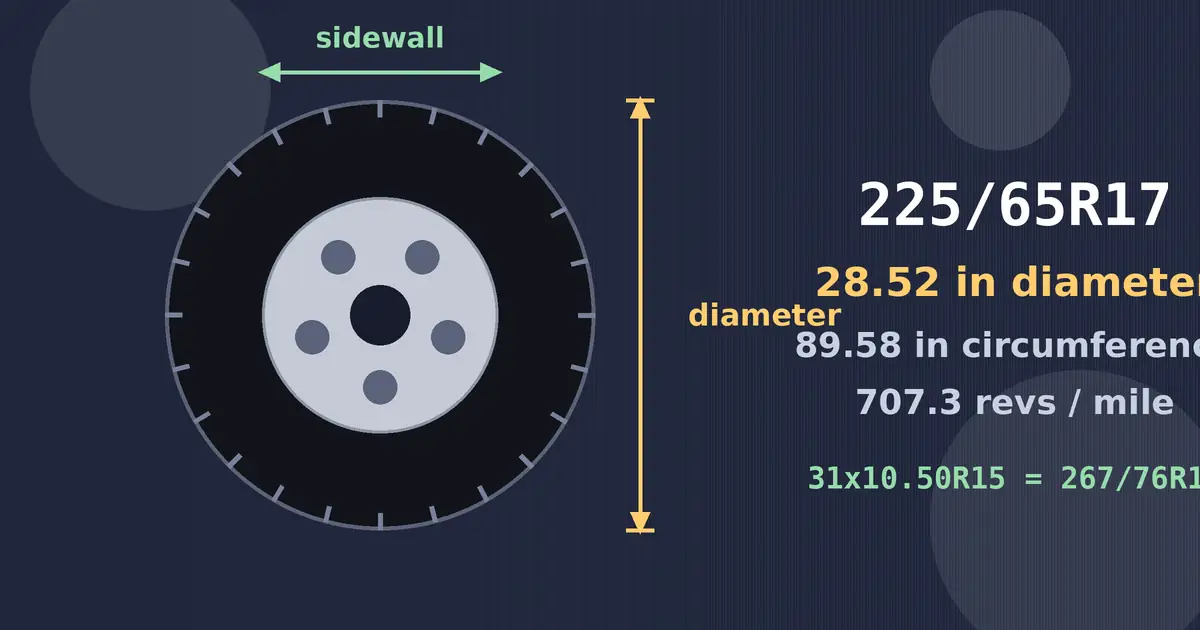
How to Read a Tire Size Code
Almost every car and light truck tire carries its size as a short code molded into the sidewall. Take the size this page opens with, 225/65R17, and split it into four parts. The first number, 225, is the section width in millimeters, measured from sidewall to sidewall. The second number, 65, is the aspect ratio: not a measurement but a percentage, stating that the sidewall height is 65 percent of the width. The letter R means radial construction. The final number, 17, is the diameter of the wheel the tire fits, given in inches, which is why tire math mixes metric and imperial units.
Two optional letters sometimes sit in front of the code: P for passenger car and LT for light truck, a stronger construction for pickups and towing. LT245/70R17 and 245/70R17 have identical dimensions; the prefix describes the service the tire was built for, not its size, so this converter accepts and ignores it. Figures after the size, such as a 102H load index and speed rating, describe capacity, not dimensions.
Here is the worked example for 225/65R17. Sidewall: 225 multiplied by 65 divided by 100 gives 146.25 mm, which is 5.76 inches. Overall diameter: the wheel contributes 17 inches, plus a sidewall top and bottom, so 17 plus twice 5.76 gives 28.52 inches, or 724.30 mm. Tire charts round that to 28.50 in, and using 28.50 in gives a circumference of 89.54 in and about 707.6 revolutions per mile. With the unrounded diameter, as this converter uses, the circumference is pi multiplied by 28.52, which is 89.58 inches, and 63,360 inches in a mile divided by that gives about 707.3 revolutions per mile. Both describe the same tire; only the rounding point differs.
Sidewall height = width × aspect ratio ÷ 100
Overall diameter = rim diameter + 2 × sidewall height
Circumference = pi × overall diameter
Revolutions per mile = 63,360 ÷ circumference in inches
How to Use This Converter
- Copy the code from your sidewall or door sticker into the first box. Metric and flotation codes both work, with or without spaces, and a lowercase r is fine.
- Read the headline diameter, then the full table of sidewall, diameter, circumference and width in inches and millimeters, plus revolutions per mile and per kilometer.
- Enter the size you are considering in the second box. The comparison states the diameter difference in inches and percent and the circumference difference, and the speedometer table shows your real speed on the new size when it reads 30, 60 and 100, in mph and km/h.
- Check the equivalent line under the result. A metric size is restated in flotation style, and a flotation size gets its direct metric equivalent.
- If a code is rejected, read the note. It spells out the two expected formats; nearly every rejection is a missing slash or a missing X.
Metric Sizes and Flotation Sizes
North American off-road and light truck tires are often sold in a second system called flotation sizing, written as 31x10.50R15. This format leads with the answer most drivers want: the first number is the overall diameter in inches, the second is the section width in inches, and after the R comes the rim diameter. There is no aspect ratio to decode, because the diameter is stated outright. The sidewall is whatever is left: half of the diameter minus the rim, so (31 minus 15) divided by 2 gives an 8.00-inch sidewall.
Converting a flotation size into metric is simple arithmetic, but the result rarely lands on a size that exists. A 31x10.50R15 is 266.7 mm wide with a sidewall that is 76 percent of its width, a direct equivalent of about 267/76R15, and no manufacturer stamps that code. Catalog sizes use rounder numbers, so the nearest metric size actually sold is 265/75R15: close but not identical, at 30.65 inches tall and 10.43 inches wide against 31.00 and 10.50 inches. That third of an inch is small enough that the two are routinely cross-shopped for the same trucks and Jeeps, yet large enough to shift clearance and speedometer readings, which is what the comparison box above is for.
What a Size Change Does to Your Speedometer and Gearing
Your speedometer does not measure speed directly. It counts wheel revolutions and converts them into a speed using the circumference of the tire the vehicle left the factory with. Fit a larger-diameter tire and each revolution carries the vehicle farther than the speedometer assumes, so the vehicle travels faster than the dial shows and the odometer under-records the distance. Fit a smaller tire and everything reverses: the dial reads high and the odometer over-records. The error is exactly proportional to the diameter change: a tire 5 percent taller makes every reading 5 percent low, so an indicated 60 mph is a real 63 mph.
Moving from 225/65R17 to 245/70R17 adds 1.99 inches of diameter, a 6.97 percent increase, and stretches the circumference by 6.25 inches. At an indicated 60 mph the vehicle on the larger size is actually traveling 64.18 mph, and at an indicated 100 km/h it is really doing 106.97 km/h. Gearing changes by the same percentage. A taller tire is effectively a higher gear: the engine turns more slowly at any road speed, acceleration and towing pull soften, and the transmission may hold lower gears longer on hills. A shorter tire acts like a lower gear, sharpening acceleration at the cost of higher revs and fuel use on the highway. Truck owners who fit much taller tires sometimes change the axle ratio to restore the original effective gearing.
The 3 Percent Diameter Rule of Thumb
Tire shops lean on a simple guideline: keep the overall diameter of a replacement tire within 3 percent of the original, up or down. Inside that band, speedometer error stays near the factory tolerance, the effective gearing barely moves, the spare remains close enough to be usable, and the tire is unlikely to rub the wheel arch, suspension or brake lines at full steering lock. Outside that band, each needs checking: clearance at full lock and full suspension travel, load index and speed rating at least equal to the original, rim width, and whether the vehicle allows speedometer recalibration. Treat the 3 percent figure as a screening rule, not a safety certificate. The worked comparison above, at 6.97 percent, fails the screen comfortably; that does not make the swap impossible, it makes it a project needing clearance checks and a recalibration plan rather than a straight purchase. Plus sizing is the rule applied deliberately: a larger wheel, a shorter sidewall, the same overall diameter.
Common Size Equivalents
The table below lists popular sizes with their computed dimensions, including the flotation size and its nearest metric neighbor. Diameter and circumference are in inches and revolutions are per mile.
| Size | Sidewall (in) | Diameter (in) | Circumference (in) | Revs per mile |
|---|---|---|---|---|
| 195/65R15 | 4.99 | 24.98 | 78.48 | 807.4 |
| 205/55R16 | 4.44 | 24.88 | 78.16 | 810.7 |
| 225/65R17 | 5.76 | 28.52 | 89.58 | 707.3 |
| 245/70R17 | 6.75 | 30.50 | 95.83 | 661.2 |
| 265/75R15 | 7.83 | 30.65 | 96.29 | 658.0 |
| 31x10.50R15 | 8.00 | 31.00 | 97.39 | 650.6 |
| 265/70R17 | 7.30 | 31.61 | 99.29 | 638.1 |
| 285/75R16 | 8.42 | 32.83 | 103.14 | 614.3 |
Notice the pair in the middle: the 265/75R15 and the 31x10.50R15 sit within half an inch of each other on every line, which is why catalogs treat them as equivalents despite their different codes. Revolutions per mile fall as diameter grows, driving both the speedometer error and the gearing change.
Mistakes to Avoid
- Reading the aspect ratio as a measurement. The 65 in 225/65R17 is a percentage of the width, not 65 mm. The same 65 on a wider tire produces a taller sidewall, which is why a 245/65 and a 225/65 are different heights.
- Comparing widths alone when changing size. A wider tire is not automatically taller. Diameter depends on width, aspect ratio and rim together, so run both full codes through the converter instead of judging by the first number.
- Assuming the metric equivalent of a flotation size is exact. The direct conversion of 31x10.50R15 is about 267/76R15, a size nobody sells. The catalog equivalent, 265/75R15, is a third of an inch shorter, a gap that matters on tight fitments.
- Mixing sizes across an axle or an all-wheel-drive system. Different diameters on one axle fight through the differential, and a mismatched spare can strain an all-wheel-drive drivetrain. Change tires in matching pairs at minimum, all four where required.
- Forgetting the spare. Upsize all four road tires and the untouched spare is now a different diameter: a short-distance, low-speed option only on many vehicles, and unusable on some all-wheel-drive systems.
- Trusting the nominal size over the maker data sheet. Two tires with the same code from different brands can differ by several millimeters in real diameter, because the code describes a size class, not a guarantee. For a tight fitment, check the published diameter for the exact model.
More Tools on This Site
Once the tire size is settled, a few neighboring converters finish the job. The Speed Converter moves between mph and km/h for the speedometer figures, the Length Converter handles the inch and millimeter measurements, the Torque Converter covers wheel nut torque for the swap, and the Horsepower Calculator explores the power side of the gearing trade-off.
Frequently Asked Questions
What does 225/65R17 mean?
225 is the section width in millimeters, 65 is the aspect ratio (the sidewall is 65 percent as tall as the tire is wide), R means radial construction, and 17 is the rim diameter in inches. Together they describe a tire 225 mm wide, with a 146.25 mm sidewall, on a 17-inch wheel: about 28.5 inches in overall diameter.
How do I convert a tire size to inches?
Multiply the width by the aspect ratio divided by 100 for the sidewall in millimeters, divide by 25.4 for inches, double it, and add the rim diameter. The width alone converts the same way: 225 mm is 8.86 inches. The converter above runs these steps and adds circumference and revolutions per mile.
What is the metric equivalent of a 31x10.50R15 tire?
By direct conversion it is about 267/76R15: the 10.50-inch width is 266.7 mm and the 8-inch sidewall is 76 percent of that width. Catalog sizes use rounder numbers, so the closest standard size actually sold is 265/75R15, at 30.65 inches tall against 31.00 inches.
How much does a larger tire change my speedometer reading?
By exactly the percentage change in diameter. A tire 5 percent taller makes every reading 5 percent low: at an indicated 60 mph the vehicle is really doing 63 mph. A shorter tire does the reverse. The comparison table works the figures for your two sizes.
What is the 3 percent rule for changing tire sizes?
It is a rule of thumb that the replacement tire should stay within 3 percent of the original overall diameter, up or down. Inside that band, speedometer error, gearing change and clearance problems stay small. Outside it, recalibration, rubbing and drivetrain stress become real concerns, so check fitment carefully.
Does changing tire size affect gearing and the odometer?
Yes. A taller tire travels farther per revolution, like fitting a higher gear: engine revs drop at a given speed, acceleration softens, and the odometer records fewer miles than were driven. A shorter tire does the opposite. The effect matches the diameter change, percentage for percentage.