Is your heart older than you? Estimate heart age from risk factors.
How to Use the Heart Age Calculator
Heart age translates your cardiovascular risk factors into a single intuitive number: the age of someone whose heart carries the same risk as yours. If your heart age is higher than your actual age, your risk factors are aging your heart faster than the calendar.
- Enter your age and sex. Risk curves differ for men and women, so both are needed for an accurate estimate.
- Add your blood pressure. Enter your systolic (top) number and note whether you take blood pressure medication, since treated and untreated readings score differently.
- Enter cholesterol values. Provide total cholesterol and HDL cholesterol. If you know you have diabetes or you smoke, include that too — both carry heavy weight.
- Read your heart age. Compare it with your actual age. The bigger the gap, the more your modifiable risk factors are costing you, and the tool shows which factors drive the difference.
Heart Age Calculator Formula
This calculator is built on the Framingham General Cardiovascular Disease risk model, one of the most validated risk tools in medicine. Each risk factor is assigned points: age brackets, total cholesterol ranges, HDL ranges (where higher is better and earns negative points), systolic blood pressure split by treated versus untreated, smoking status, and diabetes. The points are summed and mapped onto the published Framingham heart-age table, which converts a point total directly into an equivalent age — the calculator above shows you that heart age, your risk points, and the gap between the two.
Heart age itself is a clever reframing of that risk number. The calculator asks: at what chronological age would a person with healthy, well-controlled risk factors carry a point total like yours? That age becomes your heart age. A 45-year-old man who smokes, with blood pressure and cholesterol in the higher bands, scores 11 points in this calculator — the total of a much older man — and receives a heart age of 68.
It is important to understand what this is and is not. It is a population-based estimate, not a diagnosis, and it does not account for family history of early heart disease, inflammatory conditions, or fitness level. Treat it as a motivational snapshot and a conversation starter with your doctor, not a medical verdict.
The Points Behind Your Heart Age
So the result is never a mystery, here is the exact scoring this calculator uses. Add up your points, and the total converts to the heart age shown.
| Factor | Your value | Points |
|---|---|---|
| Age (men) | Under 35 / 35–44 / 45–54 / 55–64 / 65+ | −1 to 1 / 2 to 3 / 4 to 5 / 6 to 7 (rising by band) |
| Age (women) | Under 35 / 35–44 / 45–54 / 55–64 / 65+ | −9 to −4 / 0 to 3 / 6 to 7 / 8 to 10 (rising by band) |
| Total cholesterol | Under 200 / 200–239 / 240–279 / 280+ | 0 / 1 / 2 / 3 |
| HDL cholesterol | 60+ / 50–59 / 40–49 / under 40 | −1 / 0 / +1 / +2 |
| Systolic blood pressure | Under 120 / 120–139 / 140–159 / 160+ | 0 / 1 / 2 / 3 (add 1 if you take BP medication) |
| Smoker | Yes | +4 (men) / +3 (women) |
| Diabetes | Yes | +3 (men) / +4 (women) |
Two things stand out. Smoking and diabetes carry the biggest single penalties after age itself. And HDL is protective: an HDL of 60 or above is the only factor here that subtracts a point.
Example Calculation
Consider a 45-year-old man who smokes, with systolic blood pressure of 140 (not on medication), total cholesterol 240, HDL 40, and no diabetes. His points accumulate quickly: age band +2, cholesterol band +2, HDL 40 (low, so it costs rather than credits a point) +1, untreated systolic pressure in the 140s +2, and smoking +4 — a total of 11 points, which the table converts to a heart age of 68. His heart is scoring like that of a man 23 years older.
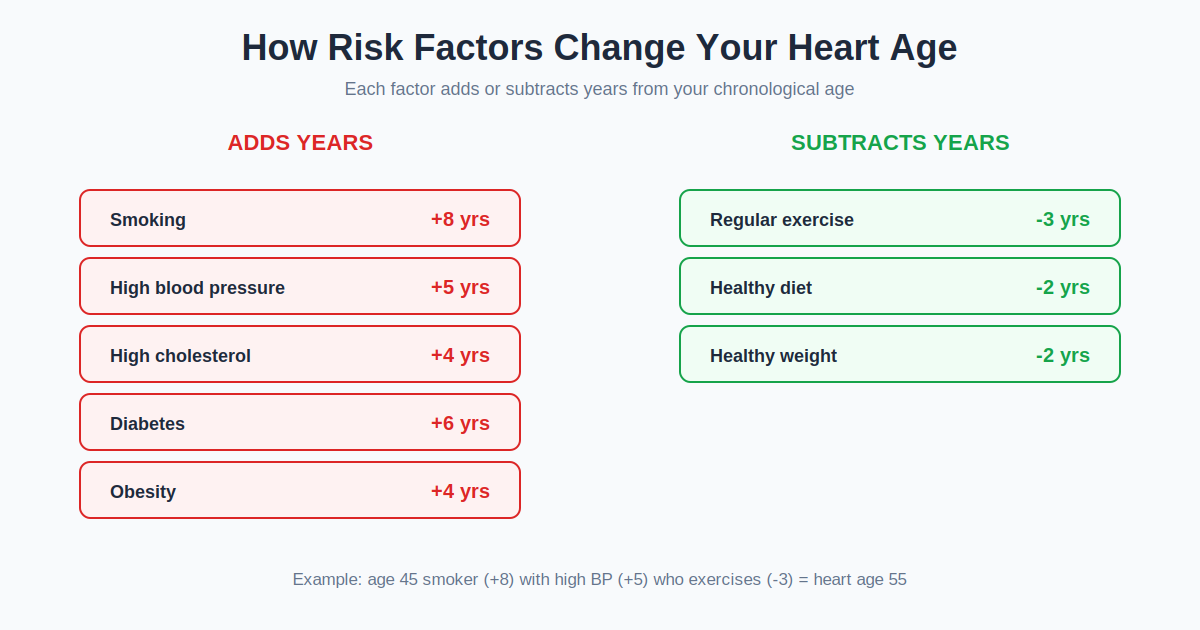
The encouraging part is how reversible much of it is. If he quits smoking, his points drop to 7 and his heart age to 56 — a 12-year improvement from one habit. Bring his systolic pressure down under 120 as well and the points fall to 5, a heart age of 50. Neither change requires perfection, just sustained control of the two biggest levers.
What Your Heart Age Gap Means
The calculator compares your heart age with your real age. A gap of three or more years younger means a genuinely healthy profile for your age — protect it. Within about two years either way, your risk factors are roughly typical for your age. Three or more years older means your arteries are, in risk terms, aging faster than you are. A gap of ten years or more deserves a real conversation with a doctor, not just lifestyle tweaks, because it usually reflects several risk factors stacking at once.
What the Research Says About Heart Age
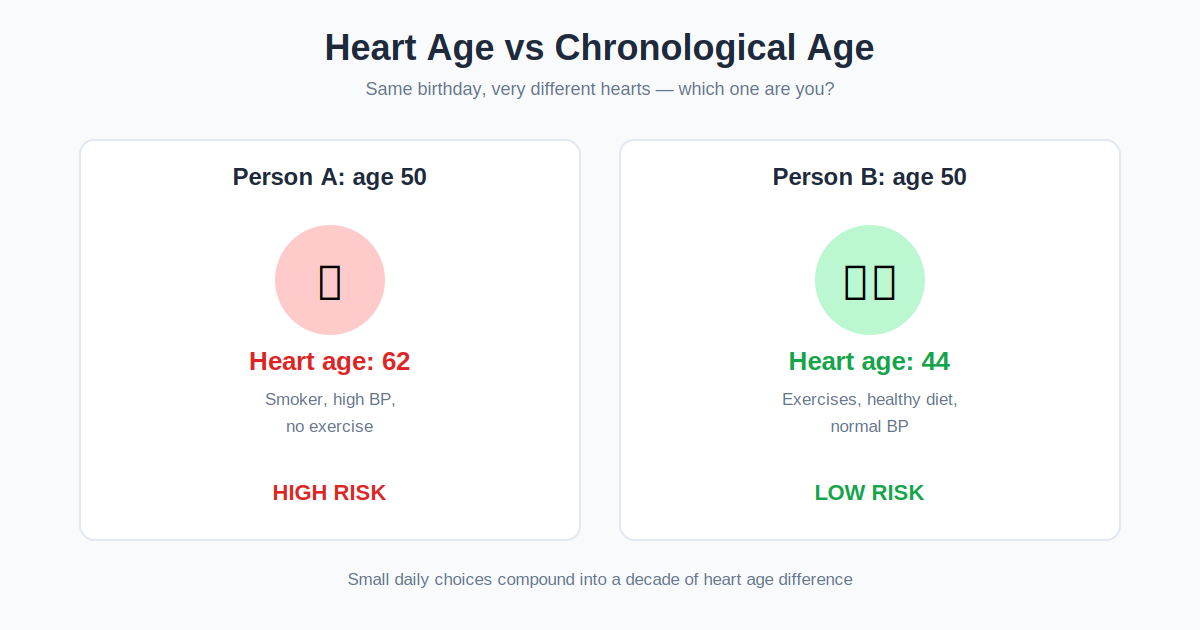
Heart age became a mainstream health idea with the Framingham Heart Study, whose cohort data underpins the scoring used here. Newer tools — notably the American Heart Association's PREVENT equations, introduced in 2023 and studied in JAMA Cardiology — express the same idea with modern population data. In a Northwestern University analysis of more than 14,000 US adults, the average heart age ran about 4 years above real age for women (55.4 vs 51.3) and about 7 years for men (56.7 vs 49.7). So an older heart age is the statistical norm, not a personal failure — but it is also why the number motivates people more effectively than abstract risk percentages ever did.
Frequently Asked Questions
What exactly is heart age?
Heart age is your chronological age adjusted for cardiovascular risk. It answers: how old would someone with perfect risk factors need to be to carry the same 10-year heart risk you do? If your heart age exceeds your real age, your risk factors are effectively aging your cardiovascular system faster than time alone.
How accurate is a heart age calculator?
It is a solid population-level estimate built on the Framingham study, which followed thousands of people for decades. For individuals it is directional rather than precise — it cannot see your arteries. Think of it as a risk communication tool, accurate enough to motivate change but not a substitute for clinical testing.
Which factors raise heart age the most?
Smoking, diabetes, and high systolic blood pressure carry the heaviest penalties in the scoring. Low HDL cholesterol and high total cholesterol add meaningful points too. Age itself is the largest single driver, which is why heart age gaps tend to widen in middle age if risk factors go unmanaged.
Can I lower my heart age?
Yes — that is the whole point. Quitting smoking, bringing blood pressure into range, improving cholesterol through diet and exercise, and managing blood sugar all remove points from your risk score. Many people can cut 5 to 15 years off their heart age within a year or two of sustained lifestyle change.
Should I see a doctor about my result?
If your heart age is substantially higher than your actual age — say 10 or more years — or you have risk factors like smoking, high blood pressure, or diabetes, bring the result to your doctor. They can order a proper risk assessment and discuss whether medication, beyond lifestyle change, is appropriate.
What is a normal heart age?
Ideally, your heart age matches or beats your chronological age. In practice, large population studies find most adults score a few years older — around 4 years for women and 7 for men on average in the Northwestern PREVENT analysis. A small gap is common; a gap of 10+ years, or a gap that keeps growing between checkups, is the signal to act on.
How often should I recalculate my heart age?
Recheck whenever your inputs change: after a health checkup with fresh blood pressure and cholesterol numbers, after quitting smoking, or after a few months of a new exercise or medication routine. Once a year alongside your annual physical is a sensible rhythm — frequent enough to catch a worsening trend, not so frequent that normal day-to-day noise in the readings misleads you.
Related Calculators
Try our BMI Calculator and Calorie Calculator for more calculations.