Free metabolic age calculator: enter your age, sex, weight, height and activity level to estimate BMR with the Mifflin-St Jeor equation and metabolic age.
Results are estimates for planning purposes and are not financial, medical, or professional advice.
How to Use the Metabolic Age Calculator
Enter your basic body stats to estimate your basal metabolic rate and find out whether your metabolism behaves younger or older than your real age.
- Enter your age in years.
- Select your sex and enter weight in kilograms and height in centimeters.
- Choose the activity level that best matches your week.
- Press calculate to see your BMR, metabolic age, and daily calorie needs.
How Metabolic Age Is Estimated
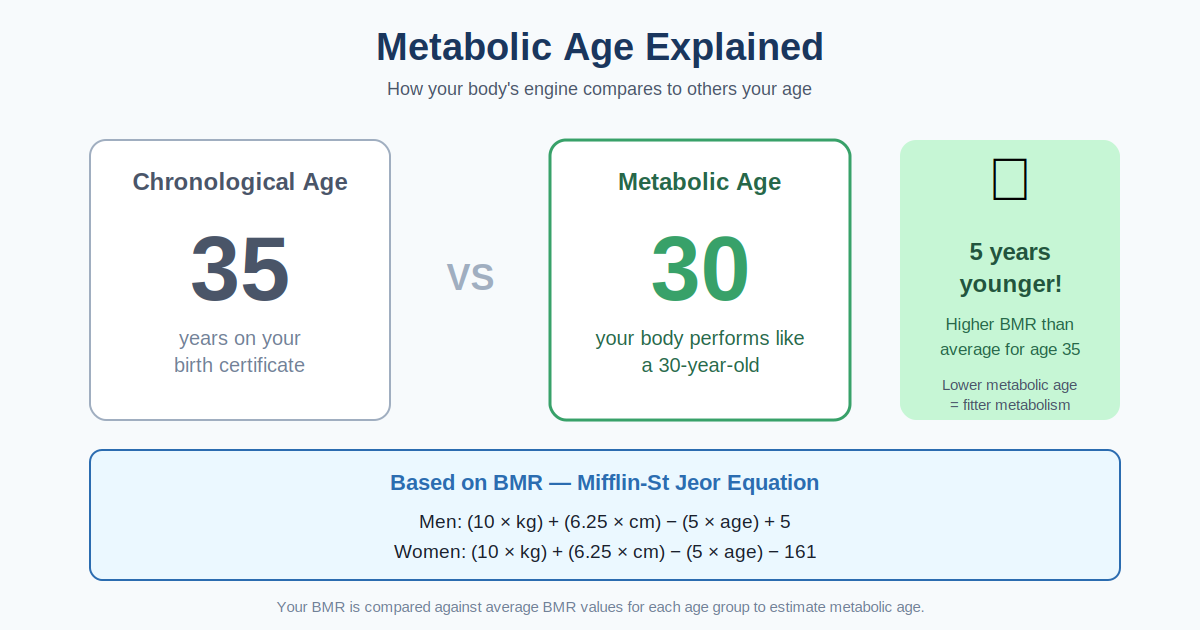
First the calculator finds your BMR with the Mifflin-St Jeor equation: for men, 10 times weight in kg plus 6.25 times height in cm minus 5 times age plus 5; for women the constant is minus 161. It then compares your BMR with reference averages for your age group and sex. If your BMR is above the reference, your estimated metabolic age comes out younger than your real age, and vice versa. This is a simplified estimate, not a medical measurement.
Example
A 35 year old man weighing 80 kg at 180 cm has a BMR of 10 times 80 plus 6.25 times 180 minus 5 times 35 plus 5, which equals 1755 calories per day. The reference for men in their thirties is about 1700, so his metabolic age estimates to 30 years, five years younger than his real age.
A female example uses the same steps. A 40 year old woman weighing 65 kg at 165 cm has a BMR of 10 times 65 plus 6.25 times 165 minus 5 times 40 minus 161, which equals 1320 calories per day. The reference for women in their forties is about 1300, so her metabolic age estimates to 38 years, two years younger than her real age.
How to Improve Your Metabolic Age
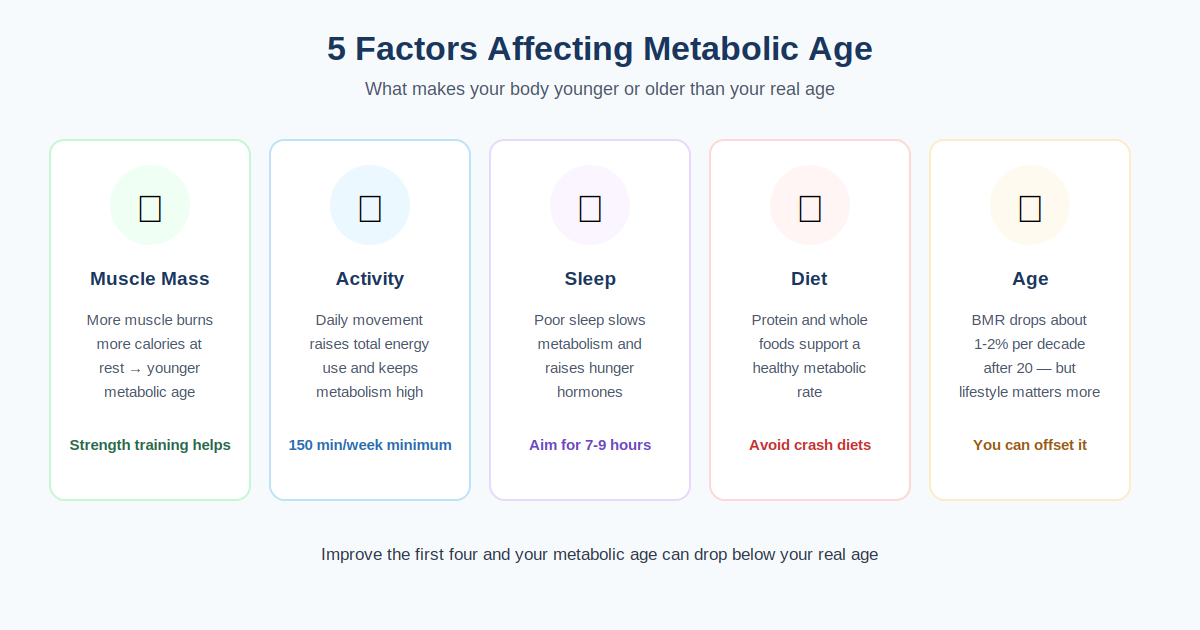
Muscle tissue burns more calories at rest than fat tissue, so strength training two to three times per week is the most effective lever. Add daily movement such as walking 8000 to 10000 steps, since non-exercise activity adds up significantly. Protein supports muscle maintenance, so aim for roughly 1.6 grams per kilogram of body weight if you train regularly. Sleep matters too: chronic short sleep disrupts hunger hormones and slows recovery. Finally, avoid crash diets, which can depress metabolic rate by sacrificing muscle along with fat.
How to Read Your Result
The tool calls your result matching when it lands within two years of your real age, which the widget uses as its verdict band. Remember what this number is: an estimate built from age, sex, weight, and height only. It has no body-composition input, so two people with identical stats get identical results even if one carries far more muscle. Activity level affects only the TDEE Calculator number, not the metabolic age itself. And thyroid or hormone issues are invisible to the formula. Use the result as a general fitness signal and see a clinician before making health decisions.
Frequently Asked Questions
What is metabolic age?
It is an estimate of how your calorie burn compares with the average for your age group. A lower metabolic age suggests a faster metabolism than average.
Is metabolic age scientifically exact?
No. True metabolic measurement needs lab equipment. This calculator gives a reasonable estimate from validated BMR equations.
How can I lower my metabolic age?
Build muscle with strength training, stay active daily, get enough sleep, and eat enough protein.
What is the difference between BMR and TDEE?
BMR is what you burn at complete rest. TDEE adds activity, and this calculator estimates it from your activity level.
Do I need metric units?
The Mifflin-St Jeor equation uses kilograms and centimeters. Convert pounds by dividing by 2.205 and inches by multiplying by 2.54.
Can my metabolic age be higher than my real age?
Yes. If your BMR runs below the reference for your age bracket, the formula estimates an older metabolic age. That is common with low muscle mass or very little activity, and it can change as those improve.
How often should I check my metabolic age?
Every few months is plenty. Meaningful changes need time: new training habits take weeks to shift body composition, so weekly checks mostly show noise.
Related Calculators
Try our BMR Calculator and Calorie Calculator for more health tools.