Estimate severance package value based on salary, tenure, and company policy.
How to Use the Severance Pay Calculator
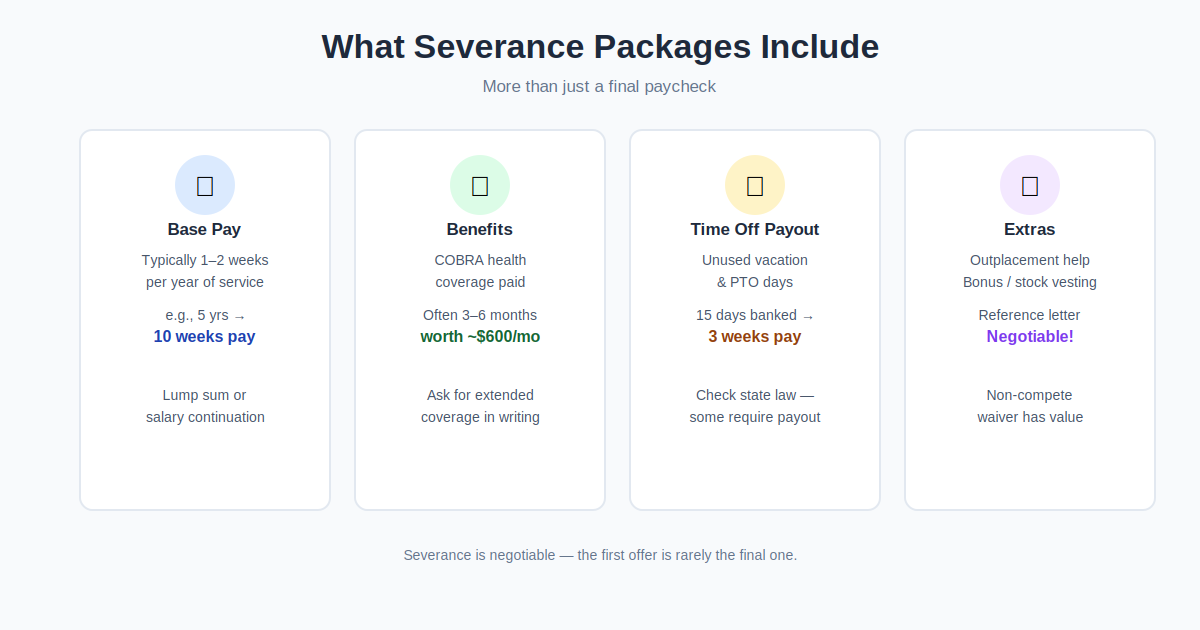
Losing a job is stressful enough without wondering what your exit package is really worth. This calculator estimates your severance using the standard weeks-per-year formula, then adds the extras people forget: unused vacation payout, continued health coverage, and any minimum guarantees. Use it to evaluate an offer or to prepare for a negotiation.
- Enter your annual salary. Use your base salary. Bonuses and commissions are sometimes included in severance formulas, but base salary is the standard starting point.
- Enter your years of service. Include partial years. Six and a half years at two weeks per year is 13 weeks.
- Enter weeks of pay per year of service. The most common corporate formula is 1 to 2 weeks per year. Check your employee handbook or offer letter for your company’s standard.
- Enter the minimum guaranteed weeks. Many policies promise a floor, often 2 to 4 weeks, even for short-tenure employees.
- Enter unused vacation days. In most states, accrued vacation must be paid out. Your daily rate is salary divided by 260 workdays.
- Set the cap if there is one. Many companies cap severance at 26 or 52 weeks regardless of tenure. Enter zero if there is no cap.
- Enter COBRA months the employer will pay. Continued health coverage is worth roughly 650 dollars per month for an individual. Even a few months adds real value.
- Click Calculate. You will see each component, the total package value, and how many months of salary runway it gives you.
How Severance Packages Work
Severance is not legally required in most cases. The Fair Labor Standards Act does not mandate it, so packages exist because of company policy, employment contracts, or collective bargaining agreements. That also means the terms are negotiable, especially for longer-tenure employees and anyone being asked to sign a release of claims.
The standard formula multiplies your weekly pay by a per-year factor times your tenure, subject to a minimum and a cap. Two weeks per year with a 4-week minimum and 26-week cap is the most common structure in corporate America. At a 90,000 dollar salary, weekly pay is about 1,731 dollars, so six years of service yields 12 weeks or about 20,769 dollars before extras.
Beyond the check, the valuable pieces include continued health insurance, outplacement services, extended stock option exercise windows, and positive reference agreements. COBRA coverage deserves attention because losing employer health insurance is often the scariest part of job loss. Three months of employer-paid COBRA is worth roughly 2,000 dollars and buys time to arrange alternatives.
Taxes apply to severance as ordinary wages, usually withheld at the 22 percent supplemental rate for amounts under 1 million dollars. One timing trick: if your termination straddles year-end, ask whether the payout can be split across two tax years to avoid bunching income into a higher bracket. Also note that severance can delay unemployment benefits in some states, so file for unemployment promptly and report the severance as required.
Worked Example
Consider Elena, who earned 90,000 dollars per year and worked at her company for 6 years. Company policy pays 2 weeks per year of service with a 4-week minimum and a 26-week cap. Six years times 2 weeks is 12 weeks, above the minimum and below the cap, so she gets the full 12 weeks.
Her weekly pay is 90,000 divided by 52, about 1,730.77 dollars. Twelve weeks comes to 20,769 dollars. She has 10 unused vacation days, and her daily rate is 90,000 divided by 260, about 346.15 dollars, adding 3,462 dollars. Her employer will pay 3 months of COBRA at an estimated 650 dollars per month, another 1,950 dollars. Her total package is worth about 26,181 dollars, giving her roughly 2.8 months of salary runway.
Before signing, Elena negotiates. She asks for 3 weeks per year instead of 2, citing her strong performance reviews, which would add about 10,385 dollars. She also requests 6 months of COBRA instead of 3. Employers often have flexibility on these terms, especially when they want a signed release. The calculator gives her the baseline numbers to negotiate from with confidence.
How Your Offer Compares to Typical Formulas
Severance formulas cluster around a few well-known benchmarks. The most common corporate standard is 1 to 2 weeks of pay per year of service, while executives and long-tenure employees often negotiate 3 or more weeks per year. Here is what each formula produces at a 90,000 dollar salary with 6 years of service, before vacation payout and COBRA are added.
| Formula | Weeks of pay | Severance amount |
|---|---|---|
| 0.5 weeks per year (bare minimum) | 3 weeks | $5,192 |
| 1 week per year (common) | 6 weeks | $10,385 |
| 2 weeks per year (standard) | 12 weeks | $20,769 |
| 3 weeks per year (generous) | 18 weeks | $31,154 |
The difference between a bare-minimum offer and a generous one is more than 25,000 dollars at these numbers — enough to fund several extra months of job searching. Enter your own company’s formula into the calculator above to see exactly where you land, then negotiate from that baseline.
A note on the WARN Act. If your job loss is part of a mass layoff or plant closing, the federal WARN Act generally requires covered employers — those with 100 or more employees — to give 60 days’ advance notice. That notice can be paid out instead of worked, but the WARN Act is a notice law: it does not itself create a right to severance pay. Your package still comes from company policy, your contract, or negotiation.
Related Calculators
Planning your next move? Our Freelance Rate Calculator helps price interim contract work, and our Emergency Fund Calculator shows how much runway you really need.

Frequently Asked Questions
How is severance pay usually calculated?
The most common formula is 1 to 2 weeks of pay per year of service, often with a minimum (2-4 weeks) and a cap (26-52 weeks). Executives and long-tenure employees frequently negotiate more.
Is severance pay required by law?
Generally no. Federal law does not require severance. It comes from company policy, employment contracts, or negotiation. Some states require payout of unused vacation regardless.
Can I negotiate my severance package?
Yes, especially before signing the release. Common asks: more weeks, extended COBRA, outplacement services, extended stock vesting, positive reference language, and non-disparagement mutuality.
Is severance pay taxable?
Yes, as ordinary wages. Employers typically withhold 22% federal on amounts under $1 million. You may owe more or less at filing depending on your total income.
Does severance affect unemployment benefits?
It depends on the state. Some states delay benefits until severance runs out; others do not count it. File for unemployment immediately and report severance as your state requires.
Does the WARN Act guarantee me severance pay?
No. The WARN Act requires covered employers to give 60 days’ advance notice of mass layoffs or plant closings. It does not create a right to severance pay itself — your severance comes from company policy, your employment contract, or negotiation before you sign.
How many months of salary does my severance cover?
Divide your severance weeks by 4.33, the average number of weeks in a month. Twelve weeks of pay equals about 2.8 months of salary runway. Add unused vacation payout and employer-paid COBRA to see the full package value.