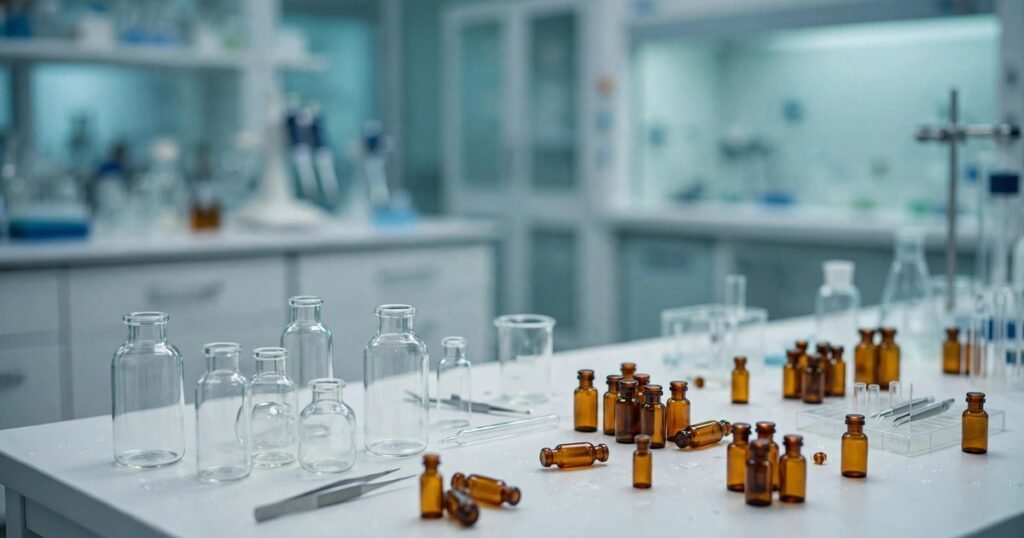
Peptides Come as Powder — the Math Turns It Into a Dose
Most peptides arrive as freeze-dried powder in a vial labeled in milligrams. After you add bacteriostatic water, you draw your dose with an insulin syringe marked in units. Bridging those two — mg to units — is a short chain of conversions, and one wrong link throws the whole dose off. This peptide calculator runs that chain for you: total micrograms in the vial, concentration per milliliter, micrograms per unit, the units to draw for your target dose, and how many doses the vial holds.
Enter four numbers, click Calculate, and every step of the math is shown so you can verify it yourself.
Reconstitution math · mcg per unit · units per dose
Presets fill in commonly discussed research ranges (BPC-157: 250–500 mcg · TB-500: 2–5 mg · GHK-Cu: 1–2 mg · Ipamorelin: 200–300 mcg · CJC-1295: 1–2 mg) — educational reference only, not recommendations.
Please enter a vial amount above 0 mg, water volume above 0 ml, and a desired dose above 0 mcg.
Units to draw
For your desired dose on a U-100 syringe
How to Use This Calculator
- Enter the vial amount in milligrams — the powder amount printed on the vial.
- Enter the bacteriostatic water added in milliliters — the volume you reconstitute with.
- Enter the desired dose in micrograms per injection — or tap one of the peptide preset chips to fill in a commonly discussed research range.
- Select your syringe size — 1 ml (100 units) or 0.5 ml (50 units), both U-100.
- Click Calculate Dose — get the units to draw, mcg per unit, draw volume in ml, and doses per vial, with every formula step shown.
Understanding the Math (mg → mcg → units)
Concentration (mcg/ml) = total mcg ÷ water (ml)
mcg per unit = concentration ÷ 100 (U-100: 100 units = 1 ml)
Units to draw = desired dose (mcg) ÷ mcg per unit
Doses per vial = total mcg ÷ desired dose (mcg)
The key insight: units measure volume, not strength. Ten units from a concentrated vial delivers more peptide than ten units from a diluted one. That is why mcg per unit matters — it is the conversion rate between the syringe scale and the peptide amount.
Worked example
A 5 mg vial reconstituted with 2 ml of water, target dose 250 mcg:
- Total peptide: 5 × 1000 = 5,000 mcg
- Concentration: 5,000 ÷ 2 = 2,500 mcg/ml
- mcg per unit: 2,500 ÷ 100 = 25 mcg per unit
- Units to draw: 250 ÷ 25 = 10 units (0.1 ml)
- Doses per vial: 5,000 ÷ 250 = 20 doses
Notice what happens when you change only the water: 5 mg in 3 ml becomes 1,667 mcg/ml, or 16.67 mcg per unit — so the same 250 mcg dose now reads 15 units. Same dose, different measurement.
Syringe Reading Guide
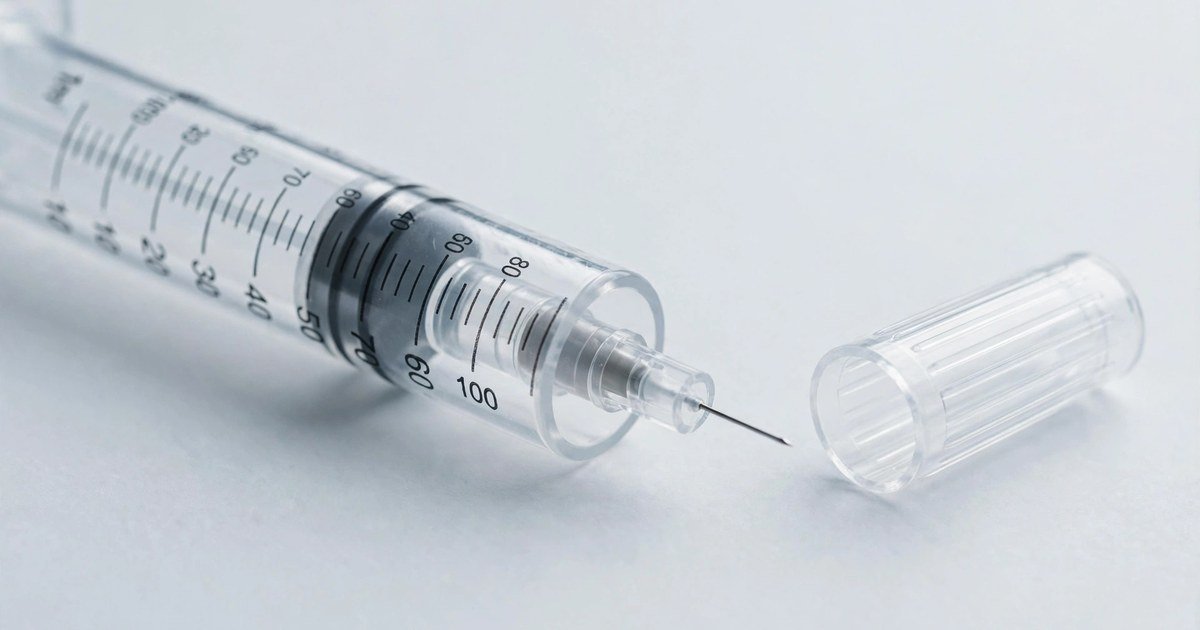
Insulin syringes follow the U-100 standard: 100 units equals 1 ml, so 1 unit is always 0.01 ml — regardless of barrel size.
| Barrel size | Total units | Best for |
|---|---|---|
| 0.3 ml | 30 units | Small doses — tick marks sit far apart, easier to read precisely |
| 0.5 ml | 50 units | Medium doses up to 50 units |
| 1.0 ml | 100 units | Larger doses; full-scale accuracy |
Because one unit is always 0.01 ml, 10 units is 0.10 ml on every barrel. The only practical difference is spacing: a 30-unit barrel spreads 30 ticks over the same length a 1 ml barrel uses for 100, making small measurements easier. The calculator checks whether your dose fits the syringe you selected — if it does not, choose a larger barrel or re-check your inputs.
About the Preset Chips
The calculator includes quick-fill presets — BPC-157, TB-500, GHK-Cu, Ipamorelin, and CJC-1295. Each fills the desired-dose field with a midpoint of the range commonly discussed in research contexts (for example, TB-500’s 2–5 mg range fills 2,000 mcg). They are a typing shortcut, not a recommendation. This tool never suggests anyone take anything; it only does the arithmetic.
How Much Water Should You Add? Start From the Concentration You Want
Most people run this math backwards: they choose a target concentration first, then work out the water. The inverse formula is just as simple: water (ml) = total mcg ÷ target concentration (mcg/ml). Want a 5 mg vial (5,000 mcg) at 1,000 mcg per ml? Add 5,000 ÷ 1,000 = 5 ml. At that concentration every 250 mcg dose is 0.25 ml — a clean 25 units.
That is the practical reason experienced users pick round concentrations: the dose lands on whole syringe ticks instead of awkward fractions. More water means a weaker mix and a bigger draw; less water means a stronger mix where a small reading error costs more peptide. Pick the concentration that makes your dose easy to measure accurately.
Reconstitution Handling Basics
The arithmetic assumes the powder actually dissolves properly. A few handling conventions every guide agrees on: let the water run slowly down the inside wall of the vial rather than spraying the powder directly; swirl or roll gently — never shake, since vigorous agitation can damage delicate peptide chains; if the powder is slow to dissolve, refrigerate the vial for 15–30 minutes and swirl again. Store reconstituted vials refrigerated (about 2–8 °C) and follow the use-by period on your product’s own guidance — many products cite roughly a month.
Frequently Asked Questions
What is a peptide calculator?
A peptide calculator converts a vial’s peptide amount (mg) and reconstitution water (ml) into practical syringe numbers: concentration in mcg/ml, mcg per unit, the units to draw for a target dose, and total doses per vial. It answers “how many units do I draw?” with math you can check by hand.
How do you convert mg to mcg?
Multiply by 1,000. One milligram equals 1,000 micrograms, so a 5 mg vial contains 5,000 mcg of peptide. This is the first step in every peptide calculation.
What does “units” mean on an insulin syringe?
Units are a volume scale. On the U-100 standard, 100 units = 1 ml, so 1 unit = 0.01 ml. Units do not measure peptide strength — the mcg per unit depends on how concentrated your vial is.
How many doses will I get from one vial?
Divide the vial’s total micrograms by your dose in micrograms. A 5 mg (5,000 mcg) vial at a 250 mcg dose gives 20 doses. The calculator shows this number automatically for any combination of inputs.
Does the amount of water change the dose?
No — it changes the measurement. More water dilutes the vial, so each unit holds less peptide and you draw more units for the same dose. The target dose stays identical; only the syringe reading changes.
What is the difference between the 0.5 ml and 1 ml syringes?
Only capacity and tick spacing. Both are U-100, so 1 unit = 0.01 ml on either. The 1 ml barrel holds 100 units; the 0.5 ml barrel holds 50. Choose the smallest barrel that still fits your dose for easier reading.
Can I use this calculator for any peptide?
Yes. The formulas are universal — they work for any lyophilized peptide vial size and any reconstitution volume. The preset chips are just entry shortcuts for commonly discussed research ranges; they do not change how the math runs.
Why bacteriostatic water instead of plain sterile water?
Bacteriostatic water contains 0.9% benzyl alcohol, a preservative that inhibits bacterial growth, so a vial can be drawn from repeatedly over its use period. Plain sterile water has no preservative and is intended for single use. The calculator’s math is identical either way — only the handling differs.
My dose works out to a fraction of a unit. What should I do?
Add more water next time you reconstitute. A more dilute vial spreads the same dose over more units — for example, a dose that reads 2.5 units in a strong mix might read a clean 5 units if you double the water. Whole ticks are easier to draw accurately.
Final Thoughts
Peptide dosing math looks intimidating because it chains three unit systems — milligrams, micrograms, and syringe units — but it is just five steps of division and multiplication. The real risk is never the formula; it is doing it quickly by hand and slipping a decimal. Run the numbers here, read the step-by-step breakdown, and double-check the units to draw before anything else. And remember: this tool does arithmetic only. Any decision about what to take, how much, or whether to take anything at all belongs with a licensed medical professional.
More Health Math
Check your daily needs with our protein calculator and measure progress with our lean body mass calculator.