Sin, cos, tan and inverses in degrees or radians with triangle visual.
How to Use the Trigonometry Calculator
Trigonometry relates the angles of a right triangle to the ratios of its sides — the foundation of surveying, navigation, physics, engineering, and computer graphics. This calculator evaluates all six trigonometric functions for any angle, computes inverse functions, and works in both degrees and radians.
- Choose degrees or radians. Degrees are familiar from school geometry; radians are standard in calculus and programming. Pick the mode matching your problem.
- Enter an angle (or a ratio for inverse functions). For sin, cos, and tan, type the angle. For arcsin, arccos, or arctan, type the ratio value instead.
- Select the function. The calculator shows all six functions — sine, cosine, tangent, cosecant, secant, cotangent — plus the three main inverses at once.
- Read the results. Each value appears with its definition reminder, so you can verify the answer makes sense for your triangle.
Trigonometry Calculator Formula
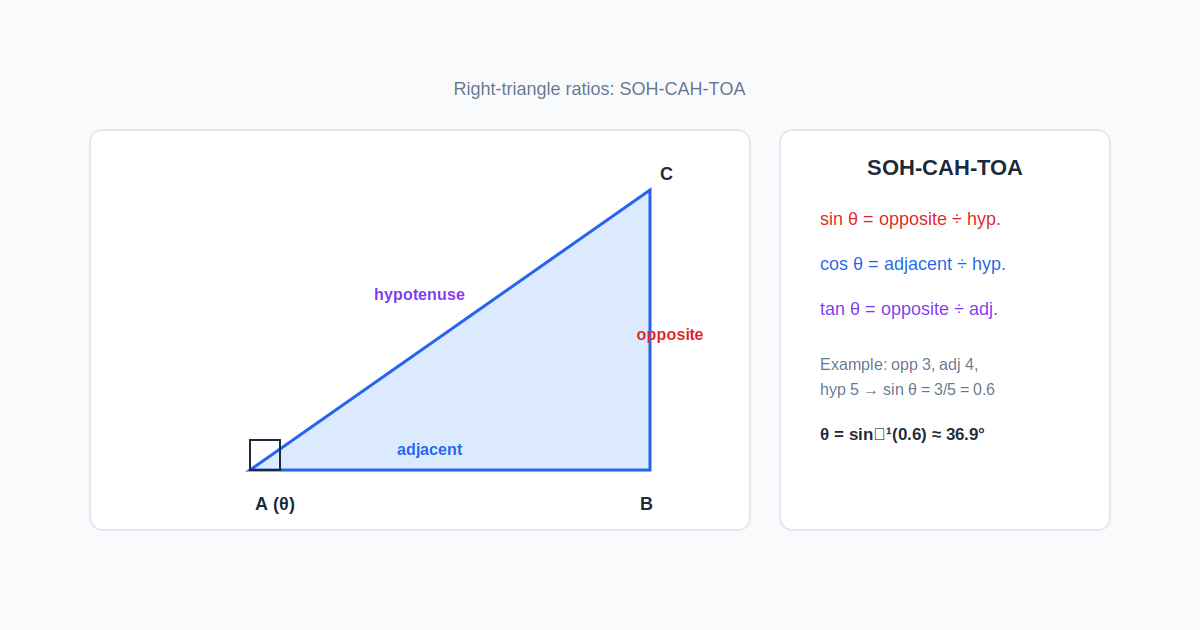
Everything in basic trigonometry flows from three ratios defined on a right triangle, memorized with the mnemonic SOH-CAH-TOA: sine = Opposite/Hypotenuse, cosine = Adjacent/Hypotenuse, tangent = Opposite/Adjacent. The remaining three functions are reciprocals: cosecant = 1/sine, secant = 1/cosine, cotangent = 1/tangent. The inverse functions reverse the question — arcsin(0.5) asks “which angle has a sine of 0.5?” and returns 30°.
Angles can be measured in degrees (360 per circle) or radians (2π per circle), related by radians = degrees × π/180. Radians are the natural unit: an angle of 1 radian subtends an arc exactly one radius long. Most scientific work and all calculus use radians, which is why the calculator offers both — mixing them up is one of the most common sources of wrong answers, so always check your mode.
The functions also extend beyond triangles via the unit circle: any angle, even beyond 90° or negative, maps to a point (cos θ, sin θ) on a circle of radius 1. This is why sine and cosine oscillate between −1 and 1 forever, modeling waves, alternating current, and sound. Tangent, the ratio sin/cos, shoots to infinity wherever cosine hits zero — at 90°, 270°, and so on.
Example Calculation
A 12-foot ladder leans against a wall, making a 70° angle with the ground. How high up the wall does it reach? The height is the side opposite the 70° angle, and the ladder is the hypotenuse, so height = 12 × sin(70°). Since sin(70°) ≈ 0.9397, the height is about 11.28 feet. The base sits 12 × cos(70°) ≈ 4.10 feet from the wall — a quick safety check that the setup is stable.
For an inverse example: a ramp rises 3 feet over a horizontal run of 12 feet. The angle is arctan(3/12) = arctan(0.25) ≈ 14.0°, comfortably below the 4.8° maximum for wheelchair accessibility only if… well, this one is steep — which is exactly the kind of judgment the numbers enable.
Exact Trig Values at Special Angles
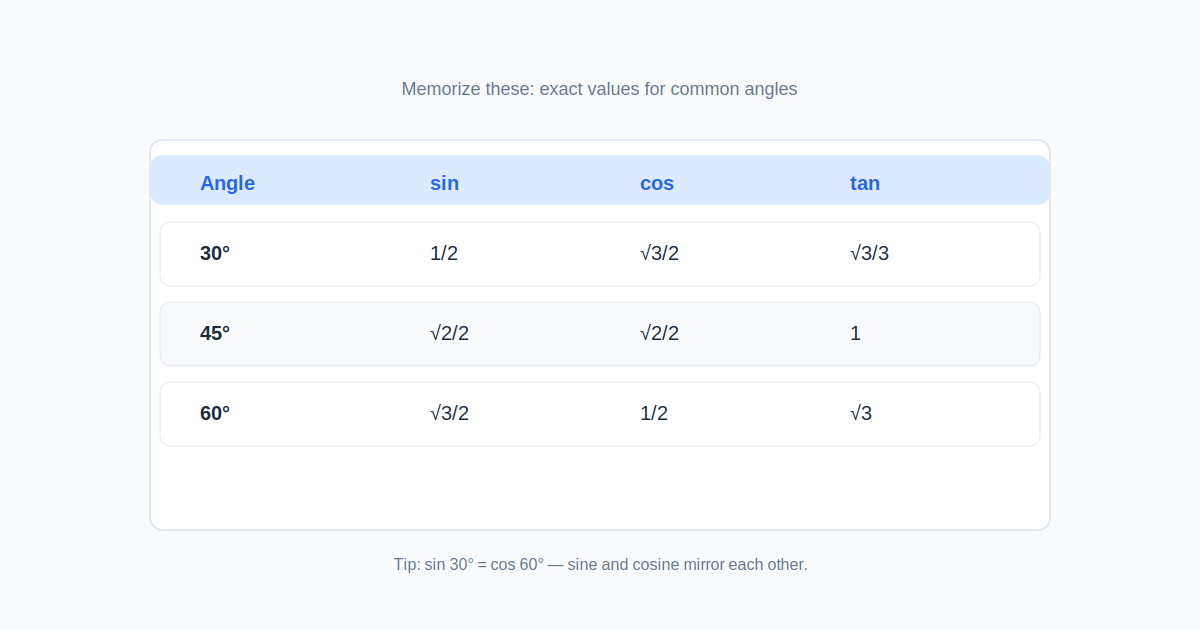
Most angles produce messy decimals, but five special angles — 0°, 30°, 45°, 60°, and 90° — have exact values worth memorizing. They come from two triangles: the 45-45-90 and half of an equilateral triangle.
| Angle | sin | cos | tan |
|---|---|---|---|
| 0° | 0 | 1 | 0 |
| 30° | 1/2 (0.5) | √3/2 (≈ 0.866) | 1/√3 (≈ 0.577) |
| 45° | √2/2 (≈ 0.707) | √2/2 (≈ 0.707) | 1 |
| 60° | √3/2 (≈ 0.866) | 1/2 (0.5) | √3 (≈ 1.732) |
| 90° | 1 | 0 | undefined |
The sine column follows a pattern: the values are √0/2, √1/2, √2/2, √3/2, √4/2 — that is 0, 1/2, √2/2, √3/2, 1. Cosine runs through the same list in reverse, and tangent is sine divided by cosine — which is why tan(90°) is undefined: its cosine is 0. Test any row in the calculator above to see the decimal form.
Frequently Asked Questions
Should I use degrees or radians?
Use whatever your problem gives you. School geometry, navigation, and construction use degrees; calculus, physics formulas, and most programming libraries use radians. The calculator handles both — just make sure the mode matches your input, since sin(30°) = 0.5 but sin(30 radians) = −0.988.
When do I use inverse trig functions?
Use arcsin, arccos, or arctan when you know side lengths and need the angle. If you know the opposite side (5) and hypotenuse (10), the angle is arcsin(5/10) = 30°. Regular functions go angle → ratio; inverses go ratio → angle.
Why is tan(90°) undefined?
Tangent equals sin/cos, and cos(90°) = 0. Division by zero is undefined, so tan(90°) has no value — on a graph it shoots toward infinity from both sides. Your calculator may show an error or a huge number; both mean the same thing.
What is the unit circle?
A circle of radius 1 centered at the origin. Any angle θ corresponds to the point (cos θ, sin θ) on it. It extends trig beyond right triangles to all angles and explains why sine and cosine repeat every 360° — the foundation of wave mathematics.
Where is trigonometry actually used?
Everywhere angles meet distances: surveying land, aiming antennas, rendering 3D graphics, analyzing AC circuits, predicting tides, and even tuning musical instruments. Any problem involving direction plus magnitude probably hides some trigonometry.
What is the Pythagorean identity?
It is the identity sin²θ + cos²θ = 1, true for every angle. It comes from the Pythagorean theorem applied to the unit circle: a point at angle θ has coordinates (cos θ, sin θ), exactly 1 unit from the origin, so cos²θ + sin²θ = 1². It also finds one function from the other — if sin θ = 0.6, then cos θ = √(1 − 0.36) = 0.8.
How do I solve a right triangle with this calculator?
You need two pieces of information besides the right angle: two sides, or one side and one acute angle. With sides, recover angles with the inverse functions — for example, arctan of opposite over adjacent. With an angle and the hypotenuse, multiply: hypotenuse × sin(angle) gives the opposite side, hypotenuse × cos(angle) the adjacent one, and the Pythagorean theorem supplies the last side.
Related Calculators
Try our Percentage Calculator and Fraction Calculator for more calculations.