Home equity loan calculator: estimate available equity at 80 percent LTV and your monthly payment. Enter home value, mortgage balance, loan APR, and term.
Results are estimates for planning purposes and are not financial, medical, or professional advice.
How to Use the Home Equity Loan Calculator
A home equity loan lets you borrow against the value you have built up in your home. Most lenders cap total borrowing at 80 percent of the home value. This calculator shows how much you can borrow and what the monthly payment would be.
- Enter your current home value and remaining first-mortgage balance.
- Enter the home equity loan amount you are considering.
- Enter the loan APR and term in years.
- Review your maximum available equity and the monthly payment.
Home Equity Formula
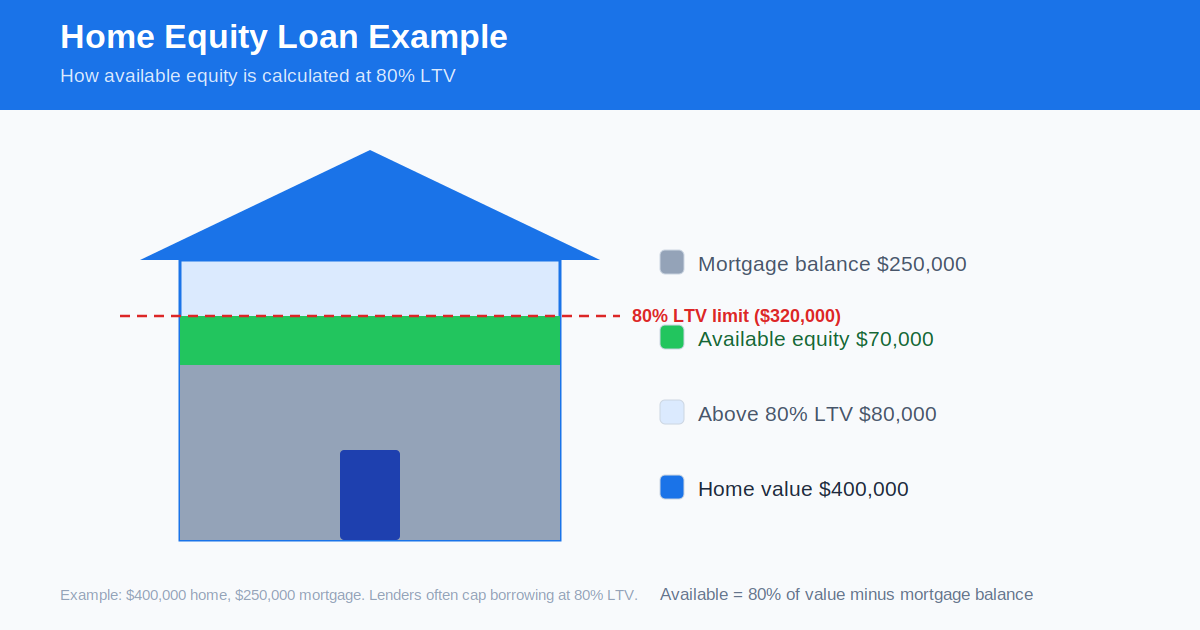
Available equity equals 80 percent of home value minus the mortgage balance: Max = (Home Value x 0.80) – Mortgage Balance. For a 400,000 dollar home with a 220,000 dollar mortgage, that is 320,000 – 220,000 = 100,000 dollars. The monthly payment uses the standard amortization formula: M = P x (r(1+r)^n) / ((1+r)^n – 1), where r is the monthly rate and n is the number of payments. A 50,000 dollar loan at 8 percent for 15 years gives a monthly payment of about 477.83 dollars.
Example
Priya owns a home worth 400,000 dollars and owes 220,000 dollars on her mortgage. At an 80 percent loan-to-value cap she can access up to 100,000 dollars. She borrows 50,000 dollars at 8 percent APR for 15 years, so her monthly payment is about 477.83 dollars and she keeps 50,000 dollars of accessible equity in reserve. Over 180 payments she will have paid about 86,009 dollars in total, of which about 36,009 dollars is interest.
LTV and Combined LTV, Explained
LTV, or loan-to-value, is your mortgage divided by the home’s value: here 220,000 over 400,000, or 55 percent. CLTV, combined loan-to-value, adds all mortgage debt together: the 220,000 mortgage plus the 50,000 loan over the 400,000 home, which is 67.5 percent. Lenders cap CLTV around 80 to 85 percent, which is exactly the limit this calculator enforces when it computes available equity.
Frequently Asked Questions
Why 80 percent loan-to-value?
Most lenders limit combined borrowing to 80 percent of appraised value to keep a safety cushion against price drops. Some lenders allow up to 90 percent, but rates are usually higher.
Home equity loan vs HELOC: which is better?
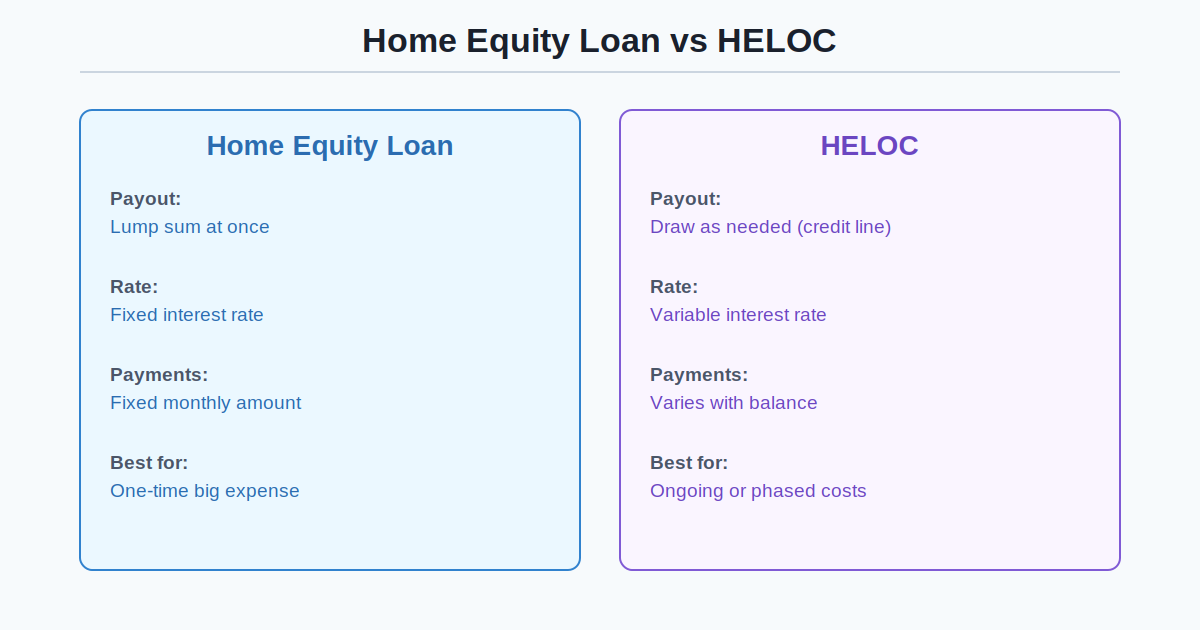
A home equity loan gives a lump sum with a fixed rate and fixed payment, best for one-time expenses. A HELOC is a revolving credit line with a variable rate, better for ongoing projects.
Is the interest tax deductible?
Interest may be deductible if the loan is used to buy, build, or substantially improve the home securing the loan. Consult a tax professional for your situation.
What happens if my home value drops?
You still owe the full loan balance. If you end up owing more than the home is worth, selling or refinancing becomes difficult, which is why lenders keep the 80 percent cushion.
How fast can I get the money?
Home equity loans typically close in two to six weeks because they require an appraisal and underwriting, unlike faster unsecured personal loans.
What is combined loan-to-value (CLTV)?
CLTV is total mortgage debt divided by the home’s value. It adds your first mortgage and any second loans together, so it shows lenders the full lien burden on the property.
What closing costs come with a home equity loan?
Expect about 2 to 5 percent of the loan amount, or 1,000 to 2,500 dollars on a 50,000 dollar loan. And remember the home is collateral: falling behind can lead to foreclosure.
Related Calculators
Estimate your primary mortgage with the Mortgage Calculator and model payoff with the Amortization Schedule Calculator.